


Morganite Engagement Ring with Diamond Halo & Guard
$$$$
14k white gold, lab-grown diamonds, morganite (client-provided)
R. came to us with a morganite already in hand and a rough idea of the look he wanted — an engagement ring with a halo of accent stones. The stone's uneven, shield-like shape shaped everything that followed: a bezel setting built to its exact outline, a diamond halo to frame it, and a three-band guard designed to nest around the solitaire so it could be worn as one piece or separated. When it arrived, he wrote: 'It is everything I was hoping for.'
'It is everything I was hoping for.' — on delivery
Quick specs
Design type
Primary Metal
Shape / Cut
Primary Stone
Accent Stones
Design Complexity
Intent: Certainty
Size
Ring size 6.5 US (17.32mm). Center stone 16x10.5mm, 6.12ctw client-provided morganite in a custom kite/shield cut.
How they made it distinctive
-
01
Bezel setting custom-molded to the exact irregular shield outline of the client's own morganite, rather than a standard stone shape
-
02
Diamond halo traces the same irregular outline, giving the asymmetrical stone a cohesive frame
-
03
Three-band ring guard built with a fitted gap so it nests directly against the solitaire's shank
-
04
Guard and solitaire can be worn together as one unified piece or the solitaire worn alone
-
05
Built entirely around a client-supplied stone rather than a stone sourced by the studio
How you'd make it yours
Stone: this piece uses a client-supplied morganite; a new commission could use a sapphire, aquamarine, or lab-grown colored stone in a similarly custom bezel
Metal: this piece is 14k white gold; the same halo-and-guard design works in rose gold or yellow gold
Diamonds: this piece uses lab-grown diamonds; a new commission could use natural diamonds for the halo and guard
Guard structure: this piece connects three bands into one guard; a new piece could use two bands or fully separate rings instead
One of a kind: this exact ring and guard were built around one client's own stone and are not reproduced — a new commission is an original piece inspired by this one, not a copy
Design changes made
The client and design team clarified early on that the 'guard' should be a connected set of bands with an open space for the solitaire to slide into, rather than three separate rings — a structural decision that shaped the final build. Metal was also settled on white gold after considering rose gold, and lab-grown diamonds were chosen over natural stones for the accents.
Who this is for
This piece is for someone who already has a stone that matters to them and wants a setting built specifically around its real shape, not a generic mount that ignores its quirks. It especially suits someone who likes the idea of a ring that can change — worn simply as a solitaire some days, and as a fuller, more layered look with the guard on others.
How it's made
Once the design was approved, the team built a 3D CAD model calibrated to the exact outline of the client's morganite, since the stone's shape was irregular rather than a standard cut. That model was 3D-printed in resin and shared with the client as a preview before casting. The resin was then used to create an investment mold, burned out in a kiln, and 14k white gold was cast into the resulting cavity for both the solitaire ring and the connected guard bands.
After casting, each piece was cleaned, polished, and finished to a high-shine surface. The bezel was hand-fitted around the client's morganite to its irregular shield outline, and the halo diamonds and the guard's pave diamonds were then set by hand along the curved band edges. The guard bands were shaped with an open gap sized to receive the solitaire shank precisely, so the two pieces sit flush when worn together.
Key note
The bezel and its surrounding halo were built to match the morganite's irregular shield-like outline rather than fitted to a standard stone shape, so the setting itself is a custom mold of this one gem.
Pricing guidance
A white gold engagement ring built around a client-supplied colored stone, with a diamond halo and a companion three-band guard, sits toward the higher end for engagement ring commissions of this complexity. Most of the added cost comes from designing a bezel to a non-standard stone outline and producing three coordinated bands rather than a single ring. Diamond quality and quantity across the halo and guard are the next biggest cost drivers.
Moves price up ↑
- ↑ Upgrading the accent diamonds from lab-grown to natural stones
- ↑ Increasing the diamond clarity or color grade across the halo and guard
- ↑ Adding more pave diamonds or extending coverage further down the guard bands
- ↑ Choosing platinum instead of white gold for greater durability and weight
- ↑ Designing the guard as fully separate rings rather than a single connected unit, which adds fabrication steps
Moves price down ↓
- ↓ Using a standard oval or cushion-cut stone instead of a custom irregular shape, which simplifies the bezel
- ↓ Reducing the halo to a single row of smaller diamonds
- ↓ Omitting the ring guard and producing the solitaire only
- ↓ Choosing a lower diamond clarity/color tier for the accents
- ↓ Using a plain polished band instead of a split shank
Questions people ask
Yes, this is a common request and the process works well when the client ships the stone to the studio ahead of design. The physical stone is measured and scanned so the setting can be built to its exact dimensions, which matters even more when the stone has an irregular or custom cut rather than a standard round or oval shape. The design team builds the ring around the stone's actual outline rather than guessing from a description. This does add a short lead time at the start of the project while the stone is received and inspected.
Morganite is a pink-to-peach variety of beryl, the same mineral family as emerald and aquamarine. It rates around 7.5 to 8 on the Mohs hardness scale, which makes it reasonably durable for daily wear but softer than sapphire or diamond. A bezel setting, like the one used here, offers more protection than open prongs because the metal rim shields the stone's edges from impact. Morganite can fade slightly with prolonged sun exposure, so it is not the ideal choice for someone who wants zero maintenance thinking about color over decades.
A ring guard is a band or set of bands designed to fit snugly around an existing center ring, usually to add sparkle, frame the center stone, or make it feel more substantial. Unlike a standard wedding band that simply sits next to the engagement ring, a guard is built with an open gap shaped to receive the center ring's shank so the two nest together as one unit. This one uses three connected bands with pave diamonds, designed specifically to match the solitaire's shank. The wearer can choose to wear the guard with the solitaire or leave it off, since the pieces are separate.
Lab-grown and natural diamonds are chemically, physically, and optically identical — the same crystal structure, the same brilliance, the same hardness rating of 10 on the Mohs scale. The only real difference is origin: one is grown in a controlled lab environment and one is mined from the earth. Lab-grown diamonds are typically less expensive at the same clarity and color grade, which is why they are a common choice for accent stones like a halo or a pave-set guard. There is no visual way to tell them apart without specialized equipment.
For a ring built around a client-supplied stone with a custom setting and a companion guard, the process typically runs several weeks from deposit to delivery. The first week or so covers design — sketch, 3D model, and a photorealistic render for approval. Once the design is approved and stones are confirmed, production including casting, hand-finishing, and stone setting for all connected pieces generally takes another three to four weeks. Complex multi-band pieces like a fitted guard can run slightly longer than a single solitaire.
Yes, and this is exactly the kind of setting a bezel is well suited for. Because a bezel is a continuous metal rim rather than individual prongs, it can be built to trace any stone outline, including irregular, asymmetrical, or custom-cut shapes like the shield-style cut used here. The metal is fitted flush against the stone's actual edges during the 3D modeling stage, which requires the physical stone or precise measurements beforehand. This also gives the stone excellent protection since the entire edge is enclosed rather than held at a few contact points.
A connected multi-band guard with pave-set diamonds adds meaningfully to the total cost compared to a solitaire alone, since it requires its own casting, its own diamond setting, and a fitted gap engineered to nest with the center ring's shank. The exact increase depends on how many bands are included and how much of the surface is covered in pave diamonds. Choosing lab-grown diamonds for the guard, as opposed to natural stones, is one of the more effective ways to manage that added cost. Producing the guard as a single connected piece rather than multiple separate rings is also generally more efficient than fully independent bands.
Explore Similar Creations
Every masterpiece starts with a spark. Explore how our clients raw ideas - sketches, heirlooms, inspirations - were transformed into bespoke works of arts.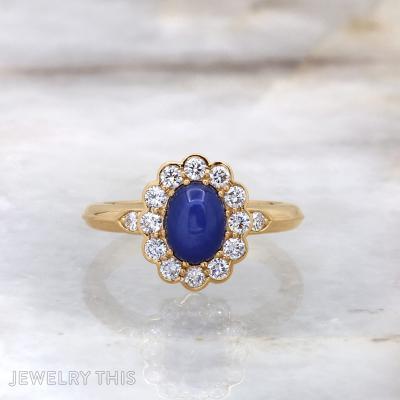
This romantic yellow gold engagement ring centers around a mesmerizing oval cabochon-cut lab grown blue ...

Look at this radiant 14k Yellow Gold Heart Shaped Moissanite Solitaire Engagement Ring. It showcases ...

Exquisite and timeless, this ring boasts a captivating design featuring two marquise-shaped stones set in ...
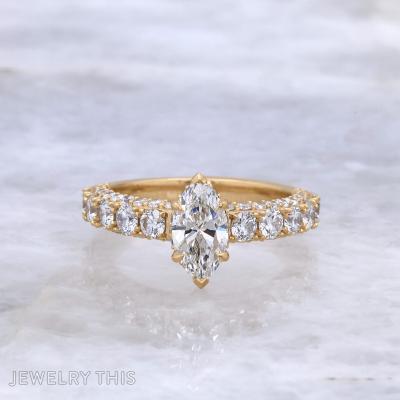
This breathtaking 14K yellow gold engagement ring is a true masterpiece of light and luxury. ...

This custom engagement ring showcases exquisite craftsmanship with a delicately carved poppy design that gracefully ...

This Rose gold ring is a captivating expression of sophistication. Adorning the top portion of ...

In this 14-karat white gold engagement ring, the centerpiece is a stunning 1.2 carat pear-shaped ...

This White gold engagement ring is a work of art, featuring a captivating lab-grown Alexandrite ...
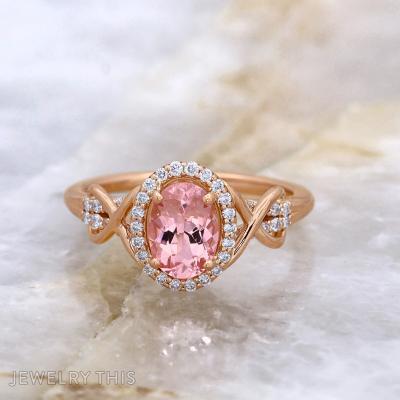
This engagement ring recreates a discontinued design the client’s wife once owned, rebuilt from photographs ...

This captivating custom engagement ring emanates timeless beauty and exquisite craftsmanship. At its heart lies ...

This yellow gold ring features a captivating oval rose cut diamond at its center, delicately ...

This elegant white gold engagement ring features a stunning princess cut moissanite center stone. The ...



