

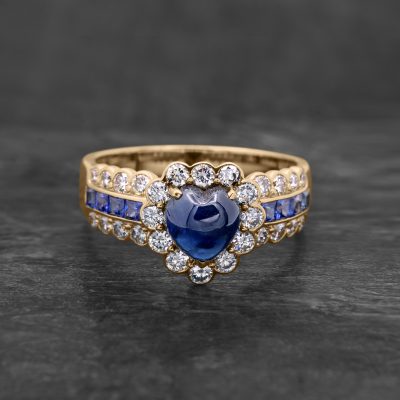
Heart Sapphire Cabochon Engagement Ring in Yellow Gold
$$$
14k yellow gold, blue sapphire, lab-grown diamonds, sapphire accents
M. came to us with a single reference photo of a heart-shaped sapphire cabochon ring and a clear instruction: keep the proportions close to what she'd found, nothing oversized. Sourcing a symmetrical heart cabochon sapphire took extra time, and she asked early on whether the stone could be cut wider — it couldn't without a costly custom cut, and she was glad to keep the one that had already been found. When it arrived, she wrote: 'I can't believe how beautiful it is! I can't get over how much it sparkles! I've never seen a prettier engagement ring.'
"OMG!!! It's gorgeous! I'm stunned! I didn't know it was going to look that good!" — on delivery
"I can't believe how beautiful it is! I can't get over how much it sparkles! I've never seen a prettier engagement ring." — on delivery
Quick specs
Design type
Primary Metal
Shape / Cut
Primary Stone
Design Complexity
Intent: Certainty
Size
Ring size 8 US (18.14mm). Center stone approximately 0.75 carat heart cabochon.
How they made it distinctive
-
01
Heart-shaped sapphire cabochon center stone — an uncommon cut requiring the setting to be custom-built around the sourced stone's exact proportions
-
02
Scalloped diamond halo echoes the heart shape and frames the smooth cabochon surface without obscuring it
-
03
Princess-cut sapphire shoulders repeat the center stone's blue color throughout the design rather than isolating it to the center
-
04
14k yellow gold chosen over 10k specifically for better long-term stone security, based on the client's past experience with a broken ring
-
05
Symmetrical, well-matched heart cabochon kept as sourced rather than custom-cut wider, avoiding a significant cost increase
How you'd make it yours
Center stone: this piece uses a heart-shaped sapphire cabochon; a new commission could use an oval or round cabochon for easier sourcing, or a faceted colored stone
Diamonds: this piece uses lab-grown round diamonds in the halo; a new commission could use natural diamonds for the same look at higher cost
Metal: this piece is 14k yellow gold; the same halo-and-shoulder design works in 14k white or rose gold as well
Shoulder stones: this piece uses princess-cut sapphires; a new commission could use a different colored stone or diamonds along the shoulders
Engraving: this piece has no inside engraving; a new commission could add a name, date, or short phrase
One of a kind: this exact ring was designed around one sourced heart cabochon sapphire and is not reproduced — a new commission is an original piece inspired by this one, not a copy
Design changes made
The client asked after seeing the render whether the heart-shaped center stone could be made wider. The team explained that doing so would require sourcing a custom-cut rough stone at significant extra cost, and the original symmetrical heart cabochon was kept as sourced.
Who this is for
This piece is for someone who wants an engagement ring with color and personality rather than a conventional diamond solitaire, and who already has a clear picture of the proportions and shape they want. It's especially right if you've found a reference image you love and want the final piece to stay faithful to that vision rather than be reinterpreted into something generic.
How it's made
Because the center stone is a heart-shaped cabochon rather than a standard faceted cut, the design team built the setting around the actual sourced stone rather than pulling from a stock mounting. Once the layout was approved, the design was 3D printed in wax, attached to a tree, and invested in plaster; the mold was fired in a kiln to burn out the wax, and molten 14k yellow gold was cast into the resulting cavity. The client was shown a photo of the printed resin model before casting, so she could see the final form ahead of metal.
After casting, the ring was cleaned, polished, and finished to a bright, uniform shine across the band and halo. The princess-cut sapphires were channel-set along each shoulder, and the round diamonds were prong-set into the scalloped halo surrounding the cabochon, which itself was set last since cabochons rely on a snug bezel-style frame rather than prongs to stay secure.
Key note
Cabochon stones are cut without flat facets and are rarely perfectly uniform in shape, so the halo and setting had to be built around the actual sourced stone's dimensions rather than from a standard pre-sized mounting.
Pricing guidance
A yellow gold engagement ring with a cabochon-cut colored center stone and a diamond-and-sapphire halo sits in the mid range for custom engagement rings of moderate complexity. Sourcing a well-matched, symmetrical cabochon in an uncommon shape like a heart adds to the baseline cost before any metal or accent stones are even factored in. Accent stone count and diamond quality are where the price moves most from there.
Moves price up ↑
- ↑ Custom-cutting the center stone to a wider or non-standard proportion rather than using an available cut
- ↑ Upgrading the round diamonds from lab-grown to natural
- ↑ Increasing the number or size of the princess-cut sapphires along the shoulders
- ↑ Moving from 14k to 18k gold or platinum
- ↑ Adding a matching wedding band designed to nest against the curved halo
Moves price down ↓
- ↓ Reducing the halo to a single row of smaller diamonds
- ↓ Using a more common stone shape (round or oval cabochon) instead of a heart
- ↓ Choosing a smaller center stone size than 0.75 carat
- ↓ Reducing the sapphire accent count on the shoulders
- ↓ Selecting 10k gold instead of 14k, though 14k is recommended for better stone retention over time
Questions people ask
Yes. Cabochon-cut stones are smooth and domed rather than faceted, and they require the setting to be built around the specific stone's shape and proportions rather than pulled from a standard mounting. This typically adds a bit of extra design time compared to a faceted stone, since cabochons vary more from stone to stone. The result is a softer, more vintage-feeling look than a faceted center stone gives.
Yes, relatively. Heart-shaped cabochons are less common than round or oval shapes, and finding one that is symmetrical with a rich, even color takes more sourcing time than a standard shape. Most heart-shaped stones available in this cut tend to run closer to one carat rather than smaller sizes. Widening or reshaping a sourced stone is not possible without custom-cutting a new one from rough material, which adds significant cost.
Both are gold alloys, and 10k is technically slightly harder than 14k, but hardness and long-term durability are not the same thing. 14k gold is generally recommended for engagement rings because it holds stones more securely over years of daily wear, and the price difference between the two is relatively small. The main tradeoff with 10k is a slightly paler gold color due to the lower gold content.
A ring in this category — yellow gold, a cabochon colored center stone, a diamond halo, and sapphire accents — sits in the mid range for custom engagement rings of moderate complexity. The center stone sourcing and the channel-set accent stones are the main cost drivers beyond the base metal. Choosing lab-grown versus natural diamonds for the halo is one of the biggest levers on the final price.
Lab-grown diamonds are chemically, physically, and optically identical to natural mined diamonds — the only differences are origin and price. Lab-grown diamonds are typically less expensive than natural diamonds of comparable size and clarity. For accent stones in a halo setting like this, most people cannot tell the two apart without specialized equipment.
Design typically takes about a week, including a render for approval before anything is sourced or made. Because this design used an uncommon cabochon shape, sourcing the center stone added extra time beyond the usual process. Once the design is approved and materials are sourced, production typically takes three to five weeks, including casting, stone setting, and finishing.
Yes, within reason. The number of diamonds in the halo and the number of sapphires along the shoulders can be adjusted, and the stone quality (lab-grown versus natural, clarity grade) can be dialed up or down. The center stone's cut and shape are generally fixed once sourced, since cabochons are not easily recut without starting over with new rough material.
Most rings can be resized within a limited range after they are made, though a ring with stones set all the way around the shoulders — like the sapphire channel-set accents here — has more resizing constraints than a plain band. Significant resizing on a ring with channel-set stones may require partially resetting the affected area. It's best to confirm the size as precisely as possible before production begins.
Check what our clients say about us

Mary Elizabeth
4 years ago
My ring turned out gorgeous and stunning! I couldn't believe how beautiful and sparkly it was! I've never seen a prettier engagement ring than the one JewelryThis made for me. Highly recommend. You will not be disappointed.
Explore Similar Creations
Every masterpiece starts with a spark. Explore how our clients raw ideas - sketches, heirlooms, inspirations - were transformed into bespoke works of arts.
This three-stone ring pairs a round center Montana sapphire with two smaller round sapphires in ...

This engagement ring pairs a 2-carat-class radiant cut lab diamond, set horizontally across a wide ...
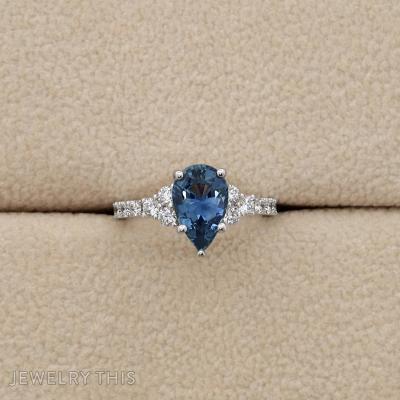
This engagement ring centers a 2.02 carat pear-shaped blue sapphire, chosen for its color over ...
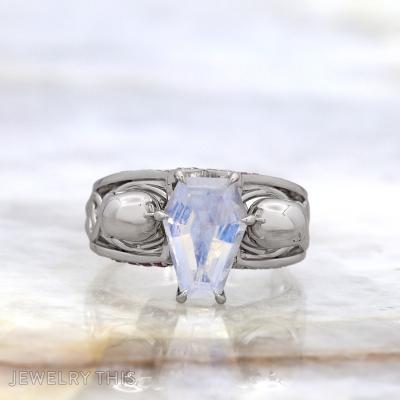
This hauntingly beautiful white gold ring is a masterpiece of dark romance and intricate symbolism. ...

This elegant white gold engagement ring features a stunning princess cut moissanite center stone. The ...

This wedding set is made sterling silver and set with a center round moonstone with ...

Introducing Our Timeless Three Stone Moissanite Engagement Ring. Make a statement of eternal love with ...

This striking engagement ring and wedding band set showcases a unique and modern design. The ...

This captivating set of rings is designed to symbolize unity and individuality. One ring is ...

This engagement ring is crafted with white gold, featuring an emerald-cut moissanite center stone and ...

This enchanting white gold engagement ring is designed to capture a botanical-inspired motif. The centerpiece ...
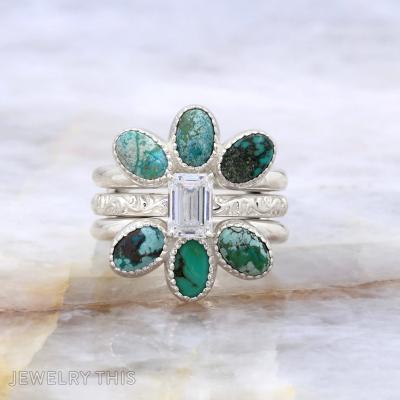
This artisanal sterling silver wedding set is a stunning fusion of modern brilliance and rustic, ...