
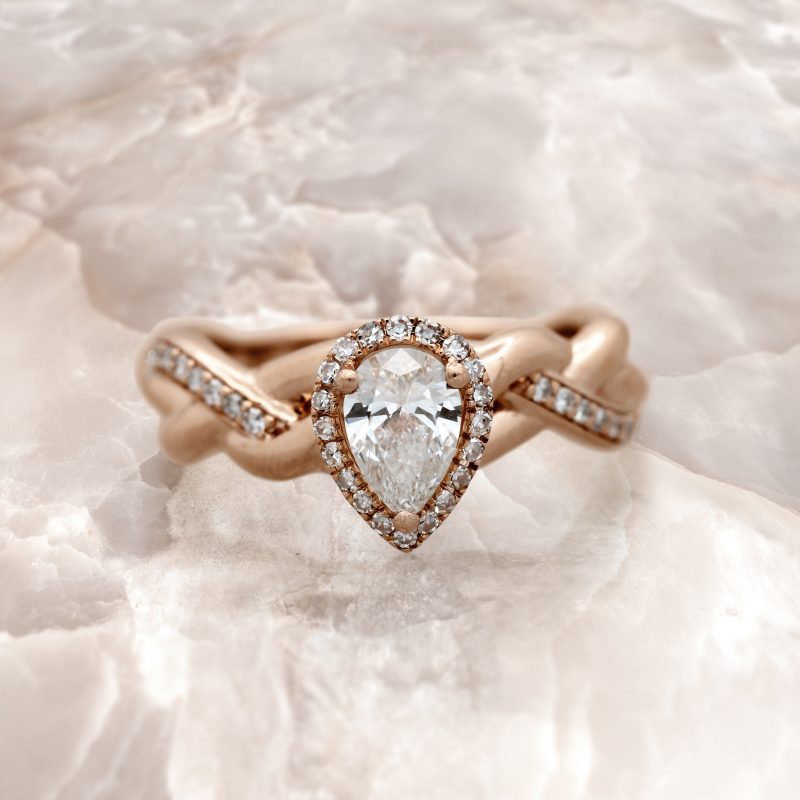


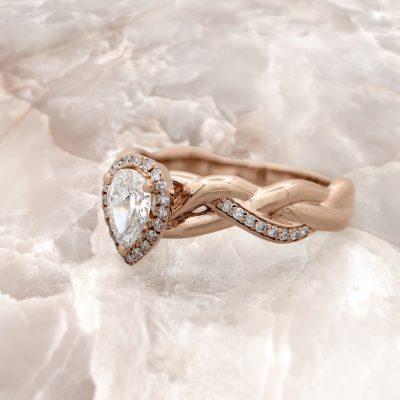
Braided Rose Gold Pear Diamond Engagement Ring
$$
14k rose gold, lab-grown diamond, lab-grown diamond accents
D. wanted to design an engagement ring for A., starting with a vision of a braided band woven from two shades of gold. The two-tone idea was simplified to an all-rose-gold braid during the design phase, chosen for comfort and long-term durability over a plated finish. When it arrived, he wrote: 'Yes it's exactly what I was hoping for!!!'
Yes it's exactly what I was hoping for!!!' — on delivery
Quick specs
Design type
Primary Metal
Shape / Cut
Primary Stone
Accent Stones
Style
Design Complexity
Intent: Certainty
Size
Ring size 6.5 US (16.92mm). Center stone 0.53 carat pear shape.
How they made it distinctive
-
01
Braided shank woven from strands of rose gold, chosen specifically for a smoother, more comfortable feel on the finger than a flat band
-
02
Design simplified from a two-tone concept to all-rose-gold construction to avoid the plating wear a white gold strand would have required
-
03
Pear-shaped lab-grown diamond chosen to stretch the center stone size within budget without sacrificing brilliance
-
04
Halo of pavé accent diamonds added around the pear shape specifically to visually anchor its point against the woven band
-
05
Several center stone shapes (round, oval, square) were test-rendered before settling on pear as the best fit for the organic band design
How you'd make it yours
Stone shape: this piece uses a pear-shaped center stone; a new commission could use round, oval, or square in the same braided setting
Stone type: this piece uses a lab-grown diamond; a new commission could use moissanite for a similar brilliance at lower cost
Metal: this piece is all 14k rose gold; a two-tone braid (white and rose gold cast separately) is possible at a higher cost and labor commitment
Halo: this piece includes a halo of accent diamonds; a new commission could use a plain pear solitaire without the halo
One of a kind: this exact ring was designed for one client and is not reproduced — a new commission is an original piece inspired by this one, not a copy
Design changes made
The original two-tone concept (two rose gold strands woven with one white gold strand) was simplified to an all-rose-gold braided band — plating the white strand would wear off over time, so an all-rose-gold build was recommended for durability and chosen instead.
Who this is for
This piece is for someone who wants an engagement ring with texture and movement rather than a plain band, and who values comfort as much as appearance. It's especially right for a partner who prefers a softer, rounded profile on the hand over sharp geometric lines, and who likes the idea of a pear-shaped stone with a bit of organic, woven character beneath it.
How it's made
Once the pear-shaped stone size and final design were approved, the ring was 3D printed in wax and attached to a wax tree inside a flask. The flask was fired in a kiln to burn out the wax, leaving a hollow mold, and molten 14k rose gold was cast into that mold under pressure. After cooling, the raw ring was removed from the mold and prepared for finishing.
The braided shank was cleaned and polished to bring out the woven texture along both bands, giving the twisted strands a smooth, rounded finish rather than sharp edges. The halo setting and the accent stones along the braid were set by hand, with the pear-shaped lab diamond secured last at the center of the halo so its orientation could be fine-tuned against the woven band beneath it.
Key note
The braided shank was finished with rounded, polished edges rather than a flat profile specifically so the woven texture would feel smooth rather than catch against the finger during daily wear.
Pricing guidance
A braided rose gold engagement ring with a pear-shaped lab diamond halo sits toward the lower-to-mid range for custom engagement rings of this complexity. Most of the baseline cost comes from the labor of shaping and finishing a woven multi-strand band, plus the center stone and the halo accent stones. Choosing lab-grown stones over natural ones is one of the biggest levers on the final price.
Moves price up ↑
- ↑ Increasing the center stone size beyond roughly three-quarters of a carat
- ↑ Switching the center stone from a lab-grown diamond to a natural diamond
- ↑ Adding genuine two-tone construction (casting strands separately in two metals and assembling) instead of a single-metal braid
- ↑ Upgrading to 18k gold instead of 14k
- ↑ Adding more accent stones or extending the halo further down the band
Moves price down ↓
- ↓ Reducing the center stone size
- ↓ Choosing moissanite instead of a lab-grown diamond for the center stone
- ↓ Removing the halo and using a solitaire pear-shaped stone instead
- ↓ Simplifying the braid to a single twisted strand rather than a woven multi-strand pattern
- ↓ Using sterling silver instead of 14k gold for the band
Questions people ask
A braided or twisted band made of solid 14k gold is just as durable as a standard band of the same karat — the woven look is achieved through shaping, not through weaker construction. Daily wear is fine for this style, and the rounded, polished edges of a well-finished braid actually reduce snagging compared to sharper geometric designs. The main thing to watch is that any plated accents (if a two-tone look is achieved through plating rather than solid metal) will wear thinner over time with repeated contact. A solid single-metal braid, like an all-rose-gold build, avoids that issue entirely.
Lab-grown and natural diamonds are chemically and optically identical — same hardness, same brilliance, same durability for daily wear. The only real difference is origin: one is grown in a controlled lab environment, the other is mined from the earth. Lab-grown diamonds typically cost significantly less than natural diamonds of the same size and quality, which is why they're a popular choice for center stones on a budget. Visually, a jeweler or an untrained eye cannot tell the two apart without specialized equipment.
Yes, there are two ways to achieve a two-tone woven look. The more affordable approach is to cast the entire ring in one metal and then plate specific strands in a contrasting color, though that plating will gradually wear with daily use. The more durable (and more expensive) approach is to cast each strand separately in its own metal and assemble them together, which keeps the color permanent but is significantly more labor-intensive. Many clients choose an all-one-metal braid instead once they understand the cost and maintenance tradeoffs of true two-tone construction.
A halo setting adds cost beyond a plain solitaire because it requires setting a ring of small accent stones precisely around the center stone, which takes additional labor and stones. For a ring in this complexity range with a lab-grown pear-shaped center stone and a halo, pricing tends to land in the lower-to-mid range for custom engagement work. The center stone size and whether it's lab-grown or natural are the two biggest factors in the final price. Band design — such as a braided or twisted shank versus a plain band — also contributes but to a lesser degree than the stones.
The typical timeline runs about one week for design — including the 3D render and any revisions — followed by three to four weeks for production once the design is approved. Production includes wax printing, casting, polishing, and hand-setting the stones. Rush timelines are sometimes possible but are not the default. From first approval to finished ring, six to eight weeks total is a reasonable expectation.
If a prong or setting loosens from an impact or normal wear, a stone can come loose or fall out, and most custom jewelers offer a warranty period during which this kind of repair is covered at no charge. The ring is typically shipped back to the maker, inspected to determine the cause, and the stone is reset or replaced as needed. This is a standard service repair, not a sign of poor original construction — settings can loosen from everyday bumps and impacts over months of wear. Keeping the original maker's warranty information on hand makes this kind of repair straightforward.
Yes, a pear shape pairs naturally with an organic, woven band style because both have a flowing, asymmetric quality rather than a strictly geometric one. The point of the pear shape echoes the movement of a twisted or braided shank in a way that a strictly round or square stone wouldn't. A halo around the pear shape also helps visually anchor the point of the stone against the texture of the band beneath it.
Yes, lab-grown diamonds are a widely accepted and increasingly popular choice for engagement ring center stones because they offer the same hardness, brilliance, and durability as natural diamonds at a lower cost per carat. They're especially practical for pear, oval, and other fancy shapes where size matters visually, since the cost savings can allow for a larger stone within the same budget. There's no difference in how the stone wears or how it needs to be cared for compared to a natural diamond.
Explore Similar Creations
Every masterpiece starts with a spark. Explore how our clients raw ideas - sketches, heirlooms, inspirations - were transformed into bespoke works of arts.
This engagement ring is crafted with white gold, featuring an emerald-cut moissanite center stone and ...
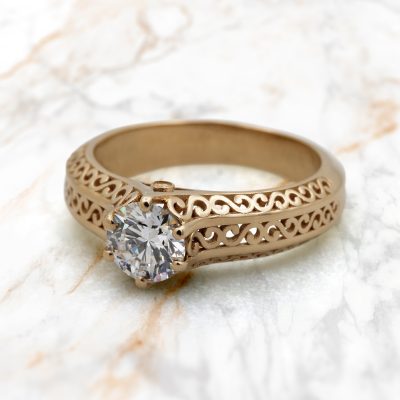
A 14k yellow gold engagement ring with filagree details set with a round lab created ...

This poignant custom white gold ring is a heartfelt tribute, capturing the enduring bond between ...

Elegance takes center stage in this custom 14k white gold engagement ring, showcasing a brilliant ...

This three-stone ring pairs a round center Montana sapphire with two smaller round sapphires in ...

This enchanting rose gold engagement ring features a mesmerizing center stone embraced by a band ...

This engagement ring centers a bi-color teal-green emerald-cut Montana sapphire, set in a four-prong mounting ...

This engagement ring began as an upgrade project: the client’s existing 1.22ct lab-grown round diamond, ...
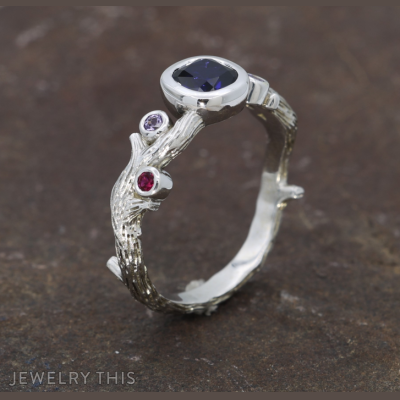
This exquisite engagement ring tells a story of love, individuality, and resilience—crafted to reflect the ...

This engagement ring centers on a shield-cut lab-grown diamond, custom cut to just over two ...

Introducing Our Timeless Three Stone Moissanite Engagement Ring. Make a statement of eternal love with ...

Elegance meets romance in this custom 14k rose gold engagement ring. At its heart, a ...



