

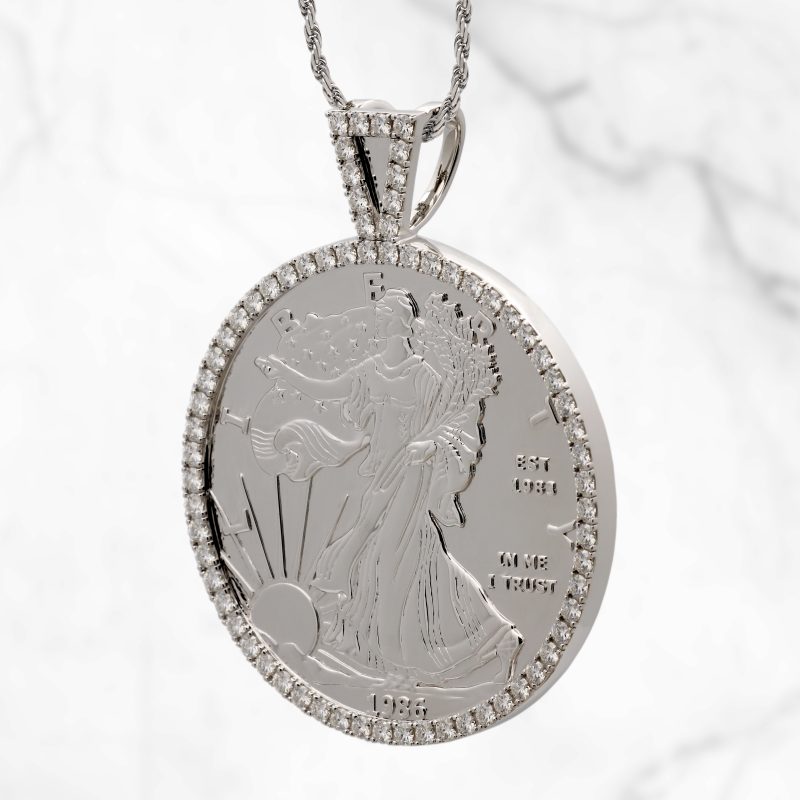


Walking Liberty Coin Pendant in Silver with Moissanite Halo
$$$
Sterling silver, moissanite
A client wanted a large coin-style pendant built from the Walking Liberty design, personalized with his own words in place of the original inscription and a meaningful founding year worked into the piece. The design went through several rounds of small adjustments — swapping the motto, reshaping the bail to carry its own ring of stones, and placing the year carefully so it balanced with the rest of the engraving. When it arrived, he wrote simply that he liked it.
'I do like it thank you.' — on delivery
Quick specs
Design type
Primary Metal
Shape / Cut
Primary Stone
Accent Stones
Style
Design Complexity
Intent: Certainty
Size
Pendant 3in diameter; bail sized to fit 9mm rope chain. 70 round stones, approximately 3.5mm each (approx. 11 total carats). Hollow construction with a recessed back wall for reduced weight.
How they made it distinctive
-
01
Built hollow with a recessed back wall, not solid, to keep a 3-inch pendant wearable on a chain
-
02
Coin inscription personalized with a custom phrase in place of the original motto
-
03
Founding year worked into the design near the sun detail rather than tucked in a generic spot
-
04
Bail redesigned from a plain loop into a solid, stone-set shape that continues the perimeter halo
-
05
Perimeter stones set slightly elevated above the coin face for a layered, dimensional edge
How you'd make it yours
Stone: this piece uses moissanite; a new commission could use lab or natural diamonds for a different cost and brilliance profile
Metal: this piece is sterling silver; the same coin-and-halo design language works in 14k or 18k gold
Size: this piece is 3 inches in diameter; a new piece can be scaled smaller or larger to its own wearer's preference
Engraving: the coin face text and date placement can be changed to a new phrase or year on a fresh commission
Bail style: a new piece could use a plain bail instead of a stone-set one if a lighter, simpler look is preferred
One of a kind: this exact pendant was designed for one client and is not reproduced — a new commission is an original piece inspired by this one, not a copy
Design changes made
The original coin inscription was replaced with a personalized phrase, and the bail was redesigned from a plain loop into a solid stone-set triangular shape to match the perimeter halo. A founding year was also added near the sun detail on the coin face after the first render was approved.
Who this is for
This piece is for someone who wants a bold, wearable statement rather than something understated — a piece sized to be noticed. It's especially right if you want a recognizable coin motif made personal through your own words or a meaningful date, rather than left as a standard design.
How it's made
Once the 3D design was approved, the pendant was modeled digitally and then produced as a cast sterling silver piece — the coin-style face, perimeter halo, and bail all cast as a connected structure. The piece was built hollow with a thin recessed wall on the back rather than a solid fill, keeping the final weight manageable for a pendant of this diameter while preserving a substantial look from the front and sides.
After casting, the coin face detail — the figure, lettering, and engraved text — was cleaned up and refined so the design read clearly against the polished silver surface. The perimeter halo and the matching bail were then set by hand with round moissanite stones, each prong individually secured so the ring of stones sits slightly elevated above the central coin surface for a layered, dimensional look.
Key note
The pendant's back wall was deliberately recessed rather than left solid, so the piece reads as a substantial, thick coin from the front while actually sitting much lighter on the chain than its size suggests.
Pricing guidance
A large silver coin-style pendant fully rimmed with dozens of set stones sits toward the higher end for pendant work of this scale and complexity. Most of the cost comes from the sheer number of stones being individually hand-set around both the perimeter and the bail, plus the hollow-construction technique required to keep a 3-inch piece wearable. Metal choice and stone type are the next biggest levers on price.
Moves price up ↑
- ↑ Increasing the stone count or upgrading from moissanite to natural or lab diamonds
- ↑ Using 14k or 18k gold instead of sterling silver for the base metal
- ↑ Enlarging the pendant diameter beyond 3 inches, which increases both metal and stone-setting labor
- ↑ Adding stone-setting to both sides of the coin face rather than just the perimeter and bail
- ↑ Requesting a fully solid (non-hollow) construction in a precious metal
Moves price down ↓
- ↓ Reducing the stone count or stone size around the perimeter
- ↓ Leaving the bail plain rather than stone-set to match the halo
- ↓ Choosing a smaller overall diameter
- ↓ Simplifying the coin-face engraving to fewer custom text elements
- ↓ Keeping the hollow construction, which reduces material cost versus a solid piece
Questions people ask
Moissanite rates 9.25 on the Mohs hardness scale, just below a diamond's 10, which makes it very scratch-resistant for daily wear on a pendant. It also has a higher refractive index than diamond, so it throws off more visible sparkle at the same size. For a pendant like this, where the stones are set in a protected perimeter rather than on a hand, durability concerns are minimal. The main difference from diamond is cost, not toughness.
Yes, hollow construction is a standard technique for larger pendants like coin-style designs. Instead of casting the piece as a solid block of metal, a thin recessed wall is built into the back, which keeps the front and sides looking substantial while cutting down significantly on weight. This is especially useful for pieces in the 2.5 to 3+ inch range, where a fully solid casting would be uncomfortably heavy to wear on a chain. The tradeoff is that hollow pieces can take slightly more labor to engineer and finish properly.
A pendant of this scale — around 3 inches in diameter with a full perimeter of hand-set stones and a matching stone-set bail — falls toward the higher end of pendant pricing. The cost is driven mainly by the number of stones being individually set and the hollow-construction technique needed to manage weight at that size. Metal choice (silver versus gold) and stone choice (moissanite versus diamond) are the two biggest factors that would move the price up or down from there. A smaller, simpler version of the same concept would cost meaningfully less.
The process starts with a 3D design phase, which typically takes about a week once a deposit is paid, followed by a render for approval. After the design is approved and paid for, production — casting, finishing, and stone setting — generally takes three to four weeks. More complex pieces with heavy hand-finishing, like a fully stone-set bail and perimeter, can run toward the longer end of that window. Revisions during the design phase, such as changing text or reshaping an element, add time before production begins.
Yes, the lettering on a coin-style design can be edited to include custom text or dates in place of the original inscription. The key is placement — a jeweler will usually suggest where new text fits best within the existing design so it doesn't crowd other engraved elements. On a piece with symmetrical lettering, adding a short date or phrase near existing negative space, rather than forcing it into a tight spot, keeps the design balanced. This kind of change is typically made during the 3D design review stage, before the piece goes into production.
A plain bail is a simple metal loop that the chain passes through, with no stones. A stone-set bail extends the design language of the piece by continuing the same ring of stones from the pendant's perimeter up through the loop itself, which creates a more cohesive, continuous look rather than a plain functional loop sitting on top of a decorated piece. The tradeoff is added labor and stone cost, since the bail shape is usually smaller and more angular, making it more time-consuming to set evenly. It's a worthwhile upgrade on pieces where the perimeter is already heavily set with stones, for visual consistency.
Yes, but the bail needs to be sized to fit the chain you plan to wear, so this should be confirmed before the piece is cast. A bail built for a 9mm rope chain, for example, will be noticeably wider than one built for a delicate 2mm chain, and the proportions of a thick bail can look oversized on a thin chain. If you already own a chain you want to use, sending a photo of it next to a coin or ruler helps the jeweler size the bail correctly from the start.
Sterling silver is a practical choice for a large pendant because it's significantly lighter and less expensive than gold or platinum at the same volume, which matters when a piece is several inches across. It takes detailed engraving and stone-setting well, holding crisp lines for coin-style designs. The main maintenance consideration is tarnishing over time with air exposure, which is addressed with periodic polishing. For stone-heavy designs like a fully set perimeter, silver's lower cost per gram relative to gold also keeps the metal cost from compounding with the stone-setting labor cost.
Explore Similar Creations
Every masterpiece starts with a spark. Explore how our clients raw ideas - sketches, heirlooms, inspirations - were transformed into bespoke works of arts.
18k white gold celtic cross pendant. Personalized on back with engraving. Pendant: 1.5inches tall. Hanging ...

This pendant renders the Roman numeral XXII entirely in pave-set round diamonds, sized to sit ...
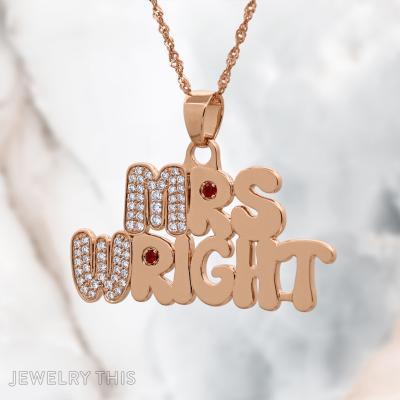
This bold and playful pendant radiates personality and charm. Crafted in 14kt rose gold, the ...

This pendant reimagines the sand dollar as a wearable keepsake, cast in sterling silver with ...

This art nouveau style pendant is a stunning recreation of a lost family piece. The ...

Embrace the natural beauty of the wilderness with this captivating custom pendant. Entirely three-dimensional, it ...

This gold plated silver pendant is a bold and distinctive statement piece that proudly showcases ...

This round pendant is cast in 14k gold-plated silver and engraved with a half-profile portrait ...

Discover the captivating allure of this one-inch custom pendant, a masterpiece by Capalyon. Crafted in ...

This elegant silver cross pendant is a heartfelt birthday gift, thoughtfully crafted by a client ...


Crafted with precision and elegance, this 14k yellow gold pendant showcases the initials HEC in ...



