


Two-Sided Lion & Logo Pendant in Gold-Plated Gold
$
Gold-plated sterling silver
A business owner wanted his company logo turned into a wearable pendant, with a crowned lion added to the opposite side as a personal touch. During design he asked for the company name added directly onto the book graphic, even though it meant shrinking the artwork slightly to fit. The piece was intended as a gift for a family member and the client hoped to have it in hand before the December holidays.
Quick specs
Design type
Primary Metal
Primary Stone
Accent Stones
Style
Design Complexity
Intent: Certainty
Size
Pendant approximately 1.5in diameter. Chain client-provided (not included).
How they made it distinctive
-
01
Double-sided design combines a personal symbol (crowned lion) with a business logo on a single pendant
-
02
Company name added directly into the book graphic at the client's request, integrating branding into the artwork rather than as separate engraving
-
03
Matte background paired with polished raised elements on both faces so each design reads clearly
-
04
Sized at 1.5 inches to function as a substantial statement piece rather than a subtle accent
-
05
Designed to pair with the client's own existing chain rather than a bundled chain
How you'd make it yours
Metal: this piece is gold-plated sterling silver; a new commission could use solid 10k or 14k yellow gold for a piece that never needs replating
Size: this piece is sized at 1.5 inches; a new commission can be scaled larger or smaller depending on how much detail needs to fit
Finish: this piece uses a matte background with polished raised elements; a new commission could use a fully polished or fully matte finish instead
Artwork: this piece pairs a lion motif with a company logo; a new commission could pair any two symbols or images the client wants represented
One of a kind: this exact pendant was designed for one client's company and personal symbol, and is not reproduced — a new commission is an original piece inspired by this one, not a copy
Design changes made
The client requested the company name be worked into the book design after seeing the first render, which required scaling the book graphic down slightly to make room for the lettering.
Who this is for
This piece is for someone who wants their business identity worn as a personal object, not just displayed on paper or a screen. It's especially suited to someone who sees a symbol of strength or leadership as part of their own story, and wants that paired with the brand they've built.
How it's made
Once the design was approved, the piece was built as a 3D digital model and then printed as a resin pattern — a physical preview of the pendant before any metal was involved. That resin pattern was used to create a mold, which was fired in a kiln to burn away the resin and leave a hollow cavity. Molten gold-plated sterling silver was then cast into that cavity to form the raw pendant.
After casting, the piece was cleaned and separated from its casting tree, then finished in two passes: a matte texture was applied to the flat background areas on both faces, while the raised lion, crown, book, and lettering were left polished so the artwork stands out from its background. The bail was finished last and stamped with a 925 mark to identify the sterling silver base beneath the gold plating.
Key note
The pendant is double-sided by design, with two completely different raised motifs modeled and finished independently on a single cast piece rather than as two separate plates joined together.
Pricing guidance
A double-sided coin-style medallion pendant with two distinct raised designs sits toward the lower end of custom pendant pricing when made in gold-plated silver, since the labor of modeling two unique faces is the main cost driver rather than the metal itself. Choosing a solid gold base instead of plating moves the price up substantially at this size. Complexity of the artwork on each face also affects modeling and finishing time.
Moves price up ↑
- ↑ Casting in solid 10k or 14k yellow gold instead of gold-plated silver
- ↑ Increasing the pendant size beyond 1.5 inches, which requires more metal and more surface detail
- ↑ Adding gemstone accents to either face
- ↑ Adding additional fine detail or dimensional layering to the lion or logo artwork
- ↑ Adding engraving to the bail or edge of the pendant
Moves price down ↓
- ↓ Reducing the pendant to a single-sided design
- ↓ Simplifying one of the two artworks to reduce modeling time
- ↓ Choosing a smaller overall diameter
- ↓ Using a flat rather than domed medallion profile
- ↓ Omitting the matte/polish contrast finish in favor of a single uniform finish
Questions people ask
This particular pendant is gold-plated sterling silver, meaning a layer of gold is applied over a sterling silver base rather than the piece being solid gold throughout. Gold plating gives the look of solid gold at a more accessible cost, but the plating is a surface coating that will gradually wear over years of daily contact, especially at high-touch points. Higher-karat plating tends to hold up longer before it needs re-plating. The same design can also be produced in solid 10k or 14k gold for a piece that does not require replating.
Yes, double-sided pendants with a different design on each face are a common request and are what this piece uses — a crowned lion on one side and a custom logo on the other. Each side is modeled separately in the 3D design phase, so the two artworks can be completely unrelated in subject and style if desired. This does add modeling time compared to a single-sided pendant, since two unique surfaces have to be designed and refined rather than one.
A flat logo image is redrawn as a 3D relief model, translating flat linework into raised or engraved surfaces that will read clearly once cast in metal. Text and fine details sometimes need to be simplified or resized slightly so they cast cleanly and remain legible at jewelry scale. The client reviews a photorealistic render of the 3D model before anything is cast, and can request adjustments such as repositioning text or resizing elements. Fine text and small logos generally need more finishing attention than bold, simple graphics.
A pendant of this size and complexity in gold-plated silver falls toward the lower end of the custom pendant price range, since two-sided artwork requires more design and modeling labor than a single-sided piece even though the material cost stays modest. Moving to a solid gold casting raises the price significantly because of the added material cost at this size. Adding gemstones or increasing the pendant's size would also raise the price from there.
A standard custom pendant typically takes several weeks from design approval to completion, covering 3D modeling, a resin preview, casting, and hand-finishing. Rush requests around a specific date, such as a holiday deadline, can sometimes be accommodated but are not guaranteed, since casting and finishing quality take priority over speed. Building in extra time beyond a hard deadline is the safest approach for any date-sensitive custom order. International or last-minute shipping changes can also add time to a project that is otherwise complete.
The raised, polished areas and the surrounding matte background age a little differently, since the raised polished details sit higher and get more direct contact and light. Over years of wear, the polished elements may develop soft highlights while the matte background stays relatively unchanged. This contrast is intentional and part of what makes raised artwork read clearly against its background. Occasional gentle cleaning helps maintain the contrast between the two finishes.
Yes, pendants are commonly ordered on their own so the client can pair them with a chain they already own, which is how this piece was made. The bail is sized to standard chain widths, but if a client has an unusually thick chain, the bail opening should be confirmed in advance so the chain fits through comfortably. A chain can also be sourced and included as part of the order if the client does not already have one.
Yes, adding lettering into an existing graphic element is a common mid-design request, as happened here when the client asked for a company name to be worked directly into the book artwork. Adding text into a confined space sometimes requires scaling down the surrounding artwork slightly so the lettering stays legible once cast. This kind of adjustment is best made during the render review stage, before the design moves into 3D modeling for production, though most software allows for revisions at that stage too.
Explore Similar Creations
Every masterpiece starts with a spark. Explore how our clients raw ideas - sketches, heirlooms, inspirations - were transformed into bespoke works of arts.
This custom-crafted necklace is a masterpiece in 14K yellow gold. The necklace features a unique ...

A heartfelt symbol of love and protection, this cross pendant was gifted by a mother ...

Crafted in radiant 10K yellow gold, this pendant features cursive script that spells out “Ling ...

Sterling silver custom made guitar pendant. Double sided with enamel guitar details on the one ...

This key-shaped pendant is a unique and meaningful piece. The top head of the key ...

This stunning custom jewelry pendant is a testament of faith and elegance. This exquisite cross ...

This custom pendant is an elegant intertwining of the parent’s initials, “VS”. At its heart ...

This gold pendant features the timeless Ten Commandments, beautifully inscribed in Hebrew letters with precision. ...

This sterling silver pendant features a cut-out design that is a recreation of a lost ...
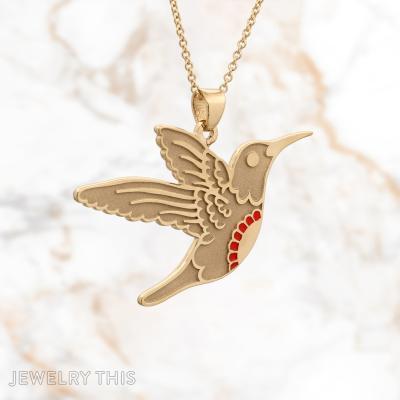
This captivating 10k yellow gold pendant captures the delicate beauty of a hummingbird, symbolizing hope ...

This pendant is inspired by a captivating historical artifact. Crafted with meticulous attention to detail, ...

This custom pendant is a heartfelt tribute to cherished college memories, designed to celebrate a ...



