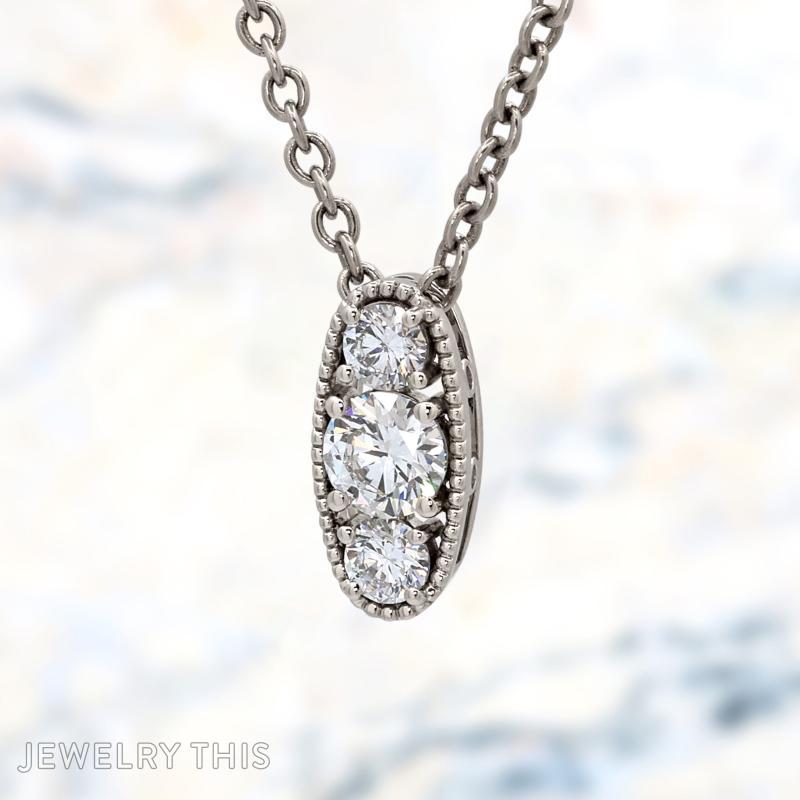
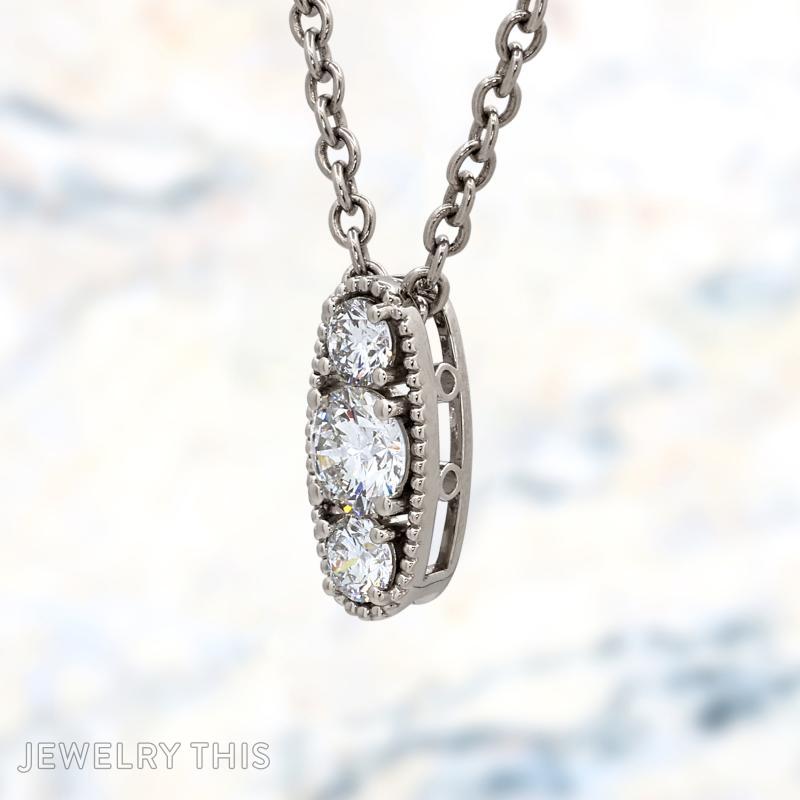
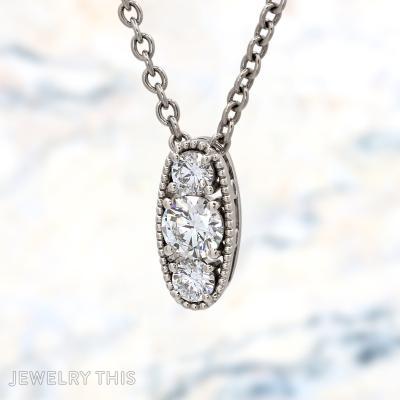
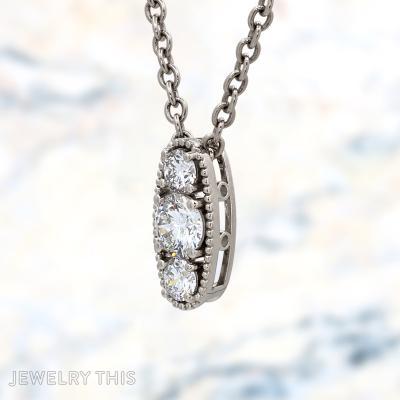
Three-Stone Oval Diamond Pendant in Platinum
$$$
Platinum, lab-grown diamonds
A client came to us after his wife lost a pendant she loved, with nothing to go on but a single old photo and his own sketch of what he remembered. He wasn't looking for an exact copy — just something that captured the shape and proportions he had in mind, done in platinum with three diamonds instead of one. When he saw the first render he wrote: 'I'm just floored, that's incredible!' — and on delivery: 'she was pretty blown away (and so was i).'
'I'm just floored, that's incredible!' — on seeing the first render
'She was pretty blown away (and so was i)!' — on delivery
Quick specs
Design type
Primary Metal
Shape / Cut
Primary Stone
Accent Stones
Style
Design Complexity
Intent: Certainty
Size
Pendant approximately 0.75in (19mm) tall, oval silhouette. Designed to fit a 1.5mm wide chain.
How they made it distinctive
-
01
Three graduated round diamonds chosen over a single large stone with a halo, specifically to fit the client's budget more realistically
-
02
Milgrain beading along the halo edges was carried over from a reference design the client liked for its edge detail
-
03
Bail repositioned during production to sit directly behind the center stone, per the client's specific request
-
04
Platinum selected over white gold for its durability and because it wouldn't require future replating
-
05
Proportions and layout were built from the client's own sketch rather than an exact copy of the lost original
How you'd make it yours
Stone type: this piece uses lab-grown diamonds; a new commission could use natural diamonds or moissanite for a different look or budget
Metal: this piece is platinum; the same milgrain-and-halo design language works well in 14k or 18k white gold
Stone count: this piece uses three graduated stones; a new commission could use a single center stone with a halo instead
Scale: this piece is sized at 0.75 inches; a new piece could be scaled down for a more delicate look
One of a kind: this exact pendant was designed for one client's wife and is not reproduced — a new commission is an original piece inspired by this one, not a copy
Design changes made
The client asked for the bail to sit directly behind the center stone rather than where it first appeared on the render, and the design was adjusted during production to move the chain attachment point down slightly, staying clear of the cross-brace element in the gallery.
Who this is for
This piece is for someone replacing something meaningful who doesn't need an exact copy — just a design that captures the feeling and proportions of what was lost. It's especially right for someone who has a clear picture in their head, even just a rough sketch, and wants a team that will build toward that vision rather than offer a fixed set of pre-made options.
How it's made
Once the design was approved, a 3D-printed resin model was produced first — the physical preview of the pendant shared with the client before any metal was committed. The resin was then set in investment plaster and fired in a kiln to burn out the model, leaving a hollow mold. Molten platinum was cast into that mold under pressure, producing the raw pendant, which was then extracted, cleaned, and prepared for finishing.
After casting, the piece was polished to bring up the platinum's natural luster, and the fine milgrain beading along the halo edges was finished by hand to keep the detail crisp. The three round lab-grown diamonds were then prong-set in sequence from center stone outward, with the bail position adjusted during production to fall directly behind the top stone as the client requested.
Key note
The chain-attachment bail was repositioned during production — after the render was approved — specifically so it would sit directly behind the center stone rather than where it first appeared in the design.
Pricing guidance
A three-stone oval pendant in platinum with lab-grown diamonds sits in the mid range for custom pendant work. Platinum's density and the hand-finished milgrain detailing are the main cost drivers, more so than the stone choice itself. Moving between lab and natural diamonds, or between platinum and white gold, is where the price shifts most from there.
Moves price up ↑
- ↑ Switching from lab-grown to natural diamonds at the same carat weights
- ↑ Upgrading from platinum to a higher total diamond carat weight across the three stones
- ↑ Adding a matching chain in the same platinum rather than sourcing one separately
- ↑ Extending the milgrain beading around additional surfaces of the mount
- ↑ Increasing the pendant size beyond 0.75 inches, which requires more metal and larger stones
Moves price down ↓
- ↓ Choosing moissanite in place of lab-grown diamonds, as was quoted as a lower-cost option
- ↓ Using 14k white gold instead of platinum
- ↓ Reducing the pendant to a smaller scale, such as 0.63 inches as the client considered
- ↓ Simplifying the milgrain edge detail to a plain polished border
- ↓ Selecting a single center stone with two smaller accents rather than three graduated stones
Questions people ask
Yes — this pendant was designed from a single photo of the original piece plus the client's own hand-drawn sketch, with no physical piece to reference. The team builds a 3D render for approval before anything is cast, so the client can compare the design against memory and adjust it before production starts. Perfect replication isn't always possible without the original, but capturing the proportions, layout, and overall feel is achievable in most cases. Clients are encouraged to be upfront that minor differences from the original are expected.
Lab-grown and natural diamonds are chemically and optically identical — same hardness, same brilliance, same appearance to the eye. The only difference is how they're formed: one is grown in a controlled lab environment, the other mined from the earth. For a three-stone piece like this, choosing lab-grown diamonds typically brings the cost down significantly compared to natural stones of the same size and quality, without changing how the piece looks.
Platinum is one of the most durable metals used in fine jewelry and holds prongs and small detail work, like milgrain beading, very securely over time. It's denser and heavier than white gold, which gives a pendant a more substantial feel on the chain. It also won't need rhodium replating the way white gold eventually does, since platinum is naturally white throughout. The tradeoff is that platinum costs more than white gold for the same design.
The design phase — sketch to 3D render to client approval — usually takes about a week. Once the design is approved and production begins, casting and finishing typically takes another 3 to 4 weeks, though this can shift depending on stone sourcing and the complexity of hand-finishing details like milgrain edging. Rush timelines are possible when there's a specific deadline, such as a holiday delivery date, if production starts early enough.
Yes, within reason — on this design, the bail position was adjusted during production so the chain would sit directly behind the center stone rather than where it first appeared on the render. Small positional adjustments like this are usually possible as long as they don't conflict with structural elements of the mount, like a cross-brace or gallery support. It's best to flag positioning preferences as early as possible, ideally during the render review stage, though some adjustments can still be made once production has started.
A pendant like this — platinum, three round lab-grown diamonds, milgrain detailing — sits in the mid range for custom pendant work. The platinum itself and the hand-finishing labor for the beaded edge detail are bigger cost factors than the diamonds in this case. Switching to white gold or moissanite are the two most common ways to bring the cost down while keeping a similar look.
Not necessarily — chains are often quoted and purchased separately from the pendant itself, which gives more flexibility on budget and style. A cable chain in a matching metal is a common recommendation since it tends to complement a vintage-inspired mount well. The pendant's bail opening width should be confirmed against the chain thickness before purchasing, since a bail that's too narrow won't accommodate a thicker chain.
Yes, and this is actually a common approach — rather than an exact replica, a client can describe what they liked and disliked about the original and use that as a starting point for something new. In this case, the client wanted the general shape and proportions preserved but changed a single large stone to three smaller graduated stones for a different look and a more manageable budget. This approach often produces a piece that feels more personal than a strict recreation would.
Explore Similar Creations
Every masterpiece starts with a spark. Explore how our clients raw ideas - sketches, heirlooms, inspirations - were transformed into bespoke works of arts.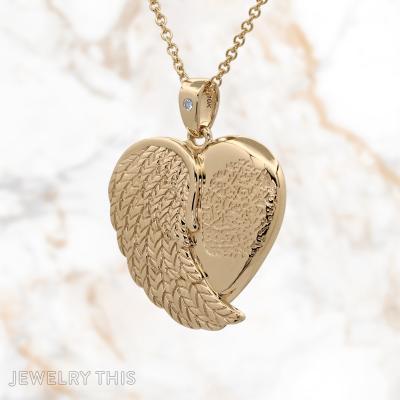
This exquisite custom pendant is a heartfelt tribute to a cherished family patriarch and veteran. ...

This custom cross pendant is a stunning testament to faith and personalization. The front of ...

A sterling silver logo pendant with bold black enamel lettering. This piece is about 1.5 ...
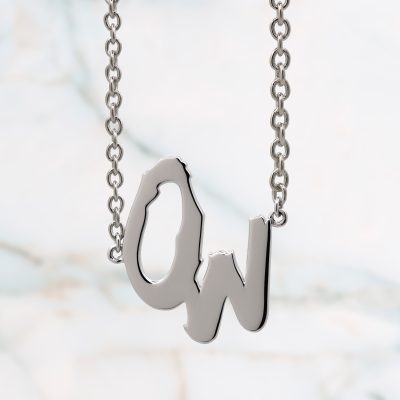
This custom logo pendant displays exquisite detail in a one inch cut out sterling silver ...

This logo pendant is a true testament to the one who wears it- the “world’s ...

This striking gold pendant features a uniquely designed skull wearing a cowboy hat, merging rugged ...

Celebrate the unique bond of marriage with this extraordinary pair of matching dice pendants. For ...

Crafted with exquisite craftsmanship and profound symbolism, this custom pendant is a testament to faith ...

This pendant reproduces a police department’s badge in 14k yellow gold, with the shield, eagle, ...

This pendant is a heartfelt representation of family unity and love. The white gold pendant ...

This pendant depicts a small winged fairy figure rendered in polished 14k white gold, holding ...
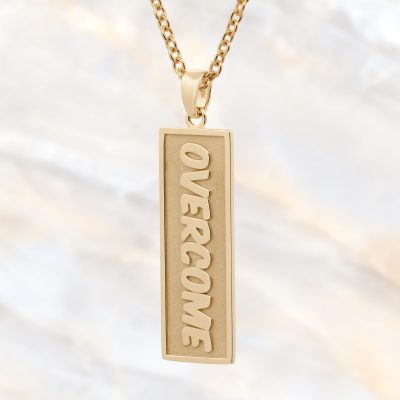
The pendant proudly displays the word “overcome” in striking 3D detail, serving as a powerful ...