


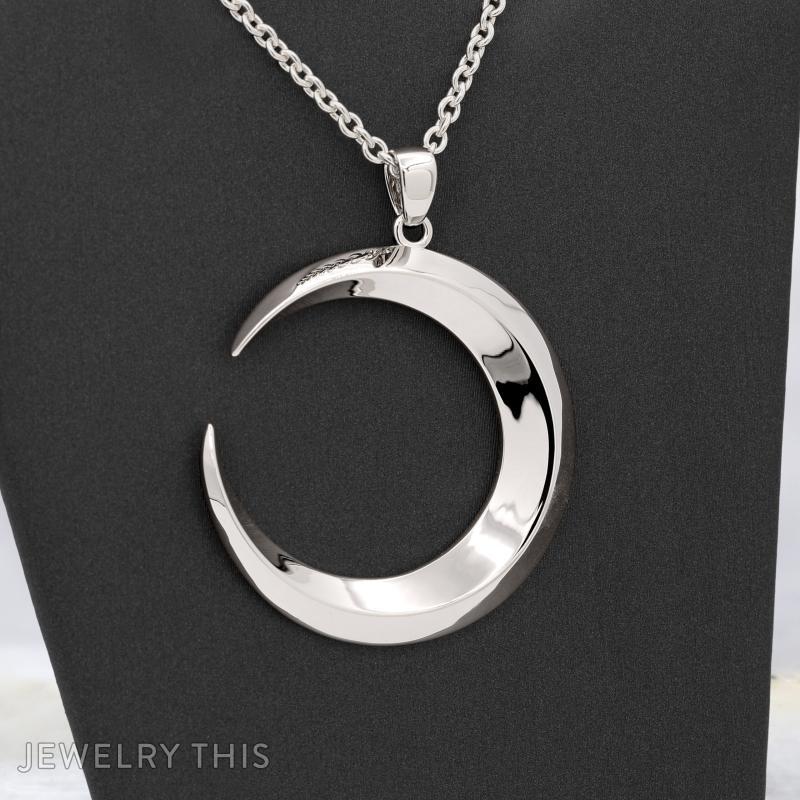


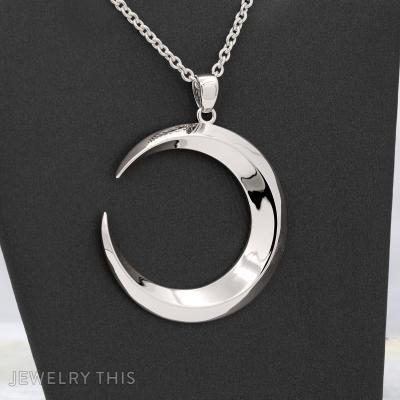
Interlocking Crescent Moon Pendants in Sterling Silver
$$
Sterling silver, amethyst, garnet
A couple came to us wanting matching crescent moon pendants that combine into a full moon when worn together — one for him, one for her, set with an amethyst and a red accent stone. He described the pieces as an anniversary and birthday gift for his wife, timed to coincide with the couple's holiday season. When the finished pendant arrived, he wrote: 'It's exactly how I pictured it.'
'I love it! It looks amazing.' — on seeing the first render
'It's exactly how I pictured it.' — on delivery
Quick specs
Design type
Primary Metal
Shape / Cut
Primary Stone
Accent Stones
Style
Design Complexity
Intent: Certainty
Size
His pendant approx. 1.5in; hers approx. 1in. His chain 2.4mm x 20in; hers 1.5mm x 20in cable chain.
How they made it distinctive
-
01
Two crescent moons modeled together so they visually form a full moon when placed side by side, despite being cast and worn separately
-
02
Larger pendant sized at 1.5 inches specifically for a broader neck and shoulder frame, while the companion piece stays closer to a standard 1-inch size
-
03
Amethyst and a red accent stone set together in the lower curve of the crescent, rather than centered, so the stones follow the moon's natural taper
-
04
One crescent left entirely plain so the pair reads as a deliberate his-and-hers contrast rather than a matched identical set
-
05
Chain gauge sized differently for each wearer — a thicker 2.4mm chain for the larger pendant, a finer 1.5mm cable chain for the smaller
How you'd make it yours
Stone: this piece uses amethyst and a red accent stone; a new commission could use any birthstone pairing or a single stone instead of two
Metal: this piece is sterling silver; the same crescent design works in 14k or 18k white, yellow, or rose gold
Pendant size: this piece is 1.5in and 1in; a new pair can be scaled up or down to fit different wearers
Chain: this piece uses 1.5mm and 2.4mm cable chains; a new commission could use a different chain style or width
Stone placement: this piece sets both stones low in the crescent's curve; a new design could center them or space them further apart
One of a kind: this exact pendant pair was designed for one couple and is not reproduced — a new commission is an original piece inspired by this one, not a copy
Design changes made
Design matched the initial brief without major changes. The client asked whether the inner moon on his wife's pendant should be sized larger to match the original reference photo, but kept the design at its rendered proportions after confirming it suited her.
Who this is for
This pair is for a couple who wants matching jewelry that still feels individual — two pieces, each wearable on its own, that only complete their full shape when together. It's especially right for anyone who wants a shared symbol without wearing an identical copy of their partner's piece, and who values a design that quietly marks a relationship milestone rather than announcing it.
How it's made
Once the design was approved, a wax model was 3D-printed and mounted to a wax tree inside a flask, which was then placed in a kiln to burn out the wax and leave a hollow mold. Molten sterling silver was poured into the mold under pressure, producing the raw crescent form for each pendant. After cooling, each piece was extracted from its mold and cleaned in preparation for finishing.
Both crescents were polished to a high-mirror shine to bring out the smooth, sculptural curve of the moon shape. On the pendant carrying stones, the amethyst and red accent stone were prong-set together into the lower curve of the crescent, positioned so the two stones sit side by side within the tapering moon shape. The plain crescent was finished to match, so the two pieces read as a single design language when placed together.
Key note
The two crescents were modeled as a matched pair from the same reference so that, despite being cast and finished separately, they visually complete a full moon shape when placed together.
Pricing guidance
A pair of sculptural sterling silver crescent pendants with two prong-set gemstones sits toward the lower end of the mid-range for custom pendant work. Producing two coordinated but distinct pieces — one plain, one gem-set — adds modeling and casting steps beyond a single pendant, which is the main driver of the baseline cost. Chain choice and gemstone selection are where the price shifts most from there.
Moves price up ↑
- ↑ Upgrading both pendants from sterling silver to 14k or 18k white gold
- ↑ Adding gemstones to the second (currently plain) crescent as well
- ↑ Choosing larger or higher-clarity gemstones for the amethyst and accent stone
- ↑ Selecting a thicker chain gauge (e.g. 2.4mm+) in precious metal rather than silver
- ↑ Adding personalized engraving to the inside of either crescent
Moves price down ↓
- ↓ Making only a single crescent pendant rather than a matched pair
- ↓ Reducing the pendant size from XL/1.5in down to a standard 1in size
- ↓ Using a single gemstone instead of two on the gem-set piece
- ↓ Choosing a thinner, simpler chain style
- ↓ Selecting a lab-created stone alternative for the accent gem
Questions people ask
Yes, this is a common request for couples' pieces — two individually wearable pendants designed from the same reference so they visually complete a shape, like a full moon, when placed side by side. The key is modeling both pieces together during the design phase so their proportions and curves align correctly. Each pendant still functions as a standalone piece with its own chain and clasp. This approach works well for crescent, puzzle-piece, and split-heart style designs.
Sterling silver (.925) is a durable, affordable option for pendants and holds prong-set stones securely with normal care. It will tarnish slightly over time with air exposure, which is easily reversed with a polishing cloth, and it does not require replating the way gold-plated pieces do. For daily wear, silver is softer than platinum or 14k gold, so stones should be checked periodically to confirm prongs remain snug. It's a solid choice for pendants that are worn regularly but not subjected to heavy impact.
Amethyst is a purple variety of quartz with a hardness of about 7 on the Mohs scale, while garnet typically rates slightly higher at 6.5–7.5 depending on the variety, both well-suited for pendant wear since pendants see less impact than rings. Amethyst tends to run larger and more affordable at a given size compared to garnet or ruby. Garnet has a deeper red tone that some clients prefer over ruby when a true red rather than pink-red look is wanted. Both stones are commonly used as birthstone or anniversary accent stones in pendant designs.
From deposit to finished piece, a two-pendant custom order like this typically takes around five to six weeks total. The first week covers the 3D design and render for approval, and once approved, production — casting, stone setting, and finishing — takes roughly three to four weeks. A resin or wax preview may be shared partway through production so the client can see the piece taking shape before it's cast in metal. Rush timelines are possible but should be discussed with the design team upfront.
A matched pair of sculptural silver pendants with a couple of gemstones and chains sits toward the lower end of the mid-range for custom pendant work. The main cost driver is producing two coordinated but individually modeled pieces rather than one, plus the gemstone setting on one of them. Chain width and metal choice (silver versus gold) are the biggest variables that move the price up or down from there. Upgrading to gold typically increases the cost substantially compared to silver.
Yes, a crescent moon pendant design like this translates well into 14k or 18k white, yellow, or rose gold. Gold costs significantly more than sterling silver due to the price of the raw metal itself, and prong-set gemstones will look slightly different against a warmer gold tone versus bright silver. Some clients choose a mixed approach — one piece in a higher karat gold and the companion piece in a lower karat or silver — to manage overall cost. The design and proportions stay the same regardless of metal choice.
When two crescent pendants are modeled together from the same reference during the design phase, their curves and proportions are built to align if held together, even though each is cast and worn as a separate piece. They are not physically connected or interlocking — each has its own bail and chain — so 'forming a full moon' is a visual effect when the two are placed next to each other, not a mechanical fit. This is a common design approach for couples who want complementary rather than identical pendants. The render stage is the best opportunity to confirm the visual alignment before casting.
Yes, each pendant in a two-piece set is typically sized to its own wearer, so different chain lengths and even different chain thicknesses are completely normal. A shorter, thinner chain is common for a smaller or more delicate pendant, while a longer, thicker chain often suits a larger pendant or a wearer with a larger neck and shoulder frame. Chain length is generally chosen based on where the wearer wants the pendant to sit, not matched to the companion piece. This flexibility is one of the advantages of ordering two pieces as a coordinated set rather than identical items.
Explore Similar Creations
Every masterpiece starts with a spark. Explore how our clients raw ideas - sketches, heirlooms, inspirations - were transformed into bespoke works of arts.
17mm round pendant with a cut out cat silhouette and detailed engraving on the back. ...

This custom sterling silver word pendant is the perfect way to commemorate a special moment. ...

Elegantly captured in flight, this captivating pendant takes the form of a majestic owl with ...

This custom pendant features a sophisticated square design with a striking enamel finish. At the ...

Crafted from 14K gold plated sterling silver, this pendant showcases a striking lightning bolt design, ...

A special tribute to a beloved brother, this ribbon pendant embodies both memory and love. ...

This custom pendant is a heartfelt gift created by a client for her partner, who ...


This custom pendant is a heartfelt tribute to cherished college memories, designed to celebrate a ...

This stunning custom sterling silver cross pendant showcases the beauty of Latin religious script and ...

Discover the elegance of this 2-inch pendant replicating the client’s company logo. A large beautifully ...

Presenting a stunning memorial pendant. This piece features a captivating two-tone heart shaped pendant. One ...



