
Birthstone Cross Pendant — Gold Family Necklace
$$$
14k yellow gold, natural diamond, ruby, garnet
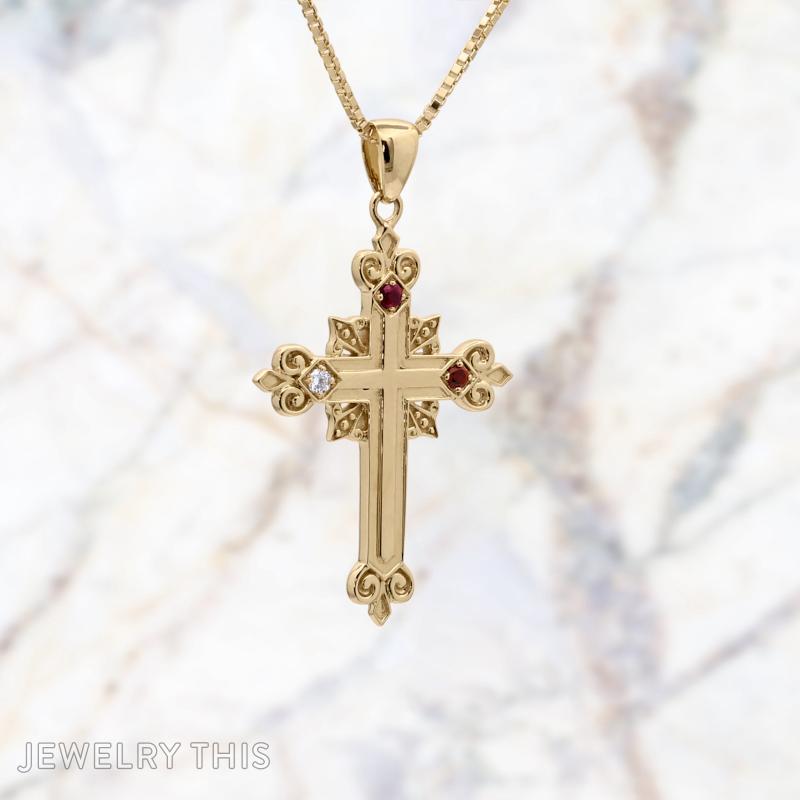
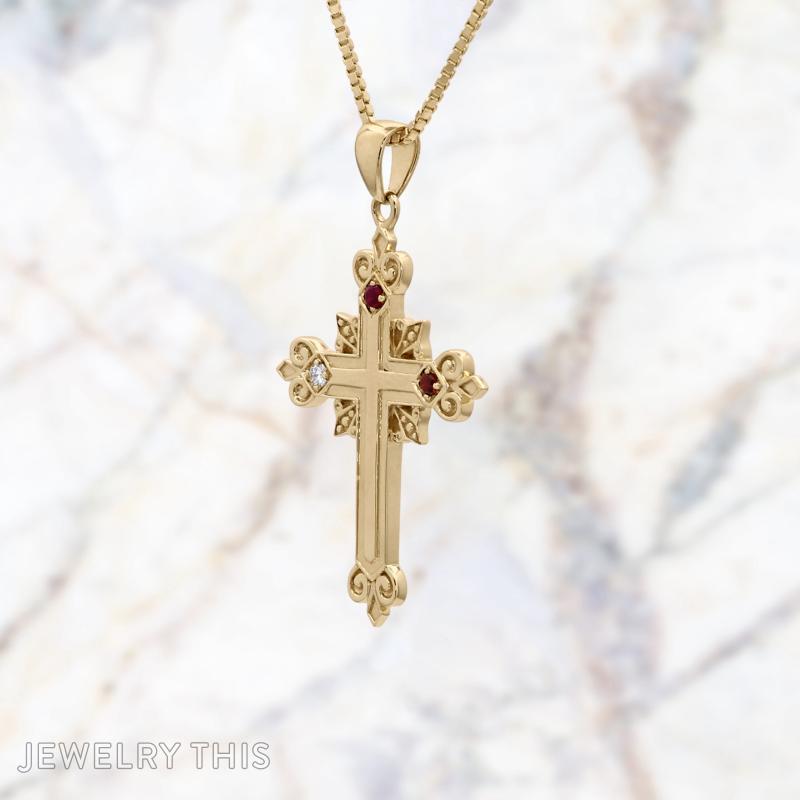
A father-to-be returned to commission a second piece from the same design language as an anniversary ring made for his wife two years earlier. This time, the goal was a cross pendant to hold three birthstones — one for him, one for his wife, and one for their baby boy, due later in the year. He chose the outer scrollwork and beading from the original ring as the starting point, and the finished piece carries that same detailing into a new form for a new chapter of the family.
'I think the design is excellent. I do prefer the gemstone at the top.' — on seeing the render
'Yes, my wife is very happy with the results, and I am happy with the service.' — on delivery
Quick specs
Design type
Primary Metal
Shape / Cut
Primary Stone
Design Complexity
Intent: Certainty
Size
Pendant approximately 1in (25mm) height. Chain: 14k gold box chain, 16in length.
How they made it distinctive
-
01
Beaded scrollwork border deliberately carried over from an earlier family ring to visually connect the two pieces
-
02
Three birthstone positions arranged to represent both parents and their baby on the way
-
03
Diamond set at the top and ruby to the side after the client adjusted the original sketch for better stone separation
-
04
Sized to just under an inch specifically to keep the pendant wearable as an everyday piece rather than a statement piece
-
05
Fleur-de-lis terminals and filigree detailing chosen to match the aesthetic of a previously commissioned ring
How you'd make it yours
Stone selection: this piece uses a diamond, ruby, and garnet; a new commission could use any three birthstones or swap to lab diamonds for a similar look
Metal: this piece is 14k yellow gold; the same scrollwork design translates well to white or rose gold
Chain: this piece uses a 16-inch box chain; a new commission could use a curb, cable, or figaro chain in a different length
Engraving: the back of the pendant can carry a name, date, or short phrase on a new piece
Size: this piece was made at approximately one inch; a new commission is sized to the wearer's preference
One of a kind: this exact pendant was designed for one family and is not reproduced — a new commission is an original piece inspired by this one, not a copy
Design changes made
The client asked for the ruby to be moved to the top position and the diamond to one side, adjusting the original sketch layout for better visual separation between the stones. The rest of the design — the beaded scrollwork border and the three-stone placement across the horizontal and vertical arms — matched the client's vision from the first proposed sketch.
Who this is for
This piece is for someone building a small collection of connected, meaningful jewelry over time rather than buying one-off pieces. It's especially right if you're marking a family milestone — a new baby, a growing family — and want a piece that ties visually back to something already meaningful without simply repeating it.
How it's made
Once the sketch was approved, the design moved into a detailed 3D model, which was reviewed before any metal was committed. From that model, a wax version of the pendant was 3D printed and attached to a wax tree, then invested in plaster and fired in a kiln to burn out the wax and leave a hollow mold. Molten 14k yellow gold was then cast into the mold under pressure and, once cooled, the raw pendant was extracted for finishing.
After casting, the pendant was cleaned and polished to bring out the detail in the scrollwork and beaded border along the cross's edges. The three center stones — a diamond and two colored stones — were then set by hand into the vertical and horizontal arms, positioned to leave room for balance between the stones without letting the smaller accents overwhelm the diamond.
Key note
The beaded edge detailing was deliberately carried over from an earlier ring design rather than newly drafted, so the two pieces share a matching decorative language despite being made two years apart.
Pricing guidance
A detailed gold cross pendant with filigree-style scrollwork and multiple set stones sits toward the upper-mid range for pendant work of this complexity. Most of the added cost comes from the labor-intensive casting and finishing required to bring out fine scrollwork and beading at a small scale, rather than from the stones themselves. Chain style and length are additional costs on top of the pendant itself.
Moves price up ↑
- ↑ Adding more scrollwork or extending the beaded detailing to cover the entire perimeter of the cross
- ↑ Upgrading the accent stones to natural sapphires or additional diamonds instead of smaller colored gemstones
- ↑ Choosing a thicker or more elaborate chain style, such as a curb or Cuban link, over a simple box chain
- ↑ Increasing the pendant size beyond one inch, which increases metal weight and setting complexity
- ↑ Adding decorative engraving to the back of the pendant
Moves price down ↓
- ↓ Simplifying the scrollwork to a plain cross silhouette without the fleur-de-lis terminals
- ↓ Reducing the stone count to a single center stone rather than three
- ↓ Choosing a thinner, more basic chain style
- ↓ Using gold-plated silver instead of solid 14k gold
- ↓ Omitting the beaded border detailing for a cleaner, unadorned edge
Questions people ask
A 14k gold cross with scrollwork and beaded detailing is durable enough for daily wear as long as it isn't subjected to heavy impact, since fine filigree-style elements are thinner than a plain solid cross. Because 14k gold is an alloy rather than pure gold, it holds up better against bending and scratching than higher-karat gold would. The chain and bail are typically the first points of wear on a pendant like this, so a sturdy box or curb chain is recommended over delicate styles. With normal care, a piece like this can be worn daily for years without significant issues.
Yes, mixing a diamond with colored gemstones like ruby and garnet in the same setting is a common approach for pieces that represent multiple family members through birthstones. Each stone can be set individually within its own recessed area so the harder diamond doesn't overshadow the softer, less brilliant colored stones. The main design consideration is spacing and placement, since the accent stones need to complement rather than visually compete with a center diamond. Setting order typically starts with the most structurally central stone and works outward.
A cross pendant with this level of scrollwork detailing and multiple set stones typically falls in the upper-mid price range for custom pendant work. The main cost driver is the labor involved in casting and finishing fine decorative details at a small scale, not the value of the stones themselves. Chain style and length are priced separately from the pendant and can shift the total up or down. Simpler designs with fewer decorative elements or a single stone cost meaningfully less.
A custom pendant with this level of detail typically takes about seven to ten days for the design phase, including a detailed sketch and a 3D model for review and approval. Once the design is approved and moved into production, casting and finishing generally take about four weeks, though highly detailed pieces can take longer depending on workload. The full timeline from first sketch to a finished, shipped piece is typically six to eight weeks under standard scheduling. Rush timelines are possible but depend on current production capacity.
It depends on the setting design — a pendant designed with a specific gap or placeholder for a future stone can usually accommodate an addition without a full remake, while a fully closed design typically requires more significant rework. When birthstones represent family members who haven't been born yet, it's worth discussing placement options that allow for future additions during the design phase. Retrofitting a stone into a finished piece is more limited than planning for it from the start. It's best to raise this possibility with the designer before the piece goes into production.
What's the difference between a diamond and other stones used as birthstones in a pendant like this?
Diamond, the traditional April birthstone, is significantly harder than most colored gemstones, rating a 10 on the Mohs hardness scale compared to around 7-8 for ruby and garnet. This means a diamond will resist scratching better over decades of wear, though all three stones used here are hard enough for normal pendant wear. The practical difference in a piece like this is more about appearance — diamond is colorless and brilliant, while ruby and garnet provide warm, saturated color. All three can be sourced as natural stones and are commonly combined in multi-birthstone designs.
Yes, carrying design elements like scrollwork, beading, or filigree patterns from a previous piece into a new one is a common request, especially for pieces meant to feel connected as part of an ongoing family collection. The design team can reference the original piece's photos or specifications to replicate compatible decorative details in the new design. Some adaptation is usually necessary since a ring and pendant have different proportions and structural needs. The goal is visual consistency in style and detailing rather than an exact one-to-one copy.
A cross shape offers more natural placement points for multiple stones along its arms compared to a circular disc, which typically centers a single stone or a small cluster. The cross's structure also carries personal or religious significance for many clients, making it a meaningful choice beyond the birthstone arrangement itself. A disc pendant tends to read as more minimal and modern, while a cross with detailing like scrollwork leans toward a more traditional or ornate aesthetic. The choice usually comes down to personal style preference and what the piece is meant to represent.
Explore Similar Creations
Every masterpiece starts with a spark. Explore how our clients raw ideas - sketches, heirlooms, inspirations - were transformed into bespoke works of arts.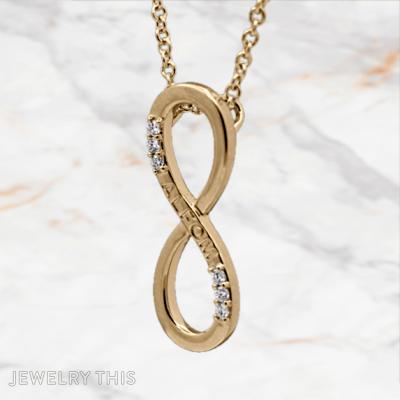
A timeless symbol of eternal love and connection. This 1-inch tall pendant features an infinity ...

Exuding luxury and sophistication, this custom pendant is a masterpiece crafted in radiant 14k yellow ...

14k yellow gold rectangular pendant featuring the mantra “Just Grace” Pendant: 1.5 inches long

This pendant combines an open cross silhouette with an overlapping heart, designed so the heart ...

Embrace the enchanting beauty of this custom cloud-shaped pendant created for a special July birthday. ...

Fans of the movie Saw will quickly notice this 3D silver pendant inspired by the ...

Sterling silver heart pendant featuring citrine, blue sapphire and peridot stones set into bezels along ...

This sterling silver pendant holds a personal prayer, a heartfelt reminder that spirals around its ...

This sterling silver pendant features the striking logo of a Motorcycle Club. The design focus ...

This custom pendant is a proud emblem of a beloved podcast, meticulously crafted to capture ...

This pendant combines two national symbols into a single cut-out design: a crowned white eagle, ...

This custom pendant is a striking homage to the spirit of varsity pride and personal ...



