


Sparrow & Sakura Flower Charm Bracelet in Gold and Silver
$$$
Sterling silver, 14k rose gold
A client wanted a bracelet built around two specific images in his mind: sparrows in flight and a sakura flower, inspired by photos he found online. Working from his reference images, the design moved from a cobalt concept to a sterling silver and rose gold piece, with the flower scaled down mid-process so it would sit comfortably on the wrist. The final bracelet pairs two silver sparrow charms with a dimensional rose gold flower at the center.
Quick specs
Design type
Primary Metal
Secondary Metal
Primary Stone
Accent Stones
Style
Design Complexity
Intent: Certainty
Size
Total bracelet length 7 inches. Flower charm approximately 1 inch; bird charms similarly sized.
How they made it distinctive
-
01
Two-metal construction pairs sterling silver sparrow charms with a 14k rose gold flower for deliberate tonal contrast
-
02
Flower and bird charms modeled directly from the client's own reference photos rather than a generic motif
-
03
Flower scaled down from the original size request after a resin test showed the larger version was impractical for wrist wear
-
04
Sparrows positioned in profile between chain links rather than as hanging dangles, for a flatter, more wearable silhouette
-
05
Layered, etched petal detail on the flower distinguishes it from a flat or stamped charm
How you'd make it yours
Flower metal: this piece uses solid 14k rose gold; a new commission could use rose gold plating for a similar look, or yellow or white gold
Charm subject: this piece features sparrows and a sakura-style flower; a new design could use different birds, flowers, or motifs meaningful to the wearer
Chain style: this piece uses a cable-link chain in the thicker of two options; a new piece could use a finer or different link style
Charm placement: these charms sit flush between chain links; a new design could use dangling charms instead for more movement
One of a kind: this exact bracelet was designed around one client's reference photos and is not reproduced — a new commission is an original piece inspired by this one, not a copy
Design changes made
The flower charm was reduced from the originally requested 1–1.25 inch size to a smaller scale after the resin print stage, since the master jeweler found the larger size impractical for everyday wrist wear. The client also selected the thicker of two chain options shown during the design phase.
Who this is for
This piece is for someone who has a specific image in mind — not just a general idea of a bracelet, but particular birds, a particular flower, a particular feeling — and wants it translated faithfully into metal. It suits someone comfortable mixing two metal tones and who wants charms that read as deliberate miniature sculptures rather than generic bracelet dangles.
How it's made
Once the design was finalized, a 3D-printed resin model of the birds and flower was produced so the client could confirm scale before any metal was committed. That model was then used to build a wax version, attached to a wax tree, invested in plaster, and fired in a kiln to burn out the wax and leave a hollow mold. Molten sterling silver and 14k rose gold were cast separately into their respective molds, then cooled and extracted for finishing.
After casting, each component was cleaned and polished — the silver chain and bird charms brought to a bright polish, while the rose gold flower was finished to highlight its layered petal detail and etched center. The bird and flower charms were then assembled onto the chain at the positions confirmed in the render, connecting the two metals into a single cohesive piece.
Key note
The flower and bird charms were cast in two separate metals and finished independently before being joined onto the chain, since sterling silver and rose gold require different polishing approaches.
Pricing guidance
A multi-charm bracelet combining two metals and dimensional sculptural elements like this one sits in the mid-to-upper range for custom bracelet work. The cost is driven primarily by the number of separately modeled and cast charms, plus the labor of finishing two different metals to a cohesive standard. Chain style and the choice between rose gold plating versus solid rose gold for the charm are the biggest additional cost swings.
Moves price up ↑
- ↑ Using solid 14k rose gold for the flower charm instead of rose gold plating over silver
- ↑ Adding more charms or a longer repeating pattern along the chain
- ↑ Increasing the dimensional detail or size of the sculptural elements
- ↑ Upgrading the chain to a heavier gauge or a more complex link style
- ↑ Adding gemstone accents to the flower center or bird eyes
Moves price down ↓
- ↓ Using rose gold plated silver rather than solid rose gold for the flower
- ↓ Reducing to a single charm rather than a three-piece arrangement
- ↓ Choosing a thinner, simpler chain link style
- ↓ Scaling down the charm sizes further
- ↓ Using the same single metal throughout rather than a two-metal combination
Questions people ask
No, custom fine jewelry studios working in traditional metalsmithing techniques typically do not work with cobalt or titanium, since these metals require industrial tooling rather than standard casting and hand-finishing methods. The usual alternatives are sterling silver, gold in various karats, platinum, and sometimes brass. If a client has their heart set on a dark, modern metal look, black rhodium plating or oxidized silver can achieve a similar visual effect using standard precious metals. These options can be sized, repaired, and refinished using conventional jewelry techniques, which cobalt and titanium generally cannot.
Rose gold plating is a thin layer of rose gold applied over a base metal like sterling silver, and it will gradually wear with regular handling, especially at high-contact points. Solid rose gold, by contrast, carries its color all the way through, so it won't fade or require replating over time. For a charm that gets handled often, like one on a bracelet, solid gold holds its finish significantly longer. Replating a worn plated piece is a straightforward service most jewelers can perform when needed.
A bracelet with multiple dimensional charms across two metals typically falls in the mid-to-upper range for custom bracelet work. The price is driven mainly by how many separate components need to be modeled and cast, and whether any of them use solid gold rather than plating. Chain style and link thickness also factor in, since a heavier chain uses more metal. Simplifying to fewer charms or a single metal brings the cost down noticeably.
A custom bracelet like this typically takes a few weeks from design approval to completion, following an initial design phase where sketches and a 3D render are reviewed and refined. Once the design is approved, production — casting, finishing, and assembly — generally takes another few weeks. More complex designs with multiple cast components in different metals can take longer than a simple chain piece. The exact timeline depends on how many revisions are needed during the design phase.
Yes, charm size is often adjusted during the design phase once a physical sample, usually a 3D-printed resin model, shows how the piece will actually look and feel at full scale. A charm that looks right in a 2D sketch can feel oversized or impractical on the wrist in person. Jewelers often recommend scaling down dimensional charms for comfort and durability during daily wear. This kind of adjustment is a normal part of the custom design process, not a sign of a design problem.
Yes, mixing sterling silver and rose gold is a common combination in custom jewelry and creates natural visual contrast between the cool tone of silver and the warm tone of rose gold. Each metal component is typically cast and finished separately, since silver and rose gold require different polishing processes, and then assembled together onto a single chain or setting. This two-metal approach is a deliberate design choice rather than a limitation. It works well when different elements of a design benefit from different metal tones.
Yes, a reference photo of a bird or animal in flight usually contains far more detail than can be reproduced at charm scale, which is often under an inch. Designers typically simplify the pose and key features — like wing position or distinctive markings — while leaving out fine textures that wouldn't read clearly at such a small size. The goal is to capture the recognizable silhouette and character of the subject rather than a literal miniature photograph. This kind of simplification is standard practice for small-scale dimensional jewelry.
Seven inches is the most common bracelet length and fits most average wrists comfortably. Length is typically confirmed late in the design process, close to final assembly, so there's time to reconsider based on how the finished charms and chain look together. A finished bracelet's length is generally fixed once assembled, so it's worth confirming wrist measurements before production begins rather than after. Most jewelers will check in on this detail before finalizing the piece.
Explore Similar Creations
Every masterpiece starts with a spark. Explore how our clients raw ideas - sketches, heirlooms, inspirations - were transformed into bespoke works of arts.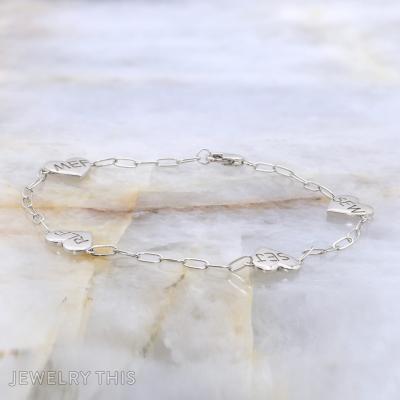
This bracelet pairs a visible paperclip-style chain with four small heart-shaped links, each hand-engraved with ...

Presenting a distinctive Art Deco-inspired white gold onyx and diamond bracelet, carefully crafted in a ...

Ignite your sparkle with this stunning Cut-Out Star Bracelet, beautifully crafted in luxurious platinum and ...

This cuff-style bracelet emanates comfort and meaning. Designed to fit snugly while embracing the wearers ...

This beautiful dainty silver bracelet features a center piece that is adorned with a moon ...

This custom bracelet, designed as a heartfelt anniversary present, features a delicate cuff style that ...

This exquisite yellow gold bracelet is crafted from a link-style chain, providing a timeless yet ...

This delicate platinum bracelet is the perfect blend of simplicity and elegance, designed for those ...

This sterling silver bangle bracelet is engraved on both the outer and inner surfaces with ...

This wide sterling silver cuff bracelet translates a previously designed pendant into a wearable statement ...

Step into luxury with our custom-designed bangle bracelet, a masterpiece crafted with vintage detailing. Fashioned ...

This cuff bracelet was designed as a companion piece to a ring the client already ...



