

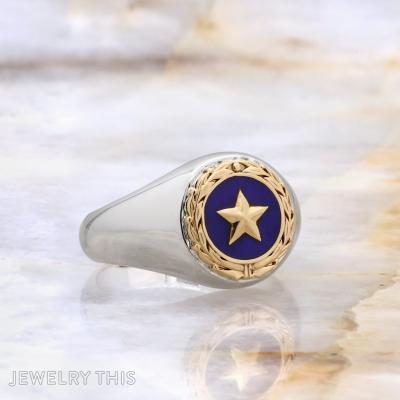
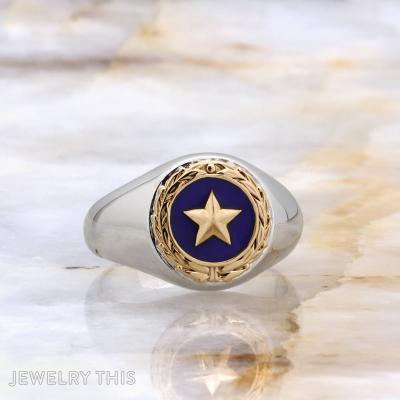
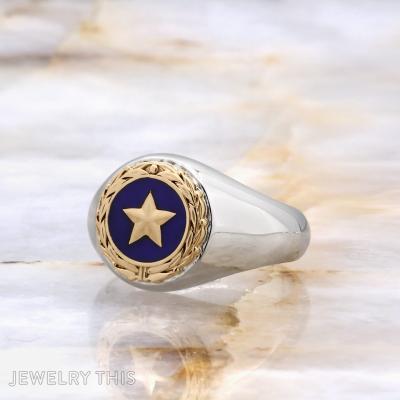
Men's Gold Star Signet Ring in Silver and Gold
$$$
Sterling silver, 14k yellow gold, purple enamel
A Gold Star family member wanted a masculine version of a ring already in the gallery — one built around the official Gold Star family pin, but sized and weighted for daily wear on a man's hand. He pushed for a two-metal construction specifically because, in his words, he's "hard on clothes and jewelry," choosing solid gold over plating so the color would hold up. When it arrived, he wrote: "I absolutely love it. Zero complaints."
'I absolutely love it. Zero complaints.' — on delivery
Quick specs
Primary Metal
Secondary Metal
Primary Stone
Accent Stones
Style
Design Complexity
Intent: Certainty
Size
Ring size 10.5 US. Top diameter slightly smaller than a dime (approximately 16-17mm).
How they made it distinctive
-
01
Solid 14k gold top chosen over gold plating specifically because the wearer described himself as hard on jewelry and wanted lasting color
-
02
Two-tone construction — sterling silver band paired with a solid gold emblem — balances durability with cost
-
03
Band widened and scaled specifically for a masculine hand while preserving the emblem's original proportions
-
04
Purple enamel color matched to the official Gold Star family pin rather than a generic purple
-
05
Wreath border hand-detailed around the star emblem for dimensional relief
How you'd make it yours
Metal: this piece uses a sterling silver band with a 14k gold top; a new commission could use all sterling silver, all gold, or a different karat combination
Enamel color: this piece uses deep purple to match the Gold Star pin; a new commission could use any enamel color meaningful to the wearer
Emblem: this piece features a star and wreath; a new commission could adapt a different symbol or emblem in the same signet format
Engraving: the inside of the band can carry a new inscription on a fresh commission
One of a kind: this exact ring was designed for one client and is not reproduced — a new commission is an original piece inspired by this one, not a copy
Design changes made
The client requested the emblem be cast in solid 14k gold rather than gold-plated silver, after learning plating wears off with heavy daily use — a small cost increase in exchange for lasting color. The band was also widened from the original design to suit a masculine hand while keeping the emblem just under the size of a dime.
Who this is for
This piece is for someone who wants to carry a meaningful emblem every day without babying it — someone who has said themselves that they're hard on their jewelry. It's especially right for anyone who wants a symbol that matters to look and wear like it belongs on a hand that works, not a display case.
How it's made
Once the design was approved, a wax model was 3D-printed and attached to a wax tree, then invested in plaster and fired in a kiln to burn out the wax and leave a hollow mold. Because the ring combines two metals, the sterling silver band and the 14k gold top were cast as separate components, each poured from molten metal into its own mold, then cooled and extracted for finishing.
After casting, the silver band was cleaned and polished to a bright finish, and the gold top was polished separately before the two pieces were joined. The star and surrounding wreath were finished with hand detailing to bring out the raised relief, and the recessed background was filled with purple enamel fired to a rich, dark tone. The gold top was then set into the silver band as the final assembly step.
Key note
Because the top is solid cast gold rather than gold-plated silver, the ring was built as two separately cast metal components joined together — a more labor-intensive approach chosen specifically so the gold color never wears off with daily use.
Pricing guidance
A two-tone signet ring combining sterling silver with a solid gold enamel top sits in the low-to-mid range for custom signet work. Casting the piece in two separate metal components rather than plating one over the other is the main driver of cost above a single-metal signet. Enamel firing and hand-detailing on the wreath border add further labor on top of the base casting work.
Moves price up ↑
- ↑ Enlarging the gold top beyond the current dime-sized diameter
- ↑ Casting the entire ring in solid gold rather than a silver/gold combination
- ↑ Adding gemstone accents around the emblem or on the shoulders
- ↑ Using 18k gold instead of 14k for the top
- ↑ Adding engraving inside the band
Moves price down ↓
- ↓ Using gold plating over silver for the top instead of solid cast gold
- ↓ Reducing the top diameter
- ↓ Choosing a single metal (all sterling silver) instead of the two-tone construction
- ↓ Simplifying or removing the wreath border detail around the emblem
Questions people ask
A solid 14k gold top is significantly more durable than a gold-plated one because there is no thin surface coating to wear away. Plating over silver typically fades or rubs thin at high-contact points within a year or two of daily wear, especially on a ring. A solid gold component keeps its color permanently since the color goes all the way through the metal, not just the surface. This construction does cost more upfront because the two metals are cast and finished as separate pieces, but it removes the ongoing need for re-plating.
Enamel is powdered glass that is applied to a recessed metal surface and fired at high heat until it melts into a smooth, glass-like finish. On a ring, it is durable for everyday wear but can chip if struck directly against a hard surface, similar to how a ceramic mug can chip. It does not fade from light exposure the way some dyed materials do, since the color is fused into glass rather than painted on. Avoiding harsh impacts and removing the ring before heavy manual work will keep the enamel looking sharp for years.
Yes, resizing the proportions of an existing design for a masculine hand typically means widening the band and, in some cases, adjusting the emblem size slightly, while keeping the core design elements intact. In this case the band was made wider while the round emblem stayed close to its original scale, just under the size of a dime. The result reads as a men's signet ring while remaining recognizably tied to the original design. This kind of adaptation is common when a client likes an existing gallery piece but needs it scaled for a different wearer.
A signet ring combining a sterling silver band with a solid gold enamel top sits in the low-to-mid range for custom signet work. The main cost driver is casting two separate metal components rather than plating one metal over another, plus the labor for enamel firing and hand-detailing the wreath border. Gold market fluctuations can also shift pricing since the top uses solid gold rather than a plated layer. Simplifying to a single metal or using plating instead of solid gold would bring the cost down.
The full process from approved design to delivery typically takes five to six weeks. The first week covers the 3D model and render, which the client reviews and approves before any metal is cast. Once approved, casting, enamel work, and finishing take another four to five weeks, since this design involves two separately cast metal components joined together. Standard shipping timelines apply once the piece clears final quality checks.
A signet ring with a two-metal top set into a band can generally be resized within a modest range, though a large gold top set into a silver band adds some complexity compared to a plain band. Because the emblem sits on top rather than wrapping around the shank, most standard resizing techniques still apply to the lower portion of the band. Significant size changes are more involved than on a simple band and should be discussed with a jeweler before ordering. It's best to confirm your ring size carefully before production begins.
Sterling silver is a solid choice for daily wear rings, especially when paired with a more durable solid gold accent for the parts that see the most wear or define the design. Silver will patina and can be polished back to a bright finish periodically, which is normal for the metal. Combining it with a solid gold top, as in this design, keeps the most visually important element permanently colorfast while keeping overall cost lower than an all-gold ring. It's a practical choice for someone who wants real precious metal without the cost of a solid gold ring throughout.
Yes, recognizable emblems and pins can be adapted into jewelry as long as the design isn't a protected trademark requiring licensing. A ring like this reproduces the visual elements of an official commemorative pin — a star, a wreath border, and a specific background color — scaled and set into a wearable format. The proportions and color are matched as closely as possible to the source design during the render approval stage. Any symbol-based commission like this should be discussed with the designer up front so expectations about accuracy are clear.
Explore Similar Creations
Every masterpiece starts with a spark. Explore how our clients raw ideas - sketches, heirlooms, inspirations - were transformed into bespoke works of arts.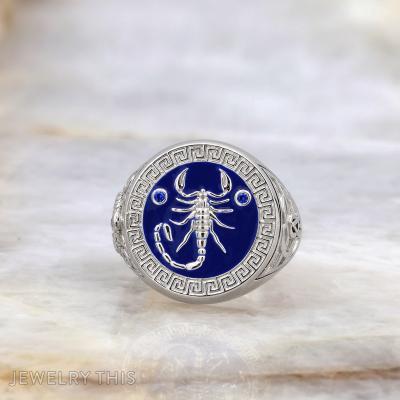
This men’s signet ring was designed to honor both a Greek heritage and an Irish ...

These rings represent exquisite pieces of personalized artistry. Crafted with precision, the initials “DK” come ...
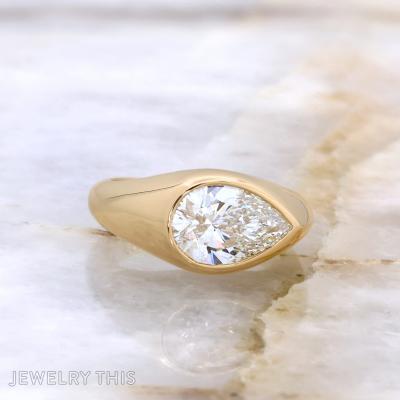
This ring centers a large pear-shaped lab diamond set sideways in a sculptural bezel of ...
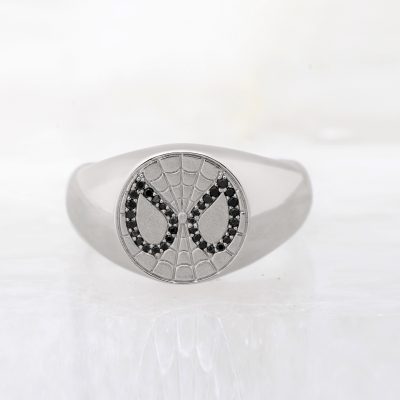
This Sterling Silver ring is perfect for the individual who wants to show off their ...

This sterling silver signet ring was customized to perfection. The top surface of the ring ...

This heartfelt custom signet ring is crafted in luminous 10K yellow gold. This special ring ...

This custom 14k yellow gold signet style ring is a beautiful replica of an original ...

This classic signet ring is crafted from Yellow gold and features a circular top which ...

This white gold signet-style ring exudes a powerful and regal presence. The ring’s flat oval ...


A pair of matching 14k yellow gold signet rings featuring a family crest that includes ...

Sterling silver men’s ring featuring an emblem logo of a firefighter as well as motorcycle ...