


Birthstone Mother's Ring — Sapphire, Family Accent Stones
$$$
14k white gold, sapphire, aquamarine, citrine, blue zircon, lab-grown alexandrite
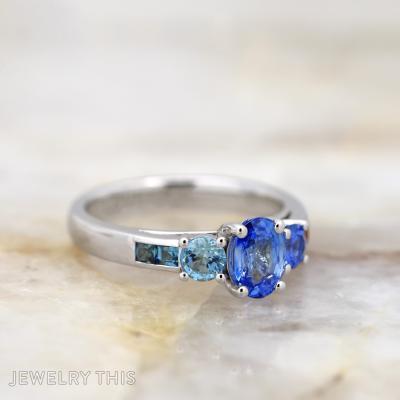
A client came to us wanting a mother's ring that didn't just represent his wife's children in a general way, but gave each child and grandchild their own specific birthstone in a specific position — an oval sapphire at the center, flanked by stones chosen one at a time for each family member. The design went through a few rounds of refinement, including switching the channel-set accent stones from rectangular to square after cutting constraints at that small size made rectangular impractical. The ring was inscribed inside the band with "LOVE" and an infinity symbol before it shipped in time for the holidays.
Quick specs
Primary Metal
Shape / Cut
Primary Stone
Accent Stones
Design Complexity
Intent: Certainty
Size
Ring size 6.5 US (16.92mm). Center stone approx 7x5mm oval; round side stones approx 3.5mm; channel-set square accent stones approx 2x2mm.
How they made it distinctive
-
01
Three-stone center section plus channel-set row lets every child and grandchild have a distinct, individually chosen birthstone position
-
02
Square channel-set accent stones chosen over rectangular after cutting constraints made rectangular impractical at the small sizes needed
-
03
Lab-grown alexandrite used in place of natural — visually and physically identical, but far more available at accent-stone size
-
04
Inside-band engraving of "LOVE" and an infinity symbol adds a private, personal detail not visible when worn
-
05
Center sapphire reviewed by video with the client before final setting to confirm its actual color against the render
How you'd make it yours
Stone count: this piece uses seven stones for a specific family size — a new commission could use more or fewer to match a different family
Center stone: this piece uses a sapphire — a new commission could use a diamond, ruby, or other colored stone as the center
Metal: this piece is 14k white gold — the same multi-stone structure works in yellow or rose gold
Setting style: this piece channel-sets the smaller accent stones — a new piece could use all prong settings for a different look
Engraving: the inside-band engraving can carry a different word, date, or symbol on a new piece
One of a kind: this exact ring was designed for one client's family and is not reproduced — a new commission is an original piece inspired by this one, not a copy
Design changes made
The channel-set accent stones were changed from rectangular to square after the client was shown both options — rectangular cuts weren't practically available at the small sizes needed for the grandchildren's stones, so square was adopted instead. The December birthstone was also switched from blue topaz to an imitation blue zircon after the topaz proved too difficult to source at the 2mm size, while keeping the same visual color and birthstone meaning.
Who this is for
This piece is for someone who wants every family member represented individually rather than blended into one generic birthstone cluster. It's especially right if you're working with a specific, countable group — children and grandchildren — and want each person to have their own defined place in the design.
How it's made
Once the design was approved from the photorealistic render, the ring moved into production: the center sapphire was selected and reviewed with the client by video before setting, and the piece was cast in 14k white gold from the finalized 3D model. After casting, the band was cleaned up and prepared for stone setting.
The oval center sapphire and the two round side stones (a sapphire and an aquamarine) were prong-set first, each with its own set of prongs sized to its stone. The four smaller square accent stones — citrine, blue zircon, lab-grown alexandrite, and aquamarine — were then channel-set in sequence along one side of the band, holding each birthstone securely without raised prongs. The inside of the band was engraved last with the word "LOVE" and an infinity symbol, and the piece received a final polish and rhodium plating before inspection.
Key note
The center sapphire was reviewed by video with the client before setting because its color came in slightly lighter than the original render — a sourcing-stage check that let the client confirm the actual stone rather than relying on the render alone.
Pricing guidance
A multi-stone white gold mother's ring with a three-stone center section and channel-set accent stones sits in the mid range for custom colored-stone rings of this complexity. Most of the cost comes from the number of individually sourced stones and the labor of setting seven stones in two different setting styles on one band. Stone choices and metal karat are what move the price most from there.
Moves price up ↑
- ↑ Increasing the number of accent stones beyond seven, for a larger family
- ↑ Using natural alexandrite instead of lab-grown — natural stones in small sizes are significantly harder to source
- ↑ Upgrading the center sapphire size or color saturation
- ↑ Switching to 18k white gold or platinum instead of 14k
- ↑ Adding diamonds alongside the colored birthstones for extra sparkle
Moves price down ↓
- ↓ Reducing the number of accent stones to represent fewer family members
- ↓ Using all round stones instead of mixing round and channel-set square cuts
- ↓ Choosing simulated or lab-created versions of the rarer birthstones
- ↓ Using sterling silver instead of 14k white gold
- ↓ Leaving the band without the inside engraving
Questions people ask
Yes, this is a common request for mother's and family rings. The key is structure — giving each stone its own defined setting position rather than scattering them randomly. In this design, a three-stone center section (one larger stone flanked by two smaller ones) transitions into a row of channel-set square stones along the band, so each birthstone has a clear spot without the ring looking busy.
Lab-grown alexandrite is chemically and physically identical to natural alexandrite — same color-change properties, same hardness, same optical behavior. The only difference is where it came from and the cost. Natural alexandrite is extremely rare, especially in the small sizes needed for accent stones, which makes it considerably harder to source and more expensive. Lab-grown is the practical choice for small accent stones without any visible difference.
Yes, blue topaz and blue zircon are both recognized as December birthstones and are used interchangeably in birthstone jewelry. At very small stone sizes, blue topaz can become difficult to source in certain cuts, and an imitation blue zircon can achieve the same color and birthstone meaning at that size. The visual difference at a few millimeters is negligible to the eye.
A ring with a three-stone center section plus several channel-set accent stones sits in the mid range for custom colored-stone jewelry, mainly because of the number of stones that need to be individually sourced and set. The cost is driven by stone count, the mix of setting styles, and metal choice rather than any one dominant factor. Simplifying the stone count or using simulated stones for rarer birthstones can bring the cost down.
After the design is approved, production for a ring with this many individually set stones typically runs four to six weeks, sometimes longer during high-demand periods like the holiday season when stone cutters are busiest. Sourcing several different colored stones in small, matching sizes can add time if any particular stone proves difficult to find. The process includes casting, cleanup, stone setting in two different styles, and final polishing.
Yes, the inside of a band can typically be engraved with a short word, phrase, or symbol as long as there's enough clear metal surface. On a multi-stone ring, the engraving is usually done as the final production step after stone setting is complete. Simple text and symbols like an infinity sign are straightforward for most jewelers to engrave cleanly.
White gold is a durable, popular choice for daily wear, especially in 14k, which balances hardness with workability. It's typically rhodium-plated to give it a bright white finish, and that plating will gradually wear with daily use and need reapplication over time, more quickly on high-contact areas. For a ring with multiple prong and channel settings, 14k white gold holds stones securely while remaining practical for everyday wear.
Yes, combining setting styles on one band is a common way to fit more stones into a structured design. In this case, round stones were used for the three-stone center section while smaller square stones were channel-set along the band for the additional accent stones. Mixing styles like this lets the design accommodate more family members' birthstones without each stone needing to be the same shape or size.
Explore Similar Creations
Every masterpiece starts with a spark. Explore how our clients raw ideas - sketches, heirlooms, inspirations - were transformed into bespoke works of arts.
This ring reimagines the traditional mother’s ring as a single sculptural rose rather than a ...

This ring brings together four birthstones in one asymmetric cluster: a large oval garnet and ...

This ring brings together three birthstones in a single woven design — a center amethyst ...

This wedding-style band is built around a three-row stone layout: two outer rows of round ...

This ring recreates a mother’s ring lost at sea, rebuilt as a multi-band coil that ...



