


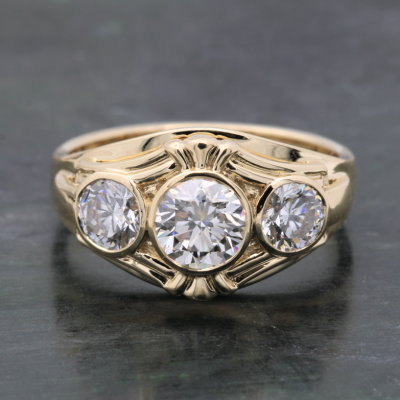


Three-Stone Bezel Diamond Ring in 14k Yellow Gold
$$$
14k yellow gold, lab-created diamonds
G. found a bezel-set diamond ring style she loved online and brought it to us as a starting point, asking to keep the shape but scale down the center stone and add two more diamonds beside it. She approved the sketch almost instantly — 'that's going to look gorgeous' — and when it arrived, she wrote simply that she loved it and never takes it off.
'That's going to look gorgeous!' — on seeing the first sketch
'I do love it! And you will be hearing back from me.' — on delivery
Quick specs
Design type
Primary Metal
Shape / Cut
Primary Stone
Accent Stones
Style
Design Complexity
Intent: Certainty
Size
Ring size 7 US. Center stone 0.82ct, total diamond weight approximately 1.52ct.
How they made it distinctive
-
01
Each of the three diamonds is fully bezel-set in its own individual rim of gold rather than sharing a single setting, giving a smooth, catch-free profile
-
02
Center stone intentionally sized down from the original inspiration piece to make room for two added accent diamonds within budget
-
03
Scalloped metalwork flanking the center stone echoes the architectural detail of the reference ring that inspired the design
-
04
Lab-created diamonds used throughout to reach a larger total carat weight at a lower cost than natural stones would allow
How you'd make it yours
Stone type: this piece uses lab-created diamonds — a new commission could use natural diamonds for the same look at higher cost, or a different stone like sapphire or moissanite
Metal: this piece is 14k yellow gold — the same bezel-and-scallop design language works well in white or rose gold
Center stone size: this piece uses a 0.82ct center — a new piece could use a larger or smaller stone depending on preference
Engraving: the inside of the band can carry a date, initials, or short phrase on a new piece
One of a kind: this exact ring was designed for one client and is not reproduced — a new commission is an original piece inspired by this one, not a copy
Design changes made
The center stone was sized down from the inspiration ring's near-one-carat stone to a 0.82ct center, with two round accent diamonds added on either side to keep the three-stone look at a lower overall cost. The ring size was also adjusted from 6¾ to 7 before production.
Who this is for
This piece is for someone who found a ring style they loved but wanted it reworked to fit their own stones and budget rather than buying it as-is. It's especially right if you want the protected, low-maintenance feel of bezel settings without giving up a multi-stone look.
How it's made
Once the sketch and 3D render were approved, the design was 3D-printed in wax and attached to a wax tree inside a flask. The flask was invested in plaster and fired in a kiln to burn out the wax, leaving a hollow mold, and molten 14k yellow gold was cast into that mold under pressure. After cooling, the raw ring was broken out of the mold and prepared for finishing. A wax model and resin preview were shared with the client before casting so she could see the piece take shape ahead of time.
After casting, the ring was cleaned and polished to a uniform high shine across the band and the scalloped metalwork framing the center stone. The three lab-created round diamonds — a 0.82ct center flanked by two smaller accents — were then set into individual bezels, each stone wrapped completely in a rim of gold rather than held by prongs, giving the finished ring a smooth, low-profile face.
Key note
The three diamonds are each fully bezel-set in their own individual rim of gold rather than sharing a single setting, which is why the center stone could be swapped to a smaller size without redesigning the flanking stones' settings.
Pricing guidance
A three-stone bezel-set ring in 14k yellow gold with lab-created diamonds sits in the mid range for custom engagement-style rings. Most of the cost comes from the diamond carat weight and the labor of hand-fabricating three individual bezel settings rather than a single prong setting. Metal karat and the choice between lab and natural stones are the biggest levers from there.
Moves price up ↑
- ↑ Upgrading from lab-created to natural diamonds of the same carat weight
- ↑ Increasing the center stone size beyond approximately 0.75–0.82 carats
- ↑ Adding more accent stones or extending stones further down the band
- ↑ Choosing platinum or 18k gold instead of 14k yellow gold
- ↑ Requesting higher clarity or color grades on the diamonds
Moves price down ↓
- ↓ Reducing the center stone size further
- ↓ Using a single accent diamond instead of two
- ↓ Choosing a thinner band profile to reduce metal weight
- ↓ Selecting a lower color or clarity grade on the lab diamonds
- ↓ Simplifying or removing the scalloped side metalwork
Questions people ask
Yes, bezel settings are one of the most durable options for daily wear because the metal wraps completely around the stone's girdle instead of relying on thin prongs. This protects the edges of the diamond from chips and snags, which is especially useful for anyone who works with their hands or simply doesn't want to worry about catching the ring on clothing or fabric. The tradeoff is that slightly less light enters the stone from the sides compared to a prong setting, though with a well-cut round diamond this is barely noticeable. Bezel settings also tend to require less maintenance over time since there are no prongs to check or re-tip.
Lab-created and natural diamonds are chemically and optically identical — both are pure carbon with the same hardness, sparkle, and durability. The only real difference is origin: natural diamonds form in the earth over billions of years, while lab-created diamonds are grown in a controlled environment in a matter of weeks. Lab-created diamonds typically cost significantly less than natural diamonds of the same carat, clarity, and color grade. For a three-stone ring like this, choosing lab-created stones makes it possible to get a larger total carat weight within the same budget.
A three-stone bezel-set ring in 14k yellow gold with lab-created diamonds in the three-quarter-carat total range sits in the mid price range for custom rings. The main cost drivers are the diamond carat weight and the labor required to hand-fabricate three separate bezel settings. Switching to natural diamonds or increasing the center stone size would push the price higher, while a smaller center stone or fewer accent stones would bring it down.
Yes, using a reference photo as a starting point is a common way to begin a custom design. The process typically starts with a sketch based on the reference image and your requested changes, followed by a 3D render for approval before anything is cast. You can keep elements you love from the original — stone shape, setting style — while changing size, stone count, or metal to fit your preferences and budget. The finished piece is inspired by the reference, not a direct reproduction of it.
A custom ring like this typically takes about five to six weeks from deposit to delivery on a standard timeline, with roughly one week for the design and sketch approval and four to five weeks for sourcing diamonds and production. Sourcing matched lab diamonds for a multi-stone design can add a few extra days if specific clarity or color grades are requested. You'll usually see a sketch first, then a photorealistic 3D render, and sometimes a resin preview of the physical model before the metal is cast. The ring is cast, cleaned, polished, and the stones are bezel-set in the final production stages.
Yes, ring size can usually be adjusted any time before the piece goes into production, since sizing is applied during the casting and finishing stages rather than being fixed at the design stage. Once a bezel-set ring like this has been cast and the stones are set, resizing becomes more limited because the bezels and scalloped detailing around the center stone are shaped specifically for that size. It's best to confirm your exact size before the final production step begins. A jeweler can usually advise on how many sizes up or down are safely possible after the fact.
Bezel settings are considered low-maintenance because there are no prongs that can bend, loosen, or need re-tipping over the years. The main thing to watch is the inside edge of the bezel, which can accumulate lotion or soap residue underneath the stone over time and may need an occasional professional cleaning. Polished yellow gold bezels can also pick up fine surface scratches with daily wear, which a jeweler can buff out during a routine polish. Overall, bezel-set rings tend to hold up well to active daily wear with minimal upkeep.
Explore Similar Creations
Every masterpiece starts with a spark. Explore how our clients raw ideas - sketches, heirlooms, inspirations - were transformed into bespoke works of arts.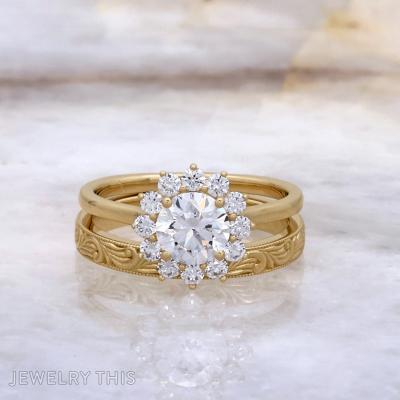
This exquisite 14K yellow gold wedding set seamlessly blends timeless romanticism with modern ethical luxury. ...

This engagement ring was recreated to resemble a vintage three-ring set from the early 1980s, ...
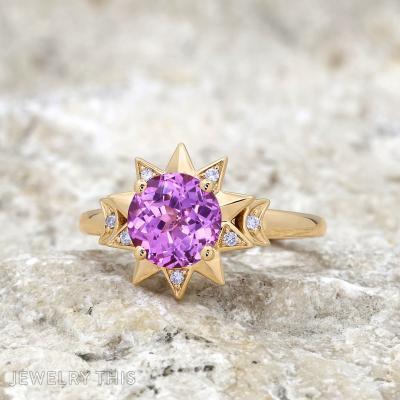
This enchanting 14K yellow gold engagement ring is a masterful celebration of celestial beauty and ...

This is a custom-designed travel ring created to replicate the client’s original engagement ring. The ...

This elegant white gold engagement ring features a stunning princess cut moissanite center stone. The ...

This white gold ring is a bold and captivating statement piece designed to allure and ...
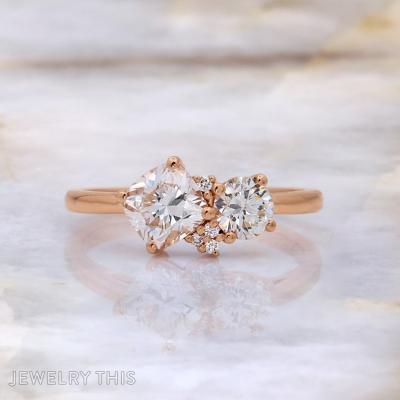
This ring reimagines two heirloom stones into a single two-stone, or toi et moi, design ...

Exuding both elegance and uniqueness, this 14k rose gold engagement ring is a captivating expression ...
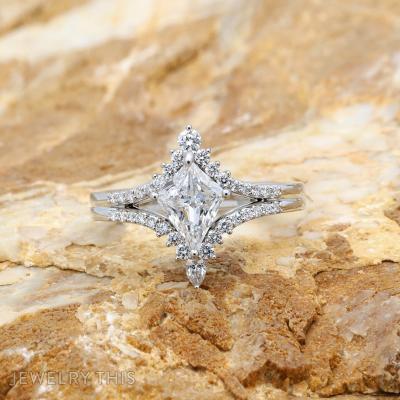
This striking white gold engagement ring features a kite-shaped lab-grown diamond as its bold center. ...

This sterling silver ring is timeless in style, exudes beauty and elegance. With its classic ...
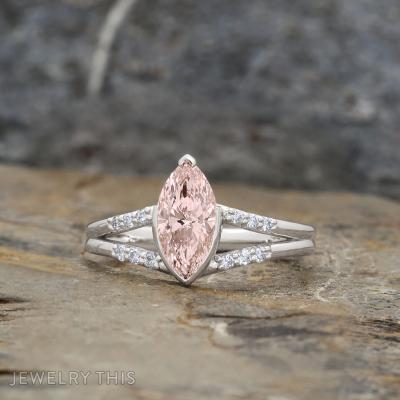
This elegant white gold engagement ring features a captivating pale pink marquise-shaped lab grown diamond ...
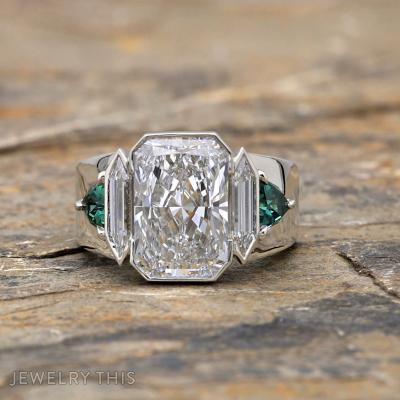
This engagement ring pairs a large elongated radiant center stone with a pair of custom ...



