


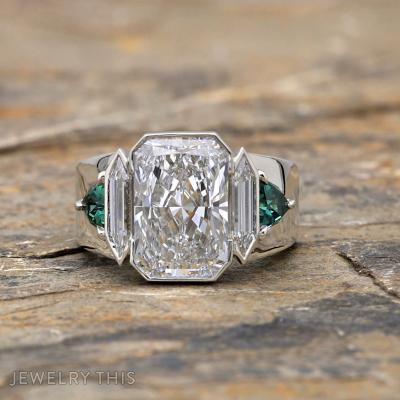


Geometric Platinum Engagement Ring with Sapphires & Diamond
$$$$
Platinum, lab diamond, natural sapphires, lab diamonds
A client came to us to build an engagement ring around a radiant diamond and a pair of teal sapphires he had personally sourced, after a prior jeweler relationship fell through. The design evolved significantly during production — a planned brilliant-cut hexagon side stone had to be re-engineered into a step cut after the cutter found the angles created visible windows, and a custom diamond had to be recut entirely after internal stressing was discovered mid-process. When it arrived, he wrote: 'This ring is absolutely gorgeous. I was overcome when I saw it. There's nothing else like this.'
'This ring is absolutely gorgeous. I was overcome when I saw it. There's nothing else like this. Thank you for your hard work.' — on delivery
Quick specs
Design type
Primary Metal
Shape / Cut
Primary Stone
Design Complexity
Intent: Certainty
Size
Ring size 4 US (14.88mm). Center stone 11.42x7.58x5.21mm. Custom hexagonal side stones approximately 8.5x2.5mm. Band tapers from approximately 9mm at center to 3mm at back.
How they made it distinctive
-
01
Custom hexagonal step-cut diamonds engineered mid-production after a brilliant cut proved unworkable for the elongated shape
-
02
Center stone half bezel flows directly into full bezels on the side hexagons, creating one continuous geometric wall
-
03
Teal sapphires personally sourced by the client and set with claw prongs shaped to a fine point after setting
-
04
Wide, dramatically tapered euro shank band designed specifically to prevent rotation on the finger
-
05
Open galleries beneath the side stones built in deliberately to keep the underside easy to clean
How you'd make it yours
Stone shape: this piece uses a radiant center with custom hexagonal step-cut side stones; a new commission could use a different elongated shape or a more standard emerald or baguette cut
Metal: this piece is platinum; the same angular, bezel-forward design language works well in 18k white gold at a lower weight
Setting style: this piece mixes bezel and claw-prong settings; a new piece could use bezels throughout or prongs throughout depending on the stones chosen
Band taper: this piece uses a dramatic taper from center to back; a new commission could use a more gradual or uniform width
Engraving: the inside of the band can carry a new inscription on a fresh commission
One of a kind: this exact ring was designed around one client's personally sourced stones and is not reproduced — a new commission is an original piece inspired by this one, not a copy
Design changes made
The hexagonal side stones were changed from a planned brilliant cut to a step (emerald-style) cut after the stone cutter found that the brilliant facets created large visible windows at the pointed ends of the elongated shape. The band taper and starting point were also revised twice after review of the render, moving the shank's origin to the tip of the hexagons and narrowing the back to 3mm for a sharper, more geometric line.
Who this is for
This piece is for someone who already knows exactly what they want and is willing to wait for the details to come together correctly, even when that means custom-cutting stones or re-engineering a shape mid-process. It's especially right for someone who wants an engagement ring with a sharp, geometric, deliberately masculine-leaning presence rather than a traditional soft or curved silhouette, and who has stones or design ideas they want built around rather than a piece chosen off a shelf.
How it's made
Once the design was finalized, a wax model was built and a resin print was shipped to the client to confirm fit and proportion before any metal was committed. The wax was then affixed to a tree, invested in plaster, and fired in a kiln to burn out the wax and leave a hollow mold. Molten platinum was cast into the mold, then the piece was extracted, cleaned, and polished ahead of stone setting.
The center radiant diamond was set in a half bezel that flows directly into full bezels on the two custom-cut hexagonal diamonds, creating one continuous geometric wall across the front of the ring. The two teal sapphires were set separately with claw prongs, shaped to a fine point after setting so they read as an afterthought beside the bezeled stones. Open galleries were left beneath the side stones specifically to keep the underside accessible for cleaning.
Key note
The hexagonal diamonds were switched from a brilliant to a step cut mid-production because the cutter determined that faceting such an elongated shape as brilliant would create large unsightly windows at the pointed ends.
Pricing guidance
A platinum three-stone engagement ring with custom-cut geometric side stones and client-sourced sapphires sits at the higher end for custom engagement work of this complexity. Most of the added cost comes from the platinum itself (denser and more labor-intensive to cast than gold) and the custom stone cutting required for the non-standard hexagonal shape. Bezel setting across multiple stones also adds meaningful hand-finishing time compared to a simple prong setting.
Moves price up ↑
- ↑ Custom-cutting side stones to a non-standard elongated shape rather than sourcing a stock cut
- ↑ Using platinum instead of white gold, which is heavier and more difficult to cast
- ↑ Bezel setting multiple stones instead of prong setting, which requires more hand-fabrication
- ↑ Sourcing a larger or higher-grade center stone
- ↑ Adding additional design iterations and 3D model revisions before final approval
Moves price down ↓
- ↓ Using a stock hexagonal or emerald-cut side stone instead of a custom order
- ↓ Switching from platinum to 14k or 18k white gold
- ↓ Using prong settings throughout instead of bezel walls
- ↓ Reducing the number of accent stones
- ↓ Choosing a standard rather than an elongated/unusual center stone shape
Questions people ask
Yes, mixing diamonds and sapphires in one setting is a common approach in custom engagement rings, and it works well as long as the stones are graded for comparable hardness and durability. Sapphires rate a 9 on the Mohs hardness scale, just below diamond's 10, so both hold up well to daily wear. The main consideration is color harmony — a jeweler will typically look at the sapphire's exact hue before finalizing metal and setting choices so the colors read well together. Bezel or prong settings both work for combination designs; the choice usually comes down to the stone shapes involved.
A step cut, like an emerald cut, uses long rectangular facets arranged in parallel rows, producing a hall-of-mirrors effect rather than intense sparkle. A brilliant cut uses triangular and kite-shaped facets designed to maximize light return and fire. Elongated or unusual shapes are sometimes cut as step cuts rather than brilliants because the facet angles needed for brilliance can create large flat 'windows' at narrow points of the stone. Both cuts are equally durable; the choice is purely aesthetic and shape-dependent.
Yes, many custom jewelers accept client-provided stones, though the process typically requires the stones to be shipped and physically inspected before final design work begins. Stone dimensions, cut, and condition are confirmed from the physical stone rather than assumed from photos, since exact measurements affect the setting design. Insured shipping with tracking is standard practice for valuable stones. Once received, the stones are usually scanned or measured so the 3D model can be built around their exact proportions.
Platinum has a much higher melting point than gold and is a denser, harder metal to work with, which generally makes casting and finishing take longer. A standard custom engagement ring build runs roughly five to six weeks from design approval to completion, but platinum pieces, especially with multiple bezel-set stones, often land on the longer end of that range or extend further. Complex, multi-stone platinum designs with custom-cut side stones can take considerably longer if a stone needs custom cutting or recutting. Timeline also depends on stone sourcing, since custom-cut stones typically add one to two weeks on their own.
A platinum three-stone ring with custom-cut geometric side stones and bezel setting throughout sits toward the higher end of custom engagement ring pricing. The dominant cost drivers are the platinum itself, which is heavier and more labor-intensive than gold, and the custom stone cutting needed for a non-standard shape. Bezel setting multiple stones by hand also adds labor cost compared to simple prong settings. Choosing gold instead of platinum, or using stock-cut stones instead of custom shapes, would bring the cost down meaningfully.
Bezel and prong settings are structurally different, so a true bezel will always show a continuous metal wall rather than individual claws. However, jewelers can shape and taper bezel walls to visually echo the angular lines of prongs, and separately, small claw-style prongs can be used on stones like trillions where a bezel isn't the chosen approach. In multi-stone designs, it's common to mix setting types deliberately — bezels on some stones, prongs on others — as long as the overall proportions are planned together in the 3D model. This mixed approach lets a designer balance security, cleanability, and a specific aesthetic across different stone shapes in the same piece.
The main strategy is leaving small open galleries or channels underneath and between bezel-set stones rather than fully enclosing the underside in metal. These openings let water, soap, and a soft brush reach the underside of each stone during normal cleaning, since a fully solid underside would trap oils and lotion residue with no way to remove them. Structural metal is still needed directly beneath a large center stone for support, but smaller side stones can often have more open space around them. This balance between structural integrity and cleanability is typically worked out during the 3D modeling stage before casting.
Yes, diamond cutters can custom-cut stones to specific non-standard dimensions, such as an elongated hexagon, though this requires sourcing from a specialized cutter rather than pulling from existing inventory. Custom cutting typically adds one to two weeks to a project timeline, and highly elongated ratios can be more difficult to execute well. Cutters may need to adjust the faceting style, for example switching from a brilliant to a step cut, if the extreme proportions of the shape would otherwise create unwanted optical windows. Lab-grown diamonds, like natural ones, can occasionally have internal stress that surfaces during cutting and requires starting over with a fresh stone.
Explore Similar Creations
Every masterpiece starts with a spark. Explore how our clients raw ideas - sketches, heirlooms, inspirations - were transformed into bespoke works of arts.
This white gold engagement ring celebrates timeless love and exquisite design. At its heart lies ...

This elegant rose gold engagement ring features a round brilliant-cut moissanite as its centerpiece. Surrounding ...


This Platinum ring is a symbol of life’s vibrant connections. At its heart, a 1 ...

This men’s wedding band is a bold and elegant statement of commitment. Crafted from black ...

This exquisite 14k white gold ring is adorned with a stunning center oval aquamarine stone, ...

This client came to us with her stunning engagement ring and requested a custom made ...

This 18karat yellow gold engagement ring exudes elegance and vintage charm. At the heart of ...

This exquisite wedding set consists of three rose gold rings that fit together seamlessly. The ...

For horror movie aficionados and fans of the macabre, this custom engagement ring is a ...

This exquisitely crafted 14K yellow gold wedding band is designed with a graceful V-shaped contour, ...

This enchanting engagement ring features a captivating pear-shaped purple sapphire at its center. The sapphire ...



