


Sapphire Bridal Set — Yellow Gold Ring & Curved Band
$$$
14k yellow gold, sapphire, natural diamonds
A. set out to design a bridal set around a sapphire he had personally sourced for his partner, working from a photo she had shown him of a ring style she loved. He had the stone shipped directly to the studio so the setting could be built to its exact dimensions, and refined small details over several rounds — keeping the prongs pointed, flattening the side profile, and adjusting the ring size — until the proportions felt right. When the finished set arrived he wrote: 'Love the set! Thank you.'
'Love the set! Thank you.' — on delivery
Quick specs
Design type
Primary Metal
Shape / Cut
Primary Stone
Accent Stones
Style
Design Complexity
Intent: Certainty
Size
Ring size 7 US (17.46mm). Center stone 7.8mm diameter round, 5.2mm depth. Engagement ring side stones 4mm (x2); wedding band stones: 3.5mm point stone (x1), 3mm (x2), 2.5mm (x6).
How they made it distinctive
-
01
Center sapphire was client-sourced and shipped in, then scanned so the setting was built to its exact 7.8mm diameter and 5.2mm depth
-
02
Wedding band contoured specifically to sit flush against the engagement ring's cluster side stones rather than using a generic straight band
-
03
Pointed prong detail preserved on both the center stone and the wedding band's single point stone at the client's specific request
-
04
Prongs and side pillars intentionally filed down and rounded after casting so the setting reads flush rather than cylindrical, matching the original reference photo
-
05
Diamond cluster placement mirrors a reference image the client's partner had chosen, rather than a standard three-stone layout
How you'd make it yours
Center stone: this piece uses a client-sourced sapphire; a new commission could use a lab sapphire, moissanite, or diamond center stone instead
Side stone shape: this piece uses round diamond clusters; a new commission could use the triple-marquise fan arrangement for a more dimensional look
Metal: this piece is 14k yellow gold; the same design language works in rose gold or white gold
Diamond grade: this piece uses VS1 clarity, F-G color; a new commission could specify a different clarity or color grade
Band contour: the flush-fit wedding band shape is built around this specific engagement ring and would be redesigned to match a different center ring
One of a kind: this exact bridal set was designed around one client's sapphire and ring size, and is not reproduced — a new commission is an original piece inspired by this one, not a copy
Design changes made
The client asked for the cylindrical side prongs to appear more flush against the band rather than standing out as pronounced pillars, and confirmed he wanted to keep the pointed-prong detail on both the center stone and the wedding band's single point stone. Ring size was also adjusted from 7.5 to 7 US during the design phase.
Who this is for
This set is for someone who already has a meaningful center stone in hand and wants a setting built specifically around it, not a generic mounting. It's especially suited to a couple who want their engagement ring and wedding band to function as one continuous design when worn together, rather than two separately purchased pieces.
How it's made
Once the design was approved, the jewelry was first modeled and 3D printed in wax, then attached to a wax tree and set into a flask. The flask was placed in a kiln to burn out the wax, leaving a hollow mold, and molten 14k yellow gold was cast into that mold to form the raw rings. After cooling, the pieces were removed from the mold and prepared for cleaning and finishing.
The cast rings were pre-polished before the diamonds were set into their clustered positions along the band and side stones, followed by the client-supplied sapphire being set last into its pointed prongs. The prongs were then filed and rounded at the bench to soften their profile, bringing down the more pronounced pillar look seen in the earlier render. A final polish and quality check completed the set before shipping.
Key note
The prongs seen as tall and cylindrical in the 3D render were intentionally filed down and rounded by hand at the bench after casting, since renders always show setting structures larger and more pronounced than they appear on the finished, polished piece.
Pricing guidance
A two-piece bridal set with a client-supplied center stone and clustered diamond accents on both rings falls in the mid-to-upper range for custom engagement sets of this complexity. Much of the cost comes from designing and fitting two rings to sit flush together, plus the labor of setting diamonds across multiple cluster positions rather than a single setting. Diamond quality and total carat weight across both rings are the next biggest cost drivers.
Moves price up ↑
- ↑ Upgrading all accent diamonds to a higher color and clarity grade beyond VS1/F-G
- ↑ Increasing the diamond sizes within the clusters on either ring
- ↑ Adding diamonds to the outer sides of the wedding band beyond the current cascade
- ↑ Choosing platinum instead of 14k yellow gold for both rings
- ↑ Replacing the round side stones with the triple-marquise fan detail originally considered
Moves price down ↓
- ↓ Using fewer accent diamonds in the wedding band cluster
- ↓ Selecting a lower diamond clarity grade such as SI1
- ↓ Simplifying the wedding band to a plain contoured band without the cascading cluster
- ↓ Using a smaller carat total weight across the accent stones
- ↓ Choosing 10k gold in place of 14k
Questions people ask
Yes, this is a common approach when a client has already sourced a specific center stone. The stone is shipped to the studio, received and scanned so the setting can be built to its exact dimensions, and then set into the finished ring once casting and polishing are complete. This ensures the prongs and setting fit the stone's actual size rather than a standard dimension. Insuring the shipment separately is recommended, since most carriers do not automatically insure jewelry-value packages.
The wedding band is custom-contoured to match the specific curve and stone placement of the engagement ring it's paired with, rather than being a generic straight band. This requires designing both rings together, using the same 3D model references, so the diamond clusters and metal contours align when worn stacked. A flush-fitting set like this cannot simply be bought separately off the shelf, since the fit depends on the exact engagement ring design.
3D renders are typically viewed at a zoomed-in scale that exaggerates small setting details like prong height and width. Once the piece is cast, the jeweler files and rounds the prongs by hand during the stone-setting stage, which reduces their visual bulk considerably. The same applies to side-profile structural elements like gallery pillars, which become far less noticeable at actual ring size and when viewed from the top while worn.
VS1 clarity means the diamond's inclusions are minor enough that they're difficult to see even under 10x magnification, and invisible to the naked eye. Moving to a higher clarity grade like VVS or flawless increases cost substantially but produces no visible difference in most ring settings, since the improvement is only detectable under a jeweler's loupe. For accent and side stones in particular, VS1 offers a clean, bright appearance without paying for a clarity level no one will ever see.
A bridal set combining an engagement ring and a custom-fitted wedding band, each with diamond accents, generally falls in the mid-to-upper range for custom work due to the dual-ring design and multiple stone-setting locations. The cost is driven primarily by diamond quality, total carat weight across both rings, and the labor required to make two rings fit together seamlessly. Using a client-provided center stone can reduce cost somewhat since the studio isn't sourcing that stone.
Production typically takes four to five weeks once the design is approved and any client-provided stones have been received. This includes wax modeling, casting, diamond setting, setting the center stone, polishing, and a final quality check before shipping. The design phase beforehand, including sketches and 3D renders for approval, can add another one to two weeks depending on how many rounds of revisions are needed.
Yes, this is a design option some clients consider, though a marquise fan arrangement on each side of the center stone creates a different visual effect than simple round side stones. One tradeoff to know about is that a marquise fan detail can prevent a companion wedding band from sitting as flush against the engagement ring as a round side-stone design allows. The choice generally comes down to prioritizing the fan's dimensional detail versus a flatter, more flush-fitting stacked look.
Yes, ring size can typically still be adjusted during the design phase before casting begins, since the 3D model can be resized without affecting the overall design. Once a ring is cast and the stones are set, resizing becomes more limited, particularly on rings with stones set close to the shank or a contoured band designed to fit flush against a companion ring. It's best to confirm sizing as early as possible in the process, ideally before the final 3D model is approved.
Explore Similar Creations
Every masterpiece starts with a spark. Explore how our clients raw ideas - sketches, heirlooms, inspirations - were transformed into bespoke works of arts.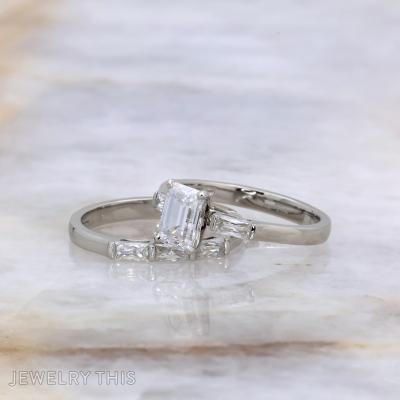
This exquisite platinum engagement ring and wedding band set features a stunning 1-carat emerald-cut moissanite ...

A contemporary masterpiece the Multi-Row Crossover Wedding Ring. A stunning symbol of love and commitment ...

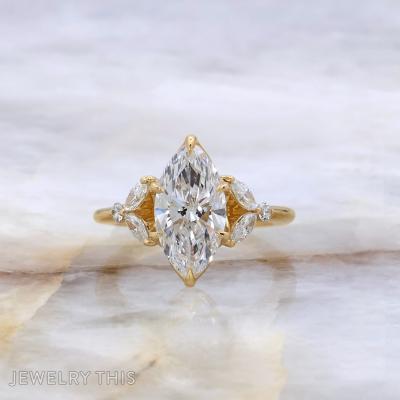
This stunning Yellow gold ring features a magnificent 1.5-carat marquise-shaped moissanite in the center. The ...

This stunning yellow gold wedding set features a unique engagement ring and matching wedding band ...

This custom engagement ring features a stunning three-stone design that beautifully highlights the uniqueness of ...

This engagement ring began as an upgrade project: the client’s existing 1.22ct lab-grown round diamond, ...

This elegant white gold ring features a timeless three-stone design centered around a brilliant 2.75 ...

This engagement ring is built around a twisting infinity-wave band in 14k yellow gold, with ...

Cat said Yes! This stunning 1.50ct round diamond six claw set in 18ct white gold ...

This enchanting ring is a celebration of two beloved worlds: Harry Potter and Disney. At ...
This breathtaking yellow gold engagement ring is a masterclass in asymmetrical, nature-inspired design. At its ...

Embrace the ethereal elegance of this custom engagement ring, a radiant tribute to love. Fashioned ...



