


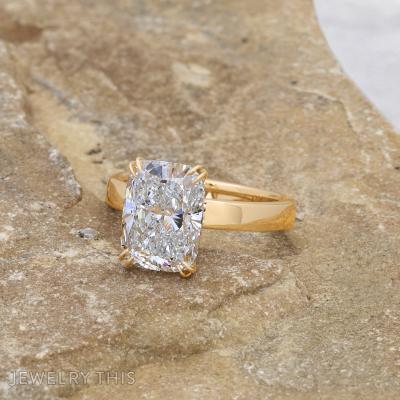


Low-Set Emerald-Cut Solitaire Engagement Ring
$$$
14k yellow gold, lab-grown diamond
A couple designed this engagement ring together after finding that pre-set online configurators didn't offer enough control over the details that mattered to them. E. knew she wanted a low-profile emerald-cut solitaire with a flatter, angled band and double prongs at each corner — details she'd gathered from reference photos. After approving the design and trying on a resin model for fit, T. took over to finalize the stone and complete the order. When the ring arrived, he wrote: 'It's perfect!! I know she's going to love it!' Months later, he returned with the news: she said yes.
'I love it!! I'm a very happy with this design and would like to move forward in the process' — on seeing the first render
'I received my resin model ring and I love it!!! I don't think I would change anything about it!' — on trying the resin model
'It's perfect!! Thank you so much it has been amazing working with you and this process! I know she's going to love it!' — on delivery
Quick specs
Design type
Primary Metal
Shape / Cut
Primary Stone
Accent Stones
Style
Design Complexity
Intent: Certainty
Size
Ring size 4¾ US (15.49mm). Band width 2.5mm. Center stone 1.80ct emerald cut.
How they made it distinctive
-
01
Double-claw corner prongs chosen specifically for the emerald cut — protects the stone's vulnerable pointed corners while adding a refined detail
-
02
Flat, angled band profile selected over rounded edges for a modern, architectural look that departs from typical solitaire styling
-
03
Low-set stone height specifically prioritized because the wearer works in the medical field and needs a reduced profile for daily tasks
-
04
1.80ct lab-grown diamond chosen to balance size preference with cost, landing precisely between the client's stated 1.5–2ct range
-
05
Resin model requested and tried on before casting to confirm the carat size and proportions felt right on the hand
How you'd make it yours
Stone cut: this piece uses an emerald cut; a new commission could use a radiant, cushion, or oval cut for a similar elongated silhouette with different light performance
Stone type: this piece uses a lab-grown diamond; a new commission could use a natural diamond or moissanite for a similar colorless look
Metal: this piece is 14k yellow gold; the same flat-band, double-prong design works equally well in white or rose gold
Band width: this piece uses a 2.5mm band; a new commission could go narrower for a more delicate feel or wider for a bolder statement
Prong style: this piece uses double-claw corner prongs; a new commission could use single prongs or a more decorative split-prong detail
One of a kind: this exact ring was designed for one client and is not reproduced — a new commission is an original piece inspired by this one, not a copy
Design changes made
Design matched the initial brief without major changes. The client refined the carat weight from a range of 1.5–2ct down to 1.75ct using a proportion visual, and the final stone settled at 1.80ct during sourcing — a sourcing refinement rather than a design change.
Who this is for
This piece is for someone who knows precisely what they want and found that pre-built online configurators didn't offer enough control over the details. It's especially right for someone who needs a lower-profile setting for hands-on daily work, and who prefers clean architectural lines — flat edges, minimal embellishment — over a more traditional rounded or heavily detailed solitaire.
How it's made
Once the design was approved and the center stone proportions confirmed, a 3D-printed resin model was produced and shipped to the client to try on before any metal was committed — confirming fit and proportion at the 1.75–1.80 carat size. After approval, a wax model was 3D printed and attached to a tree, invested in plaster, and fired in a kiln to burn out the wax and leave a hollow mold. Molten 14k yellow gold was then cast into the mold under pressure to form the raw ring.
After casting, the ring was cleaned, polished to a high shine across the flat, angled band, and finished with crisp edges rather than rounded ones to preserve the architectural look. The emerald-cut lab diamond was then set using double-claw prongs at each corner, a setting chosen specifically to secure the cut's pointed corners while keeping the stone sitting low and close to the finger.
Key note
The double-claw corner prongs are not purely decorative — they're the traditional way to protect an emerald cut's vulnerable corner points, which are the most chip-prone part of the stone.
Pricing guidance
A solitaire engagement ring with a 1.5–2ct lab-grown emerald-cut diamond in 14k gold sits in the mid range for engagement rings of this carat size. Most of the cost comes from the diamond itself rather than the setting, since the band design here is a simple flat profile without accent stones. Diamond color, clarity, and carat weight are what move the price most from there.
Moves price up ↑
- ↑ Choosing a higher clarity grade (VVS2 or better) at the same carat weight
- ↑ Increasing carat weight beyond 1.8ct
- ↑ Switching from a lab-grown to a natural diamond of the same size and quality
- ↑ Upgrading from 14k to 18k gold
- ↑ Adding pavé or accent diamonds along the band or under the halo
Moves price down ↓
- ↓ Reducing carat weight toward the lower end of the 1.5–2ct range
- ↓ Choosing a slightly lower clarity grade (VS2 or SI1) that still appears eye-clean
- ↓ Using 10k gold instead of 14k
- ↓ Simplifying the prong style from double-claw to a single standard prong
- ↓ Choosing a smaller or thinner band width
Questions people ask
Lab-grown and natural diamonds are chemically, physically, and optically identical — both score a 10 on the Mohs hardness scale and have the same fire and brilliance. The only real differences are origin and price, with lab-grown diamonds typically costing significantly less for the same carat weight, color, and clarity. Both require the same care and are equally durable for daily wear. The choice generally comes down to personal preference and budget rather than quality.
A double-claw prong uses two small prongs at each corner instead of one wider prong, cradling the emerald cut's pointed corners from both sides. Emerald cuts have exposed, angular corners that are more vulnerable to chipping than rounded cuts, so this prong style offers extra protection at the most fragile points. It also tends to read as a slightly more refined, vintage-inspired detail compared to a single corner prong. This setting style is common on emerald and other step-cut stones for exactly this reason.
The height of the stone above the finger is primarily determined by the diamond's depth, which is in turn a function of its carat weight and cut proportions — a larger stone will always sit somewhat higher than a smaller one of the same shape. A setting can be designed to minimize the metal added above the stone's natural depth, bringing the overall height as low as the stone allows. For someone who needs a lower profile for work or daily tasks, this is usually the main lever available, since the stone's own depth sets the floor.
A solitaire engagement ring in this carat range with a lab-grown emerald-cut diamond in 14k gold sits in the mid range for rings of this size. The diamond itself accounts for most of the cost, with color and clarity grade shifting the price meaningfully even at the same carat weight. A simple band design without accent stones or a halo keeps labor costs on the lower end relative to more elaborate settings.
The full process from approved design to finished ring typically takes about five to six weeks. The first week covers the 3D render and client approval, followed by a resin model shipped to the client to confirm fit and proportion before any metal is cast. Once the design and stone are finalized and approved, production — casting, finishing, and stone setting — takes roughly four to five weeks. Sourcing a specific diamond by color and clarity grade can add a few days if a particular combination isn't immediately available.
Yes, band width and profile are some of the most flexible elements of a solitaire design. This ring uses a 2.5mm flat band with angled rather than rounded edges, but the same emerald-cut-and-double-prong design language works with a narrower or wider band, or a more traditional rounded profile. Changing the band width slightly affects how substantial the ring feels on the hand without altering the stone or setting style.
Yes, a 3D-printed resin model can be shipped so you can try on the exact size and proportions of your ring before any metal is committed. This step is especially useful when deciding between carat weights, since a model lets you see and feel the difference on your own hand rather than relying on a visual rendering alone. If anything feels off after trying it on, adjustments can still be made before casting begins. This step typically adds about a week to the overall timeline.
Yes, emerald cuts have large, open step-cut facets and a flat table that make inclusions and color more visible than in a round brilliant, which hides flaws better through its many small facets. This is why clarity grade matters more for an emerald cut — a VS2 or better grade is generally recommended to avoid visible inclusions. Color grade is similarly more noticeable in an emerald cut's open facets, which is why many buyers choose a higher color grade like D or E for this shape.
Explore Similar Creations
Every masterpiece starts with a spark. Explore how our clients raw ideas - sketches, heirlooms, inspirations - were transformed into bespoke works of arts.
This ethereal engagement ring is a masterpiece of gothic-inspired botanical design, meticulously crafted from white ...

Introducing this Nature Lover’s Engagement Ring. The ultimate dream engagement ring for nature lovers. Crafted ...

Embrace the ethereal elegance of this custom engagement ring, a radiant tribute to love. Fashioned ...

This custom engagement ring exudes elegance and sophistication with its unique design. At its center ...
This unique gold ring was inspired by the delicate artistry of uni sushi, transforming a ...

This captivating yellow gold engagement ring features a stunning pear-shaped diamond as its centerpiece. The ...

This modern 14k rose gold ring features a unique wrapping design that splits at the ...

This elegant 18karat gold engagement ring features a mesmerizing oval shaped 2.5carat Aquamarine at the ...
This engagement ring pairs a round moissanite center stone with a slim 14k white gold ...

This ring recreates a cherished original: a large oval center stone flanked by two pear-shaped ...

This timeless three stone engagement ring is crafted in 14k white gold and features a ...
This ring reimagines two heirloom stones into a single two-stone, or toi et moi, design ...



