


Amethyst Three-Stone Anniversary Ring in Gold
$
Gold-plated sterling silver, amethyst, cubic zirconia
A client came to us wanting to mark his one-year anniversary with a promise ring for his partner, built around her February birthstone. He referenced a ring style she loved with stones running down the band, and the design was adjusted along the way to fit his goals — landing on a single amethyst center stone with one clear accent stone on each side. When it arrived, he wrote that she absolutely loved it.
'That is so great thank u very very much' — on production update
'I love ittttt thanknu guys so so muchhh' — on seeing the final render with accent stones
'Thank u so so much it was a great experience and she absolutely loves the ring thank you guys so much' — on delivery
Quick specs
Design type
Primary Metal
Shape / Cut
Primary Stone
Accent Stones
Style
Design Complexity
Intent: Certainty
Size
Ring size 7 US (17.32mm).
How they made it distinctive
-
01
Amethyst chosen specifically as February's birthstone to mark the couple's anniversary month connection
-
02
Oval cut selected to match a reference photo the recipient had already expressed love for
-
03
Accent stones added late in the process, adjusted from a full row down to one per side to fit the budget
-
04
Gold-plated sterling silver chosen deliberately to keep the piece affordable while still achieving a gold look
How you'd make it yours
Stone: this piece uses amethyst; a new commission could use any other birthstone or a colored sapphire for a similar look
Metal: this piece is gold-plated sterling silver; the same design works in solid 14k gold or sterling silver with rhodium plating
Accent stones: this piece has one clear CZ per side; a new piece could add more stones running further down the band, or use lab diamonds
Setting: the four-prong center setting is integral to how the oval stone is shown off and would carry over to a new commission
One of a kind: this exact ring was designed for one couple's anniversary and is not reproduced — a new commission is an original piece inspired by this one, not a copy
Design changes made
The design moved from a full row of side stones to no accent stones, then settled on one small round clear stone per side — each adjustment made to keep the design within the client's target range while still capturing the sparkle he wanted.
Who this is for
This piece is for someone who wants to give a meaningful birthstone ring without an elaborate budget — someone celebrating a relationship milestone who wants the piece to carry personal significance through the stone choice itself. It's especially right for a first custom piece, where simplicity and sentiment matter more than size or stone count.
How it's made
Once the design was approved, a wax model of the ring was produced using a 3D printer. This model was attached to a wax tree, set inside a flask, and placed in a kiln, where the wax was burned out to leave a hollow mold. Molten gold-plated sterling silver was then cast into the mold, cooled, and the raw ring was removed for finishing.
After casting, the band was cleaned and polished to a bright finish. The oval amethyst was set into a four-prong setting at the center, positioned to show maximum color through the top facet. The two small round accent stones were then set into simple prong mounts on either side of the center stone, added as a late-stage design adjustment before the piece moved to final polishing and gold plating.
Key note
The accent stones were added to the design after the center stone setting was already planned, meaning the side prongs were sized and placed during the finishing stage rather than in the original wax model.
Pricing guidance
A simple amethyst ring in gold-plated sterling silver with two small accent stones sits at the lower end of custom pricing for this category. The baseline cost comes from the metal type, the center stone, and the labor for a straightforward three-stone setting. Adding more or larger accent stones, or upgrading the base metal, is where the price moves up from there.
Moves price up ↑
- ↑ Upgrading from gold-plated sterling silver to solid 14k gold
- ↑ Adding accent stones that run halfway down the band instead of just one per side
- ↑ Choosing a larger center amethyst or a higher-clarity stone
- ↑ Switching the accent stones to natural diamonds instead of CZ
- ↑ Adding a milgrain or engraved detail to the band
Moves price down ↓
- ↓ Removing the accent stones entirely and keeping a solitaire setting
- ↓ Choosing a smaller center stone
- ↓ Using a more common stone shape like round instead of oval
- ↓ Simplifying the prong setting to a lower-profile style
- ↓ Choosing a plain polished band with no texture
Questions people ask
Amethyst rates a 7 on the Mohs hardness scale, which makes it reasonably durable for regular wear but softer than sapphire or diamond. It can handle daily activities like typing or light housework, but it's best to remove it before heavy manual labor, swimming, or contact sports. Amethyst can also fade slightly with prolonged sun exposure, so it's worth avoiding leaving it on a sunny windowsill. With normal care, a well-set amethyst ring holds up well for years of regular wear.
Gold-plated sterling silver is a silver base with a thin layer of real gold applied to the surface, while solid gold is gold throughout. The plating gives the look of gold at a lower cost, but it will gradually wear thin with daily wear, especially at points of friction like the underside of a ring. Most gold plating lasts one to two years before it needs to be reapplied, depending on how often the piece is worn. Solid gold never needs replating and will look consistent for the life of the piece.
Yes, this is a common design — a colored birthstone as the center stone flanked by one or two smaller clear accent stones, typically cubic zirconia or diamond. The accent stones add sparkle and contrast without overwhelming the center stone's color. This setup works well in a classic three-stone or five-stone layout depending on how many accents are added. It's a flexible design that can be adjusted in stone count, size, and metal to fit different budgets.
A three-stone ring with a birthstone center and two small clear accents in gold-plated sterling silver sits toward the lower end of the pricing range for custom jewelry. The main cost drivers are the metal choice, the center stone size, and the number and type of accent stones. Moving to solid gold or upgrading the accents to natural diamonds pushes the price up from there. This style is often chosen specifically because it balances a meaningful center stone with a manageable overall cost.
The design phase typically takes about a week, during which a sketch and 3D render are created and refined based on feedback. Once the design is approved, production takes roughly three to four weeks to complete, including casting, stone setting, and finishing. Adding accent stones partway through the process, as happened with this ring, can add a small amount of time without significantly extending the overall timeline. Most custom rings like this are completed within four to six weeks from deposit to shipping.
In many cases, yes — if the accent stones are set in simple prong mounts, a jeweler can remove the CZ stones and reset natural or lab diamonds of a similar size without redesigning the ring. The feasibility depends on the exact setting style and stone dimensions, so it's worth having the ring inspected before attempting a swap. This is a common upgrade path for clients who started with a more budget-friendly option and want to upgrade later. It won't change the ring's overall design, just the material of the side stones.
Amethyst is the traditional birthstone for February, known for its purple color that ranges from pale lilac to deep violet. It's a popular choice for birthstone jewelry because it's widely available, relatively affordable compared to many colored gemstones, and durable enough for regular wear. Amethyst gets its purple color from iron impurities and irradiation within quartz crystal formations. It's commonly used as a center stone in rings because its color reads clearly even at moderate carat sizes.
A simple band like this one can typically be resized within a range of one to two sizes up or down without issue, since the design doesn't include stones set all the way around the band. Because the accent stones sit only at the very top near the center stone, most standard resizing work can be done without disturbing the stone settings. Larger resizing adjustments may require more significant rework and should be discussed with a jeweler beforehand. It's best to confirm your size as accurately as possible before production to avoid needing a resize.
Explore Similar Creations
Every masterpiece starts with a spark. Explore how our clients raw ideas - sketches, heirlooms, inspirations - were transformed into bespoke works of arts.
This exquisite custom ring beautifully reimagines a cherished vintage design in 14k white gold, featuring ...

This white gold ring is nothing short of a masterpiece, showcasing a captivating lab-grown ruby ...

This yellow gold boasts a captivating pairing of colors. Adorned with small round yellow sapphire ...

This custom ring, crafted from gold-plated sterling silver, is a unique blend of artistry and ...

A one-of-a-kind 14k white gold three stone engagement ring. The center stone is a faceted ...
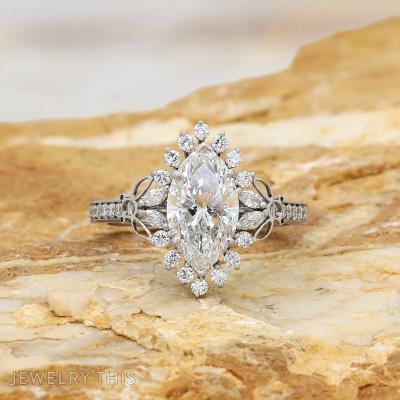
This engagement ring centers a marquise-cut lab diamond, colorless and just under two carats, surrounded ...

This wide 14k white gold band translates a favorite piece of pop-culture design into a ...

Custom made 14k white gold wedding ring featuring bezel set black onyx. Outer surface of ...

This elegant 18karat gold engagement ring features a mesmerizing oval shaped 2.5carat Aquamarine at the ...

This custom ring features a stunning wave design, symbolizing the ups and downs of life, ...

This custom wedding band is a sentimental recreation of the original ring, bringing back cherished ...

This elegant three-stone engagement ring features a classic design. A dazzling round diamond sits at ...



