

Two-Tone Silver Coin Pendant With Gold Geometric Crest
$
Sterling silver, gold plating
He wanted a specific coin-style emblem recreated as a pendant he could wear every day — a piece he described as the first and only jewelry he'd own besides his wedding ring. He worked with the team through a few rounds of chain options before landing on a thicker silver box chain strong enough for daily life. When it arrived, he wrote: 'I got my order today, and I love it. Thank you so much.'
'I love it thank you' — on seeing the first render
'I got my order today, and I love it. Thank you so much' — on delivery
Quick specs
Design type
Primary Metal
Secondary Metal
Primary Stone
Accent Stones
Style
Design Complexity
Intent: Certainty
Size
Pendant approximately 1in diameter; chain 3.1mm rounded box chain, 24in.
How they made it distinctive
-
01
Two-tone silver and gold-plated finish chosen specifically to match a reference emblem the client wanted preserved
-
02
Thicker 3.1mm box chain selected over a thinner option after the client explained he needed something durable for daily wear
-
03
Sterling silver base chosen for its hypoallergenic properties after the client described reacting badly to lower-quality metals
-
04
Raised lettering wraps the full outer border on both sides of the coin-style design
-
05
This is one of only two pieces of jewelry the client owns, giving the design added personal significance
How you'd make it yours
Metal: this piece is sterling silver with gold-plated accents; a new commission could use solid 14k gold for permanent two-tone color
Chain: this piece uses a 3.1mm box chain; a new piece could use a bead, curb, or figaro chain instead
Size: this piece is about one inch across; a new commission could be made larger or smaller
Engraving: the back of the pendant can carry a new inscription on a fresh commission
One of a kind: this exact pendant was designed for one client and is not reproduced — a new commission is an original piece inspired by this one, not a copy
Design changes made
The chain was upgraded from a thinner 1.8mm box chain to a sturdier 3.1mm version after the client noted he needed something strong enough for daily wear and that thinner options felt too delicate for his lifestyle.
Who this is for
This piece is for someone who wants a specific emblem or symbol turned into a wearable keepsake rather than a generic pendant off a shelf. It's especially right if you're hard on your jewelry day to day and need something sturdy enough to hold up, or if you have sensitive skin and need a hypoallergenic metal you can trust to wear constantly.
How it's made
Once the client approved the 3D render, the design was 3D-printed in wax and attached to a wax tree inside a flask. The flask was fired in a kiln to burn out the wax, leaving a hollow mold, and molten sterling silver was cast into that cavity under pressure to form the raw pendant. After cooling, the piece was removed from the mold and prepared for finishing.
The cast pendant was pre-polished first, then given a final high polish across the silver surfaces before the center emblem received its gold plating. Plating was applied after all polishing steps were complete so the finish would not be disturbed by further buffing. The piece then passed through quality control before the box chain was attached and the completed pendant was shipped.
Key note
The gold plating is applied only after the silver surfaces are fully polished, since plating is a delicate final layer that mechanical polishing would otherwise damage.
Pricing guidance
A two-tone sterling silver coin pendant with gold-plated detailing at roughly an inch across sits toward the lower end of custom pendant pricing. Most of the cost comes from the two-sided raised lettering and the dimensional center emblem, plus the gold plating step itself. Chain choice is a separate cost driver that can move the total up or down independently of the pendant itself.
Moves price up ↑
- ↑ Upgrading from gold-plated silver to solid 14k gold accents for a permanent two-tone finish
- ↑ Choosing a thicker or longer chain, such as a heavier box or Cuban-style chain
- ↑ Increasing the pendant diameter beyond one inch for more surface detail
- ↑ Adding engraving to the back of the pendant
- ↑ Using a double-sided design with raised lettering on both faces
Moves price down ↓
- ↓ Reducing the pendant to a single-tone finish rather than two-tone
- ↓ Choosing a thinner, lighter chain
- ↓ Simplifying the center emblem to a flatter, less dimensional design
- ↓ Selecting a shorter chain length
- ↓ Omitting the gold-plated accents entirely for an all-silver piece
Questions people ask
Yes, gold plating is a thin surface layer applied over sterling silver, and it will gradually wear with daily contact, especially on raised or high-touch areas. Most gold-plated pieces hold their finish well for one to two years of regular wear before replating is worth considering. The silver base underneath remains structurally sound even after the plating fades. Replating is a standard jewelry service available from most jewelers when the time comes.
Sterling silver is one of the more hypoallergenic metal options available, which is why it's commonly chosen by people who react to lower-quality alloys or costume jewelry. It is not completely allergen-free for everyone, but most people who break out from cheaper metals do fine with .925 sterling silver. If you have a known silver sensitivity specifically, platinum would be a safer alternative, though it comes at a higher cost. For most metal-sensitive wearers, sterling silver is the practical hypoallergenic choice.
A sterling silver pendant with gold-plated detailing at around an inch in diameter sits toward the lower end of custom pendant pricing. The cost is driven mainly by the complexity of the design — raised lettering, a dimensional center emblem, and the gold plating step all add labor. Chain selection is priced separately and can shift the total depending on thickness, length, and material.
The process typically starts with about a week to produce a 3D render based on the reference image and description provided. Once the design is approved, production — including casting, polishing, and plating — generally takes four to five weeks. The full timeline from first approval to shipping is usually around five to six weeks total. Chain sourcing happens in parallel and does not typically add extra time.
A box chain is made of small interlocking square links, giving it a solid, substantial feel that resists kinking and holds up well to daily wear. A bead chain is made of small connected spheres, which gives a slightly more casual, rounded look and tends to be a bit more flexible. For someone who is rough on their jewelry or wants something sturdier, a thicker box chain generally holds up better over time than a thinner bead chain. Both are available in sterling silver and can be sized to the same lengths.
Yes, a flat or dimensional logo or emblem from a reference photo can be translated into a 3D pendant design. The team builds a 3D render first so you can review proportions, lettering placement, and metal color before anything is cast. Fine details like small raised letters or interlocking line work can generally be reproduced, though exact fidelity depends on the clarity of the original reference image. This approach works for personal symbols, organizational emblems, and other graphic references.
Yes, chain length is typically offered in common sizes like 20, 24, and 30 inches, and can usually be adjusted to a specific preference. A longer chain, such as 24 to 30 inches, lets the pendant sit lower on the chest, while shorter lengths sit higher and closer to the collarbone. The chain is selected and priced separately from the pendant itself, so length changes do not affect the pendant design. It's worth trying on a similar length chain beforehand if you're unsure what will feel right.
A two-tone piece like this combines a sterling silver base with gold-plated accents, so care involves managing two different surfaces. The silver portions can be polished with a standard silver polishing cloth, while the gold-plated areas should be cleaned more gently to avoid accelerating wear on the plating. Avoiding harsh chemicals, chlorine, and excessive friction on the gold areas will help the plating last longer. Occasional professional cleaning can help maintain the contrast between the two finishes.
Explore Similar Creations
Every masterpiece starts with a spark. Explore how our clients raw ideas - sketches, heirlooms, inspirations - were transformed into bespoke works of arts.
This custom pendant features a unique diamond-shaped design with an intricate cut-out cloud motif at ...
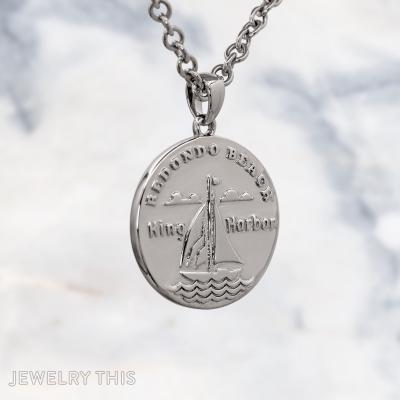
Crafted in luminous 10K white gold, this 25 mm double-sided pendant captures the essence of ...

Crafted with meticulous attention to detail, this custom pendant is a true testament to elegance ...

This pendant is inspired by a captivating historical artifact. Crafted with meticulous attention to detail, ...

14k white gold pendant featuring symbols to represent religions of the world. Personal initial in ...

This oval-shaped marvel commemorates the journey of engagement. At its core lies a captivating tableau: ...

This custom jewelry pendant features a captivating Celtic knot design. Meticulously crafted in glowing 10k ...

Indulge in a distinctive piece with this 3D miniature whiskey bottle pendant, a masterful creation ...


Unlock the mystery of elegance with this captivating custom pendant. Skillfully crafted in sterling silver, ...


This pendant reproduces a police department’s badge in 14k yellow gold, with the shield, eagle, ...



