

Personalized Gold Inverted Cross Pendant with Engraving
$$$
14k yellow gold
A repeat client returned for a second pendant — a simple inverted cross meant to hang from a gold chain he already owned. Getting the proportions right against that specific chain took real back-and-forth: bail size, arm thickness, and overall height were all adjusted more than once after he tried the piece on in hand. When the final version arrived properly fitted, he wrote: "I got it and it's super perfect. Thank you again for your patience and persistence on this one!!"
'The cross is perfect.' — on seeing the first render
"I got it and it's super perfect. Thank you again for your patience and persistence on this one!!" — on delivery
Quick specs
Design type
Primary Metal
Primary Stone
Accent Stones
Design Complexity
Intent: Certainty
Size
Cross height approximately 19mm (3/4 inch); arm width and depth approximately 2mm. Bail sized to fit 3.5mm chain.
How they made it distinctive
-
01
Bail custom-shaped and sized to slide onto the client's own existing chain rather than a generic standard chain
-
02
Edge treatment intentionally softened rather than sharp-cornered or fully rounded, for an organic rather than machined look
-
03
Cross proportions (height, arm width, and depth) refined over several rounds specifically to look balanced against this client's chain thickness
-
04
Vertical engraving placed along one arm for a personal detail that reads as intentional rather than decorative
-
05
Sized using a resin model the client could physically test against his own chain before final casting
How you'd make it yours
Metal: this piece is 14k yellow gold — the same design works in 18k yellow gold, white gold, or rose gold
Edge treatment: this piece uses softened organic edges — a new commission could use sharp square edges or fully rounded edges instead
Engraving: this piece carries a short vertical name engraving on one arm — a new piece could carry a date, initial, or short word instead, or omit engraving entirely
Bail style: this piece uses a compact squared bail sized to a specific chain — a new commission could use a standard round bail or a different custom shape
Orientation: this piece is an inverted cross — the same proportions and edge treatment work equally well for an upright cross
One of a kind: this exact pendant was sized and finished specifically for one client's chain and is not reproduced — a new commission is an original piece inspired by this one, not a copy
Design changes made
The bail was reduced from the original larger design to a smaller, squared shape that better matched the scale of the cross, and the cross itself was sized up in height, width, and arm thickness after the first piece read as too slender against the client's chain. The engraving orientation was also finalized as vertical text down the shorter arm rather than horizontal.
Who this is for
This piece is for someone who already owns a chain they love and wants a pendant that looks like it was made for it specifically, not just placed on it. It suits a person who thinks in millimeters — who will look at a render, hold up a coin for scale, and ask for another round of adjustment until the proportions feel exactly right, and who values that precision more than getting the piece quickly.
How it's made
Once the design was approved, a 3D-printed resin model was produced first — a preview the client could see and, in this case, physically try on before any metal was cast. The resin was then used to create an investment mold, which was fired in a kiln to burn out the pattern, leaving a hollow cavity that molten 14k yellow gold was cast into under heat. After cooling, the piece was removed from the mold and cleaned of investment material before finishing began.
The cast cross was hand-finished to soften its edges into the organic, not-quite-square, not-quite-round profile the client wanted, avoiding a crisp machined look. The vertical engraving was added to the back of one arm after the main shaping was complete, and the piece was polished to its final shine. The bail was fabricated and attached separately, sized specifically to the client's own chain.
Key note
A visible porosity flaw discovered after polishing led to a full re-casting of this piece rather than an attempt to patch or fill the affected metal.
Pricing guidance
A simple inverted cross pendant in 14k gold, sized and finished by hand, sits toward the lower end of custom pendant pricing. Most of the cost comes from the hand-finishing needed to achieve softened, organic edges rather than a machine-crisp shape, plus a small engraving step. Because there is no center stone, gold weight and labor are the two main cost drivers.
Moves price up ↑
- ↑ Increasing the metal karat from 14k to 18k gold
- ↑ Adding a stone or accent detail to the cross itself
- ↑ Requesting multi-line or two-sided engraving instead of a single small line
- ↑ Choosing a larger overall size, which increases gold weight and finishing time
- ↑ Requesting a fully hand-fabricated (rather than cast) construction
Moves price down ↓
- ↓ Reducing the pendant to a simpler, uniform-width cross without organic edge softening
- ↓ Skipping the engraving entirely
- ↓ Using a smaller overall height
- ↓ Choosing sterling silver or gold-plated silver instead of solid 14k gold
- ↓ Using a standard round bail instead of a custom-shaped squared bail
Questions people ask
Yes, this is a common request and it changes how the piece is designed. The bail size, chain width, and even the pendant's proportions are worked out specifically to look right against the exact chain provided, rather than being sized to a generic standard. It typically takes a few rounds of review using photos of the pendant next to the chain to get the scale right. Bringing your own chain also means the finished pendant will match its karat and tone rather than needing a new chain sourced.
An inverted cross is simply a cross oriented upside down, and it can be made in any precious metal including 14k or 18k gold. The shape itself does not require any different construction than a standard upright cross — it is a design choice, not a structural one. Edge treatment (sharp, rounded, or softened) and arm proportions are typically the main design variables clients discuss when customizing one.
A simple cast pendant like an inverted cross, with no center stone, generally falls toward the lower end of custom pendant pricing. The primary cost drivers are the gold weight, the amount of hand-finishing required to achieve a specific edge profile, and any engraving. Adding features like a stone, a higher karat, or two-sided engraving will move the price up from there.
A standard custom pendant typically takes about one week for the initial 3D design and render, followed by roughly two weeks for casting, finishing, and polishing once the design is approved. If size adjustments are needed after seeing a resin or metal sample, that adds additional time for each round of changes. Rush timelines are sometimes possible but should be discussed upfront since hand-finishing cannot be significantly compressed.
Yes, engraving on the back or along one arm of a cross pendant is a common addition and works well on a flat or narrow metal surface. Text is usually kept short given the limited surface area, and orientation (vertical versus horizontal) is a matter of personal preference. Engraving adds a modest amount to the cost and a small amount of time to production, but does not otherwise change the design.
This is exactly why resin models are used before final casting — they let you physically check size and proportion against something like an existing chain before committing to metal. If adjustments are needed, the model is revised and, if helpful, a new resin can be produced for another check. This step adds some time to the process but prevents having to recast a finished metal piece unnecessarily.
Yes, casting flaws such as porosity — small internal voids in the metal — can occasionally occur even with careful casting technique, and they are usually caught during the polishing and finishing stage. When this happens, the standard resolution is to re-cast the piece entirely rather than attempt to repair the affected area, since porosity can compromise durability over time. This does add time to production, but ensures the finished piece meets quality standards.
Bail sizing is based on the measurements of the chain provided at the time of design, so it's important to confirm those measurements as precisely as possible before casting. If the pendant's proportions change during the design process, the bail's interior opening can be affected even if that wasn't the intent, so it's worth re-checking chain fit any time the overall size changes. If a fit issue is discovered after the fact, the bail can be remade and reattached without needing to recast the entire pendant.
Explore Similar Creations
Every masterpiece starts with a spark. Explore how our clients raw ideas - sketches, heirlooms, inspirations - were transformed into bespoke works of arts.
This remarkable reversible pendant embodies the celestial essence of two zodiac signs, Scorpio and Leo, ...

This custom jewelry pendant features a captivating Celtic knot design. Meticulously crafted in glowing 10k ...

This elegant initial pendant is crafted in the shape of an “R” with a beautiful ...

Immerse yourself in the ocean’s beauty with this custom pendant inspired by the coral emoji. ...

This unique minimalist reindeer necklace was created with 14k white gold head and 14k yellow ...

This platinum triangular pendant is an exquisite fusion of geometry and personal connections. This unique ...
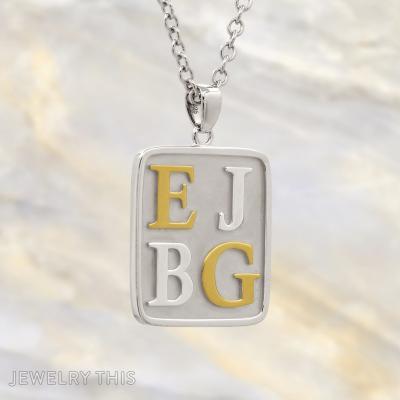
This rectangular sterling silver pendant carries four initials arranged in a two-by-two grid — E ...

Exuding sleek sophistication, this custom logo pendant boasts the bold letter “B” elegantly adorned with ...

Indulge in the captivating allure of this custom pendant crafted from 14k white gold, this ...

This pendant inspired by the traditional Hawaiian Palaoa necklace. Crafted with meticulous attention to detail, ...

This pendant, inspired by a logo originally found on a hat, is a striking and ...




