


Jiu Jitsu Grapplers Pendant — Two-Tone Stone Belts
$$$
14k yellow gold, black diamonds, lab-created diamonds
A purple belt in Brazilian Jiu Jitsu wanted a pendant recreating a grappler piece he'd seen on a training partner, capturing the sport itself in gold. When he couldn't borrow the original piece to send in for reference, he told us to go ahead and interpret it from photos alone — one figure's shorts in white stones for the students who cheer him on, the other in black for the instructor he trains under. When the render came back he wrote: 'Exactly how expected. Great job. It's perfect.'
'Exactly how expected. Great job. It's perfect.' — on seeing the render
Quick specs
Design type
Primary Metal
Shape / Cut
Primary Stone
Accent Stones
Style
Design Complexity
Intent: Certainty
Size
Pendant approximately 25g in 14k yellow gold; two full-figure grappler design.
How they made it distinctive
-
01
Fully sculptural two-figure design captures a live grappling pose rather than a flat or symbolic emblem
-
02
Black pave stones on one figure's shorts represent the instructor the client trains under
-
03
White pave stones on the other figure's shorts represent the students who cheer him on
-
04
Interpreted entirely from photographs after the reference piece could not be borrowed for exact measurement
-
05
14k yellow gold chosen to hold the fine pave stone setting across two dimensional figures
How you'd make it yours
Stone color: this piece uses black and white pave stones on the two figures; a new commission could use a single color or a different two-tone combination
Stone type: this piece uses black diamonds and lab-created white diamonds; a new commission could use moissanite or cubic zirconia for a similar look
Metal: this piece is 14k yellow gold; the same sculptural design works in 18k yellow, white, or rose gold, or sterling silver
Scale: this piece is sized around 25 grams; a new commission could be modeled larger or smaller
Chain: this piece pairs with a separately sourced chain; a new commission can specify a different chain style, width, or length
One of a kind: this exact pendant was designed for one client and is not reproduced — a new commission is an original piece inspired by this one, not a copy
Design changes made
The client originally planned to ship his training partner's pendant in for exact measurement and reference, but when that fell through he approved moving forward from photos alone, with the addition of black and white stone-set shorts on the two figures.
Who this is for
This piece is for someone whose sport is part of their identity, not just an activity they do. It's especially right if you want a piece that reads instantly to anyone who trains, and quietly represents the community around you — the students, the coach, the mat — to everyone else.
How it's made
Once the design was approved, a wax model was 3D printed and attached to a wax tree, which was invested in plaster and fired in a kiln to burn out the wax and leave a hollow mold. Molten 14k yellow gold was then cast into the mold under pressure, producing the raw two-figure pendant, which was extracted, cleaned, and prepared for finishing.
Because the piece is fully sculptural, the two grappling figures were hand-finished and polished individually to bring out the musculature and pose before any stones were set. The pave stone setting was done last: black diamonds were set into one figure's shorts and white lab-created diamonds into the other's, stone by stone, to keep the pave surface even across the curved fabric-like form.
Key note
The two figures were polished and finished separately before assembly-stage stone setting, since the dimensional grappling pose has undercuts and angles that are easier to reach and refine before the pave stones are seated.
Pricing guidance
A fully sculptural two-figure pendant with pave stone setting on both figures sits toward the higher end for pendants of this category. Most of the cost comes from the 3D sculptural modeling and the hand-finishing required to bring out the figures' musculature and pose, plus the labor of setting pave stones into two separate curved surfaces.
Moves price up ↑
- ↑ Increasing the pendant's overall size or weight beyond 25 grams
- ↑ Upgrading to 18k gold from 14k
- ↑ Using natural diamonds instead of lab-created diamonds for the white stones
- ↑ Adding more pave coverage or larger stones to either figure's shorts
- ↑ Adding a matching chain in the same karat gold rather than sourcing a lower-cost chain
Moves price down ↓
- ↓ Reducing the pendant to a smaller scale or lower gram weight
- ↓ Using cubic zirconia or moissanite instead of lab diamonds for the white stones
- ↓ Simplifying the figures to a flatter, less dimensional relief rather than full sculptural form
- ↓ Choosing 10k gold instead of 14k
- ↓ Using a single stone color rather than the two-tone black-and-white pave design
Questions people ask
Yes. A fully three-dimensional pendant depicting two figures in a grappling pose is achievable through sculptural 3D modeling and casting. The figures are modeled digitally first, refined through a render for approval, then cast in gold and hand-finished to bring out the musculature and pose. This kind of dimensional figure work is more labor-intensive than a flat or relief pendant, since every angle of the two intertwined bodies has to read correctly from all sides.
Pave-set diamonds sit low and close together in individual prongs, which makes them fairly resistant to snagging compared to raised prong settings. Both natural and lab-created diamonds rate a 10 on the Mohs hardness scale, so the stones themselves will not scratch or wear under normal use. The main long-term consideration is that pave settings have many small prongs, so periodic inspection is worthwhile to make sure none have loosened over years of wear.
Lab-created and natural diamonds are chemically and physically identical — same hardness, same brilliance, same appearance to the eye. The difference is origin: lab diamonds are grown in a controlled environment rather than mined. For small pave stones like the ones used here, lab diamonds are the more common choice because they deliver the same look at a lower cost per stone, which matters when dozens of small stones are being set.
A fully sculptural pendant with two dimensional figures and pave stone setting on both sits toward the higher end for custom pendants. The primary cost driver is labor — sculpting and hand-finishing a dimensional figure takes considerably more time than a flat design, and setting pave stones into two curved surfaces adds further setting time. Metal weight and stone choice (lab versus natural) are the next biggest factors in the final cost.
The process typically runs about six to eight weeks from approval to delivery on a standard timeline. The first week or so covers the sketch, 3D model, and rendered design for approval. Once approved, casting and hand-finishing a sculptural piece like this generally takes four to five weeks, with pave stone setting as one of the final production steps before polishing and quality check.
Yes, a two-figure sculptural pendant can be made in plain polished gold with no stones at all, which would lower the overall cost since no stone sourcing or setting labor is required. The figures themselves would still need the same sculptural modeling and hand-finishing to read clearly. Some clients choose a single stone color or a smaller stone count rather than removing stones entirely, if they still want some contrast between the two figures.
Yes, the chain is generally sourced separately from the pendant and can be specified in different widths and lengths, including styles like box chain or cable chain. A thicker or longer chain in the same karat of gold will add to the overall cost, since it uses more metal. Many clients already own a chain they want to use, in which case only the pendant itself needs to be produced.
Sculptural figure pendants can be cast in 10k, 14k, or 18k gold in yellow, white, or rose tones, as well as sterling silver for a lower-cost option. Higher karat gold has a richer color and slightly higher cost per gram, while lower karat options are more budget-friendly and still durable for daily wear. The choice mostly comes down to color preference and desired weight, since the sculptural detail translates well across all of these metals.
Explore Similar Creations
Every masterpiece starts with a spark. Explore how our clients raw ideas - sketches, heirlooms, inspirations - were transformed into bespoke works of arts.
This custom made dragon pendant is testament to the bond shared by the client and ...

This custom pendant features a distinctive panda logo adorned with a crown, meticulously crafted to ...
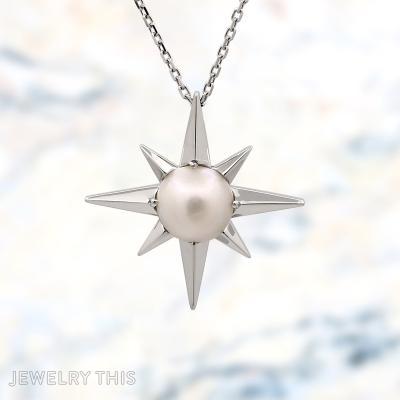
This stunning custom pendant features a striking starburst design crafted in polished silver, beautifully showcasing ...
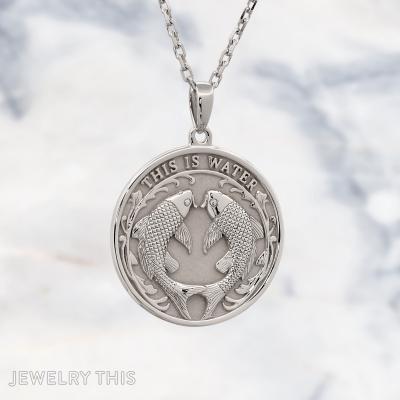
This sterling silver pendant centers on two koi fish facing one another beneath the phrase ...

This elegant gold pendant features a timeless circular frame with a modern, artistic twist. At ...

This necklace was created to replicate the signature of a loved int. This signature necklace ...

This sterling silver pendant is a unique symbol of an unforgettable moment in life. The ...

This striking pendant is designed to honor a life partner, featuring their initials in a ...

This striking 14K yellow gold plated pendant features a Southern Cross design. This unique piece ...

This graceful 14karat Yellow gold pendant features a trio of delicately sculpted leaves forming a ...


A birthstone pendant create in 14k white gold that includes garnet and citrine gemstones. The ...



