

Four-Stone Family Pendant — Diamonds and Aquamarine
$$$
14k white gold, natural diamonds, aquamarine
A father wanted a pendant for his wife that represented their four children in a single piece — two daughters marked by diamonds, two sons by a softer blue stone, with the stones placed in birth order. He was new to custom design and admittedly a little hesitant about the process, but stayed closely involved in every decision, down to the exact stone placement and setting style. He had it timed to arrive for her birthday in early January.
Quick specs
Design type
Primary Metal
Shape / Cut
Primary Stone
Accent Stones
Design Complexity
Intent: Certainty
Size
Pendant approximately 42mm (1.65in) long. Stone size approximately 4.5mm / 0.36 carat each.
How they made it distinctive
-
01
Four individually prong-set stones represent four children, arranged in birth order rather than by size or symmetry alone
-
02
Diamonds and aquamarines paired specifically for contrast — a softer light blue chosen over sapphire so it would not visually compete with the diamonds
-
03
Open, twisting ribbon design keeps each stone exposed to light on all sides rather than framed by a bezel
-
04
Stone size held at a deliberate minimum so all four stones could be sourced as a closely matched, symmetrical set
-
05
Original reference design's accent stones removed entirely, simplifying the piece to the four meaningful center stones only
How you'd make it yours
Stone type: this piece uses natural diamonds and aquamarines; a new commission could use lab diamonds or a different colored gem such as blue topaz
Metal: this piece is 14k white gold; the same open-ribbon design works in yellow or rose gold
Stone count and order: this piece represents four children in birth order; a new commission could represent a different number of people in any order
Setting style: this piece uses prong settings; a bezel setting is possible on a new piece for more stone protection
Chain: this piece was designed to pair with an existing chain; a new commission can include a matching chain in the same metal
One of a kind: this exact pendant was designed for one family and is not reproduced — a new commission is an original piece inspired by this one, not a copy
Design changes made
The accent stones from the original reference photo were dropped entirely at the client's request, simplifying the design to just the four birthstone-style center stones. The gemstone choice shifted from sapphire to aquamarine after the client learned sapphires run darker than the light blue he had in mind.
Who this is for
This piece is for someone who wants a family tribute that doesn't look like a literal family tree or name pendant — something that reads as fine jewelry first and a personal symbol second. It's especially right for a parent who wants each child acknowledged individually, in a specific order that means something, rather than as a generic cluster of stones.
How it's made
Once the design was approved, a resin model was 3D printed from the final CAD file — the exact physical shape the metal piece would take. That resin was attached to a wax tree and invested in plaster, which was fired in a kiln to burn out the resin and leave a hollow mold. Molten 14k white gold was then cast into the mold, cooled, and separated from the tree for cleanup.
After casting, the pendant was cleaned, filed, and polished to bring up the finish across the twisting open-ribbon form. The two natural diamonds and two aquamarines were then set by hand into individual prong settings along the piece, with the diamonds positioned higher and the aquamarines lower, matching the approved render. Prongs were chosen specifically over a bezel to keep the stones open to light on all sides.
Key note
The stone sizes were deliberately kept at a confirmed minimum (about 4.5mm) rather than sized down further, specifically so all four stones could be sourced as a visually matched, symmetrical set.
Pricing guidance
A moderately complex pendant with four individually prong-set stones in 14k white gold sits in the mid range for custom pendant work. Sourcing a matched set of four stones in consistent size and quality is a meaningful driver of the baseline cost, on top of the open-ribbon metalwork and hand stone-setting. Diamond origin (natural vs lab) is the single biggest lever on price for a piece like this.
Moves price up ↑
- ↑ Choosing natural diamonds over lab-created diamonds for the two primary stones
- ↑ Increasing individual stone size beyond roughly a third of a carat each
- ↑ Upgrading diamond clarity/color grade beyond VS1/G
- ↑ Adding a matching chain in the same metal rather than using an existing chain
- ↑ Setting all four stones in a single symmetrical row rather than a simpler two-stone layout
Moves price down ↓
- ↓ Switching both diamonds to lab-created diamonds, which cost significantly less at identical clarity and color
- ↓ Reducing stone size slightly, which also widens sourcing options and shortens timelines
- ↓ Using a single birthstone-style colored gem type for all four accent positions instead of mixing diamond and aquamarine
- ↓ Choosing a simpler two-stone layout instead of four individually set stones
- ↓ Selecting a lower-cost colored stone such as blue topaz instead of aquamarine
Questions people ask
Yes, this is a common request — each child is represented by an individual stone, often chosen by birthstone, gender association, or simply a preferred color. In this pendant, two diamonds represent two children and two aquamarines represent the other two, arranged in birth order along a twisting open design. The stones can be arranged in a line, a cluster, or spaced around a design depending on what layout fits the number of children. The key design consideration is keeping the stones close enough in size that they read as a cohesive, matched set.
Natural and lab-created diamonds are chemically and visually identical — same hardness, same brilliance, same durability for daily wear. The only real difference is origin: natural diamonds form underground over millions of years, while lab diamonds are grown in a controlled setting in a matter of weeks. For small stones like the ones in this pendant, lab-created diamonds typically cost roughly half as much as natural diamonds of equivalent clarity and color grade. Many clients choose lab diamonds specifically to redirect that savings toward stone size or additional design elements.
Aquamarine rates around 7.5 to 8 on the Mohs hardness scale, which is reasonably durable for daily wear in a pendant, though softer than diamond or sapphire. Because pendants are not subject to the same daily impact as rings, aquamarine holds up well in this application. It should still be removed before swimming in chlorinated water or using harsh cleaning chemicals, as repeated exposure can dull the stone's surface over time. A light cleaning with mild soap and warm water is the safest routine maintenance.
Sapphires are available in many shades, but their most common and recognizable form is a deeper, more saturated blue. Aquamarine naturally occurs in a much lighter, softer blue-green tone, which reads as a clear visual contrast to colorless diamonds without competing with them for attention. Clients who want a pastel or pale blue accent, rather than a bold jewel tone, typically land on aquamarine or blue topaz instead of sapphire. The choice is purely aesthetic — both stones are suitable for pendant settings.
A pendant with four individually set stones in 14k white gold, combining natural diamonds and a colored gemstone, sits in the mid range for custom pendant work. The cost is driven primarily by sourcing a well-matched set of four stones and the hand-finishing required for an open, twisting metal form. Choosing lab-created diamonds instead of natural ones is the most significant way to reduce the cost while keeping the same visual design.
From design approval to shipping, a pendant like this typically takes three to five weeks. The first week or so covers the sketch, 3D model, and render approval process, where adjustments to stone placement and sizing are made. Once approved, production — casting, finishing, and hand stone-setting — generally takes another three to four weeks. Sourcing a matched set of stones in a specific size and quality can add a few extra days if unusual combinations are requested.
Yes, stone order and layout are fully customizable on a new commission. In this pendant, the stones were deliberately ordered to reflect birth order, with the stone for the eldest child placed highest. Other layouts — a cluster, a straight vertical line, or stones spaced around a shape — are all achievable depending on the number of stones and the overall design language chosen for the piece. The setting style, such as prongs versus bezel, can also be adjusted based on how much of the stone the client wants visible.
Prong settings hold a stone with small metal claws rather than a continuous metal rim, which leaves more of the stone exposed to light from the sides. On this pendant, prongs were chosen specifically because a bezel setting would have covered more of each stone's edge, reducing brilliance and visual presence. Prongs are generally considered less protective than a bezel against impact, but for a pendant that isn't subject to the knocks a ring would take, this tradeoff is minimal. The choice ultimately comes down to how much of the stone a client wants visible versus how much protection they want built in.
Explore Similar Creations
Every masterpiece starts with a spark. Explore how our clients raw ideas - sketches, heirlooms, inspirations - were transformed into bespoke works of arts.

This custom sterling silver pendant is an elegant piece with a minimalist design that carries ...

This pendant reimagines the sand dollar as a wearable keepsake, cast in sterling silver with ...

This custom pendant features a beautifully crafted Filipino sun, symbolizing hope and unity, with a ...

This round pendant features a detailed image of the sacred figure, surrounded by an elegant ...
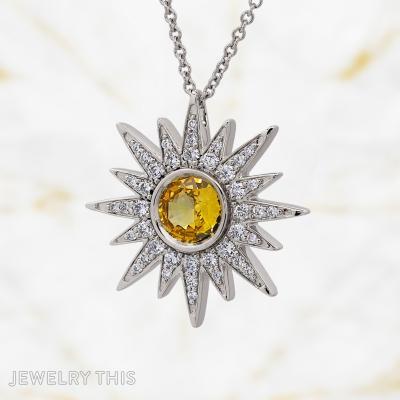
This sun pendant radiates warmth and brilliance, just like the sun it was inspired by. ...

Expertly crafted in lustrous 14k yellow gold, this custom pendant features a charming cutout design ...

14k yellow gold heart pendant featuring personal initial H in the center of the pendant. ...

Sterling Silver pendant featuring a screaming monkey wearing a crown. The crown is gold plated. ...


This pendant reimagines the traditional Ten Commandments tablets as a wearable piece — two arched ...

This exquisite sterling silver heart logo pendant holds deep meaning. This 1-inch tall pendant is ...



