

Flat-Edge Cross Pendant with Crown Bail in White Gold
$$
14k white gold, natural diamonds
A. came to us wanting a cross pendant inspired by a photo he'd found, but reworked to be solid rather than hollow and with flat, squared-off ends instead of rounded ones. The crown detail from the reference image was the one element he wanted kept exactly as it was. When it arrived, he wrote simply that it came out perfect.
'Yes I am, it came out perfect. Thank you.' — on delivery
Quick specs
Design type
Primary Metal
Shape / Cut
Primary Stone
Accent Stones
Design Complexity
Intent: Certainty
Size
Pendant approximately 1 inch in length. Bail adjusted to fit a 5mm chain.
How they made it distinctive
-
01
Cast solid rather than hollow — client specifically wanted more heft than the hollow reference piece he found
-
02
Flat, squared-off cross ends instead of rounded — a deliberate departure from the reference photo's shape
-
03
Crown detail preserved exactly from the reference image — the one feature the client wanted kept untouched
-
04
Bail widened specifically to fit a 5mm chain the client already owned, avoiding the need for a new chain purchase
-
05
Diagonal vine wrap element retained across the diamond-set arms for a decorative but still clean look
How you'd make it yours
Stone type: this piece uses natural VS1 diamonds; a new commission could use lab diamonds for the same look at lower cost
Casting weight: this piece is cast solid; a new piece could be made hollow for a lighter feel
Cross ends: this piece has flat, squared ends; a new commission could use rounded or pointed ends
Metal: this piece is 14k white gold; the same design language works in yellow or rose gold
Vine detail: the diagonal wrap on this piece could be simplified or removed on a new commission for a plainer cross
One of a kind: this exact pendant was designed for one client and is not reproduced — a new commission is an original piece inspired by this one, not a copy
Design changes made
The cross ends were changed from rounded to flat/squared per the client's request, and the piece was redesigned to be solid gold rather than hollow like the reference photo. The bail was also widened later in the process to accommodate the client's own 5mm chain instead of a thinner one.
Who this is for
This piece is for someone who found a design online that was close but not quite right, and wants it adjusted to their own specifics rather than accepting it as-is. It fits someone who already owns a chain and wants a substantial, solid pendant built to pair with it rather than a lightweight, hollow piece.
How it's made
Once the design was approved, the pendant was 3D printed in wax and attached to a wax tree inside a flask. The flask was placed in a kiln to burn out the wax, leaving a hollow mold in its place. Molten 14k white gold was then poured into that mold, producing the solid raw pendant once it cooled and was removed.
After casting, the piece was cleaned up and polished to bring out the finish on the flat-ended cross and the crown detail at the top. The channel-set diamonds were set by hand into the recessed channels running down each arm of the cross, and the diagonal vine element was finished separately to stand out against the polished surface. The bail was shaped and sized specifically to accommodate a 5mm chain rather than a standard thinner chain.
Key note
The pendant was deliberately cast solid rather than hollow, adding more gold weight than a typical cross pendant of this size in order to match the heft the client wanted.
Pricing guidance
A moderately detailed white gold cross pendant with channel-set diamonds and a dimensional crown accent sits in the mid range for custom pendant work. Labor for the channel setting and the sculpted crown and vine details is the main cost driver, with diamond quality and total gold weight shifting the price from there.
Moves price up ↑
- ↑ Casting the piece solid rather than hollow, which uses significantly more gold
- ↑ Upgrading diamond clarity beyond VS1 or increasing the number of channel-set stones
- ↑ Widening the bail further to accommodate a heavier statement chain
- ↑ Adding complexity to the vine or crown details with more dimensional sculpting
- ↑ Choosing platinum instead of white gold for the pendant body
Moves price down ↓
- ↓ Casting the piece hollow instead of solid to reduce gold weight
- ↓ Reducing the diamond count or choosing a lower clarity grade
- ↓ Simplifying the vine detail or removing it entirely for a plainer cross
- ↓ Using a smaller overall pendant size than 1 inch
- ↓ Choosing a lower metal purity, such as 10k instead of 14k white gold
Questions people ask
Yes, a cross pendant can be cast solid rather than hollow, which is exactly what was done on this piece after the client noted the reference photo he found felt too lightweight. Casting solid uses more metal and adds noticeable heft compared to a hollow casting of the same size. The tradeoff is a higher gold weight and cost, since more precious metal is used in production. For a pendant worn as a primary daily piece, many clients prefer the more substantial feel of a solid casting.
Channel setting holds a row of diamonds between two parallel strips of metal with no visible prongs, giving a smooth, continuous line of stones down the surface, which is the setting used on this cross. Prong setting instead holds each stone with small individual metal claws, leaving more of the stone visible from the side. Channel settings tend to be more protective of the stones' edges since the metal walls shield them from daily knocks. They are a common choice for pendants and bands where a clean, streamlined look is wanted.
A cross pendant of this complexity, in 14k white gold with channel-set VS1 diamonds and sculpted crown and vine details, falls in the mid range for custom pendant work. Most of the cost comes from the labor involved in channel setting and finishing the dimensional details, not just the materials. Choices like solid versus hollow casting, diamond clarity, and overall size all move the price from there. Metal purity, such as 14k versus 18k, is another factor that can shift cost up or down.
From design approval to a finished piece, production on a pendant like this typically takes about four to five weeks. Before that, the design phase itself usually takes one to two weeks, covering an initial sketch and then a 3D render for approval. Once the design is approved and finalized, the piece moves into wax printing, casting, and hand-finishing. The full process from first conversation to delivery generally falls within a standard six to eight week timeline.
Yes, the bail opening on a pendant can be widened or adjusted to fit a specific chain width, which is what was done here to accommodate the client's own 5mm chain. This is a common request when someone already owns a chain and wants to avoid purchasing a new one. It does require confirming the exact chain width before the piece is finalized, since the bail is sized during the design and casting stage, not adjusted afterward. Getting this measurement right ahead of time avoids a pendant that fits too loosely or too tightly on the intended chain.
The diamonds used in this pendant are natural, VS1 clarity stones. VS1 means the diamonds have very slight inclusions that are difficult to see even under magnification, placing them in a high clarity range. Lab-grown diamonds of the same clarity grade are chemically identical to natural diamonds and would look the same to the eye, typically at a lower cost. The choice between natural and lab-grown is primarily about cost and personal preference rather than visible appearance.
Yes, the crown accent at the top of a cross pendant is a decorative element that can be adjusted, simplified, or left off entirely depending on preference. On this piece, the crown was specifically the detail the client wanted preserved unchanged from his reference image, while other elements like the rounded ends were altered. This shows that individual design elements can be kept, removed, or modified independently rather than needing to accept or reject an entire reference design as-is. It's a useful approach for anyone working from an inspiration photo who only loves part of it.
This pendant was made in 14k white gold, which balances durability with cost and is a common choice for daily-wear pendants. 14k gold is harder and more resistant to scratching than 18k gold, since it contains a higher percentage of alloy metals, making it a practical choice for a piece worn often. 18k gold has a richer color and higher gold content but is softer and typically costs more. For a solid-cast piece with channel-set stones, 14k offers a good balance of durability and value.
Explore Similar Creations
Every masterpiece starts with a spark. Explore how our clients raw ideas - sketches, heirlooms, inspirations - were transformed into bespoke works of arts.
When a client chose to upgrade her engagement ring, she wanted a beautiful and meaningful ...

This circular gold pendant encapsulates the beauty of nature and the radiance of the sun. ...

Embrace elegance in a compact size with our exquisite 14kt yellow gold pendant. Measuring a ...

Club logo pendant with dimensional text. This pendant is 2 inches in size and was ...

Crafted with intricate detail, this custom pendant showcases the outline of the state of Texas ...
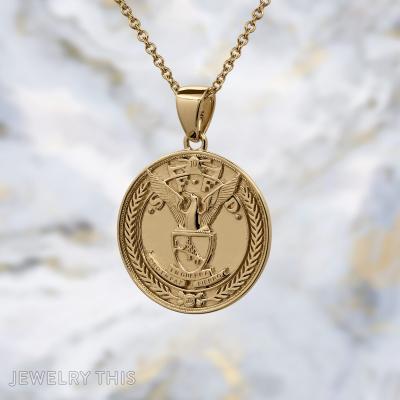
A daughter’s love for her father shines through this meaningful gift. This 1-inch pendant features ...

This platinum pendant centers on a five-pointed star, drawn with one point up and cut ...


This lovely gold plated silver pendant is a symbol of love, commitment and family. The ...

This reversible pendant was designed as a coin-style zodiac piece, carrying a dimensional scorpion on ...

This custom compass pendant beautifully embodies a meaningful journey, featuring coordinates representing the birthdays of ...

This stunning yellow gold pendant centers on a luminous round pearl. Above the pearl, a ...



