


Custom Monogram Pendant With Pavé Stones in Silver
$$
Sterling silver, moissanite
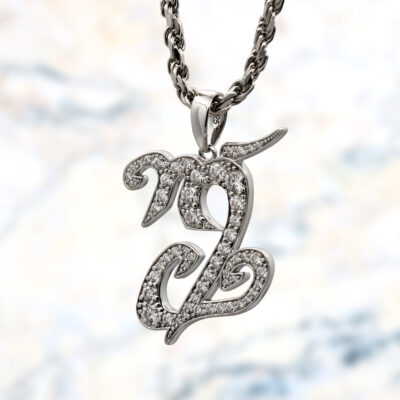
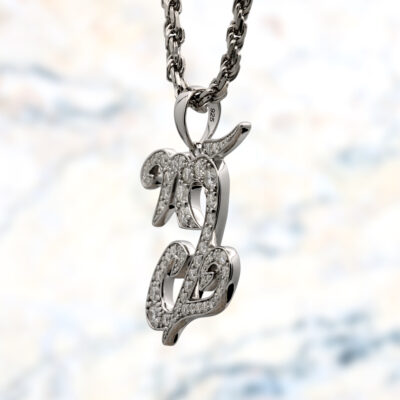
A father came to us wanting a cursive-letter pendant covered edge to edge in clear stones for his son's graduation, to wear on a rope chain the family already had. The design came together quickly and he upgraded the stones along the way for extra sparkle, though a sizing mismatch discovered during stone-setting pushed the timeline right up against the graduation date. It arrived the day after the ceremony, and he wrote: 'Everyone absolutely loves it!!!!'
'Everyone absolutely loves it!!!!' — on delivery
Quick specs
Design type
Primary Metal
Shape / Cut
Primary Stone
Accent Stones
Design Complexity
Intent: Certainty
Size
Pendant approximately 1 inch (25.4mm). Bail sized for 2.5mm rope chain. 59 round stones in 17 different sizes.
How they made it distinctive
-
01
Open cursive letterform fully paved with 59 stones across 17 different sizes, following the curves of the script rather than a uniform grid
-
02
Moissanite upgrade applied to the full design at no added cost, increasing brilliance and durability over the originally planned cubic zirconia
-
03
Bail sized specifically to the client's existing 2.5mm sterling silver rope chain rather than a generic opening
-
04
Cut-out design kept slightly thicker than standard minimum gauge specifically to preserve durability on the open, unsupported script strokes
How you'd make it yours
Stone coverage: this piece is fully paved edge to edge; a new commission could concentrate stones in just one letter or section instead
Stone type: this piece uses moissanite; a new commission could use cubic zirconia for lower cost or lab diamonds for a diamond-grade result
Metal: this piece is sterling silver; the same cursive design language works in 14k gold for a warmer tone
Size: made to fit this piece's intended chain and scale; a new piece is sized to its own wearer and chain
Engraving: a flat back area could carry a short inscription on a new piece
One of a kind: this exact pendant was designed for one client's son and is not reproduced — a new commission is an original piece inspired by this one, not a copy
Design changes made
The center letterform was identified as the natural focal point for concentrated stone coverage when the client asked about reducing cost, though he ultimately chose to keep the full stone coverage across the entire design rather than isolating it to one area.
Who this is for
This piece is for someone who wants a milestone gift with real visual weight — something that catches light and gets noticed, not just a plain nameplate. It's especially right for a graduation, a birthday, or any moment where the recipient deserves a piece that feels deliberately crafted rather than off-the-shelf.
How it's made
Once the cursive design was approved as a 3D render, the piece moved to production: a wax model was 3D-printed, attached to a tree, and invested in plaster. The flask was fired in a kiln to burn out the wax, leaving a hollow mold, and molten sterling silver was poured in to cast the raw pendant. After cooling, the piece was removed from the mold and prepared for cleanup and polishing.
Because the open letterform has no straight edges, the polishing pass had to follow the curves of each stroke by hand before setting began. The pendant's 59 stones span 17 different sizes, so each stone seat was individually sized and the stones were set one at a time, following the pendant's cursive path from top to bottom, rather than in uniform rows.
Key note
A cut-out cursive design with dozens of varied stone sizes requires each setting seat to be individually sized after casting, since even a tenth of a millimeter of shrinkage during cleanup can throw off the fit of a specific stone.
Pricing guidance
A sterling silver cut-out script pendant fully paved with small round stones sits toward the lower end of custom pendant pricing, though the stone-setting labor for a high stone count pushes it up from a plain silver piece. Because the cost is driven more by the number of individual stones set than by the metal itself, pricing shifts significantly based on stone type and coverage. Moissanite or lab diamond alternatives raise the baseline further due to material cost per stone.
Moves price up ↑
- ↑ Upgrading from moissanite to lab-grown or natural diamonds across all stones
- ↑ Increasing total stone count or covering the full design rather than one section
- ↑ Choosing a larger pendant size, which requires more stones and more metal
- ↑ Adding stone setting to both the front and back of the design
- ↑ Switching the base metal from sterling silver to 14k gold
Moves price down ↓
- ↓ Limiting stones to a single section of the design, such as one letter
- ↓ Using cubic zirconia instead of moissanite or diamond
- ↓ Reducing the overall stone count
- ↓ Keeping the pendant size smaller than 1 inch
- ↓ Leaving some areas of the design open/unset for a lower stone density
Questions people ask
Moissanite is a durable gemstone rated 9.25 on the Mohs hardness scale, just below diamond's 10, which makes it a strong choice for a pendant set with dozens of small stones. It has a higher refractive index than diamond, so it actually throws more fire and sparkle in direct light. Moissanite costs significantly less than natural or lab diamonds of comparable size, which is why it is a common upgrade path from cubic zirconia. For a piece with many small stones, the difference in brilliance compared to CZ is noticeable even at a glance.
Cubic zirconia and moissanite are both diamond simulants, but they are chemically different materials with different durability. CZ rates around 8 to 8.5 on the Mohs hardness scale, while moissanite rates 9.25, making moissanite more resistant to scratching over years of wear. Moissanite also has more brilliance and fire than CZ due to its higher refractive index. CZ remains the lower-cost option and is a reasonable choice for occasional-wear pieces, while moissanite holds up better for daily wear.
A custom pendant with a dense stone-setting design like this typically takes about one week for the 3D design and render phase, followed by three to four weeks of production once the design is approved. Production includes wax modeling, casting, polishing, and hand-setting each stone, which takes longer when a piece has a high stone count or varied stone sizes. Delays can occur if stone sizing doesn't match the cast settings precisely after casting shrinkage, which sometimes requires sourcing replacement stones. Total turnaround from deposit to delivery is generally five to six weeks under standard timing.
A sterling silver pendant with a high stone count, like one covered edge to edge in small round stones, typically falls in the lower-to-mid range for custom pendant work. The labor to individually set dozens of stones is the primary cost driver, often more significant than the metal cost itself. Stone type has a large effect on final price — cubic zirconia is the most budget-friendly option, moissanite sits in the middle, and lab or natural diamonds cost considerably more. Pendant size and overall stone density also affect the final price.
Yes, this is a common way to manage cost on a densely set design. Rather than placing stones throughout an entire cut-out letterform, stones can be concentrated in one focal area, such as a single central letter, while leaving the rest of the design in polished bare metal. This reduces the total stone count significantly while still giving the piece sparkle and visual interest. The tradeoff is a less uniform, more contrast-driven look compared to full coverage.
The 3D render gives a very close preview of the finished piece, but some slight variation in metal tone and stone luster is normal between a digital render and the final cast and polished piece. This is standard across custom jewelry production, since lighting, polish finish, and the exact faceting of each stone affect how light reflects differently than a rendered image. The overall design, proportions, and stone placement will match the approved render closely. Any variation is cosmetic and does not affect the durability or structure of the piece.
Yes, pendants like this are typically designed with a bail sized to fit a chain the client already owns rather than requiring a new chain purchase. The jeweler needs to know the width of the existing chain, typically in millimeters, before finalizing the pendant's 3D model so the bail opening is cast correctly. A rope chain in the 2 to 3mm range is a common pairing for a 1-inch pendant on a man's necklace. Confirming chain width before casting avoids the need for bail modifications after the fact.
A fully paved cut-out letterform pendant around 1 inch in size can use anywhere from 40 to 60 or more small round stones, depending on how much of the open design is covered. This particular style of pendant used 59 stones across 17 different sizes to follow the curves of the cursive lettering without gaps. Using many different stone sizes, rather than one uniform size, allows the stones to follow tapering and curving metalwork more precisely. This level of stone-size variation adds setting complexity compared to a design using a single stone size throughout.
Check what our clients say about us

jeremy wright
3 years ago
We needed a custom pendant for a graduation present. Talked to a couple local jewelers but ultimately ended up choosing Jewlerythis. The whole process was surprisingly easy for getting a custom piece made. You essentially just need to send in an idea and they work with you to build a piece that ends up coming out amazingly well. Communication throughout the process was top notch. Product quality is fantastic!!!
Highly recommend this Jewlerythis!!!
Explore Similar Creations
Every masterpiece starts with a spark. Explore how our clients raw ideas - sketches, heirlooms, inspirations - were transformed into bespoke works of arts.

Crafted in radiant 14k yellow gold, this custom necklace features the word “Believe” accompanied by ...

This exquisite 1.25 inch oval pendant is a beautiful way to keep the spirit of ...

A cherished token of legacy and family pride, this silver pendant was meticulously crafted for ...

The Gold plated Silver pendant features a beautifully detailed elephant walking with its trunk lifted ...

This distinctive yellow gold pendant captures the mystique of the lunar cycle. Shaped as a ...

This stunning 14k white gold pendant is the perfect way to commemorate a special occasion. ...

This pendant takes the shape of the Virgo constellation, rendered in 14k rose gold with ...

Embark on a personalized journey with this custom rose gold pendant, a wearable masterpiece showcasing ...

Celebrate love and symbolism with this exquisite custom pendant, crafted in sterling silver with a ...


This pendant depicts a small winged fairy figure rendered in polished 14k white gold, holding ...



