


Celtic Knot Pendant — Client-Designed Trinity Knot in Gold
$
10k yellow gold
C. came to us with a Celtic knot she had designed herself — a shape that meant something personal to her — and wanted it recreated in solid metal rather than bought generic. She switched the metal to 10k yellow gold partway through so a separate jeweler could safely solder it onto an existing sterling silver necklace without damaging a plated finish. When it arrived, she wrote: "Stunning doesn't even BEGIN to cover how gorgeous this pendant is. I am SO happy! It's PERFECT!!"
'Would it be possible to make it without the bail? ... Otherwise, it's PERFECT!' — on seeing the first render
'Stunning doesn't even BEGIN to cover how gorgeous this pendant is. I am SO happy! It's PERFECT!!' — on delivery
Quick specs
Design type
Primary Metal
Primary Stone
Accent Stones
Style
Design Complexity
Intent: Certainty
Size
Pendant approximately 0.75in tall. Attached via open jump ring (client-intended for professional soldering); chain/necklace sourced separately by client.
How they made it distinctive
-
01
Design originated from the client's own hand-drawn Celtic knot sketch, not a stock template
-
02
Metal upgraded mid-project from gold-plated silver to solid 10k gold specifically so the piece could survive a later independent soldering
-
03
Standard bail omitted in favor of an open jump ring so the pendant could attach directly to an existing connected-knot necklace
-
04
Open, dimensional cut-out knotwork gives the piece depth and movement rather than a flat engraved surface
-
05
Kept under an inch tall per the client's request while still preserving the full detail of the knot pattern
How you'd make it yours
Metal: this piece is solid 10k yellow gold — a new commission could use 14k, 18k, rose gold, or gold-plated sterling silver
Attachment point: this piece uses an open jump ring instead of a bail — a new piece could use a fixed soldered bail or a different connector
Size: this piece is about 0.75 inches tall — a new commission could be scaled larger if the knotwork detail allows it
Design source: this piece reproduces the client's own sketch — a new commission could start from your own drawing or a stock knotwork pattern
One of a kind: this exact pendant was cast from one client's personal design and is not reproduced — a new commission is an original piece inspired by this one, not a copy
Design changes made
The standard fixed bail was replaced with an open jump ring so the piece could be attached directly to the client's existing necklace, and the metal was changed from gold-plated sterling silver to solid 10k yellow gold so a separate jeweler could solder the connection without damaging the finish.
Who this is for
This piece is for someone who already has a design in their head — or on paper — and wants it made real rather than settling for something close. It's especially right if you have an existing piece of jewelry you want a new element to join, since the attachment details can be adapted to fit your plan.
How it's made
Once the render was approved, the design was 3D printed in wax and attached to a wax tree within a flask. The flask was then invested in plaster and fired in a kiln to burn out the wax, leaving a hollow mold of the pendant. Molten 10k yellow gold was poured into that mold under pressure, and once cooled, the raw casting was broken out and separated from the tree for finishing.
After casting, the pendant was cleaned up and polished to a bright finish across the open knotwork, with attention paid to smoothing the interior cut-out edges where the strands cross over one another. Because the piece needed to be soldered onto another necklace after delivery, it was finished in solid 10k gold rather than plated silver — a surface that can withstand a second soldering process without the finish lifting or discoloring. The jump ring at the top was left open rather than closed, per the client's request, so she could connect it herself before having it professionally soldered.
Key note
The metal was upgraded from gold-plated silver to solid 10k gold specifically so the piece could survive a second, independent soldering job without the plating being damaged.
Pricing guidance
A small dimensional pendant with open knotwork detail in solid gold sits toward the lower end of custom work of this complexity. Most of the cost comes from the labor of cleaning and polishing the interior cut-out edges of an openwork design, plus the gold content itself. Metal karat and size are the two levers that move the price most from there.
Moves price up ↑
- ↑ Upgrading from 10k to 14k or 18k gold, which increases both material cost and value
- ↑ Increasing the pendant size beyond roughly an inch, which requires more metal and more finishing time
- ↑ Adding a soldered, permanently closed bail rather than an open jump ring
- ↑ Adding stones or enamel fill within the open sections of the knotwork
- ↑ Requesting a two-tone finish across different sections of the knot
Moves price down ↓
- ↓ Choosing gold-plated sterling silver instead of solid gold
- ↓ Reducing the pendant size toward the smaller end of what the knot's detail can support
- ↓ Simplifying the knotwork pattern to fewer crossing strands
- ↓ Using a standard closed bail instead of a custom open attachment point
- ↓ Sticking with sterling silver throughout rather than mixing metals
Questions people ask
Yes. This pendant started as the client's own hand-drawn Celtic knot design, which the design team translated into a 3D model and then cast in metal. The process includes a render for approval before anything is cast, so you can request adjustments to proportion or detail before it's made. Personal or original designs like this are common, and the final piece follows your sketch rather than a generic template.
Gold-plated sterling silver has a thin layer of gold over a silver base, so it's lighter in color saturation and the plating can wear thin over time, especially if the piece undergoes any later soldering or repair work. Solid 10k gold is gold throughout, so it holds up better under a second soldering process and won't show bare metal if the surface is later polished or adjusted. For a piece meant to be modified or attached to another piece of jewelry down the line, solid gold is the more durable choice.
Yes, though there needs to be some kind of connection point — it can't be left with nothing at all. A common solution is an open jump ring in place of a fixed bail, which lets you connect the pendant to an existing chain yourself. An open jump ring isn't permanently secure on its own, so if durability matters, plan to have it professionally soldered closed once it's attached.
Open, dimensional knotwork is more delicate than a solid pendant because the metal is thinner at the points where strands cross and separate. Casting it in a sturdier metal rather than a soft plated finish helps it hold up to daily wear and occasional handling. Pieces under an inch with fine cut-out detail are generally considered better suited to careful daily wear than rough or active use.
A small dimensional pendant in solid gold with open knotwork detail falls toward the lower end of custom pricing for pieces of this complexity. The main cost drivers are the gold content and the hand-finishing needed to clean and polish the interior edges of an open design. Simpler, smaller, or plated versions bring the cost down, while larger sizes or higher karat gold push it up.
For a piece like this, the process typically runs about four to six weeks from approval to delivery. The 3D design and render usually take five to seven days, and once approved, production — wax printing, casting, cleaning, and finishing — takes another three to four weeks. You'll typically see a render for approval and sometimes a resin preview before the final metal piece is made.
Yes, mixing metals is a common and workable choice, especially when a client already owns a chain or necklace in one metal and wants a pendant made in another. The main consideration is how the two pieces will be connected — a jump ring or soldering may be needed to join a gold pendant to a silver chain securely. The visual contrast between gold and silver is also a deliberate style choice many clients make intentionally.
Not precisely — renders are a close approximation, but the real luster and tone of yellow gold can vary slightly from how it appears on screen. Lighting, monitor calibration, and the reflective quality of polished metal all affect how a render looks compared to the physical piece. Most clients find the finished piece reads warmer and shinier in person than in the digital render.
Explore Similar Creations
Every masterpiece starts with a spark. Explore how our clients raw ideas - sketches, heirlooms, inspirations - were transformed into bespoke works of arts.
Honor a cherished life with this 1-inch silver pendant featuring a delicate heartbeat motif at ...

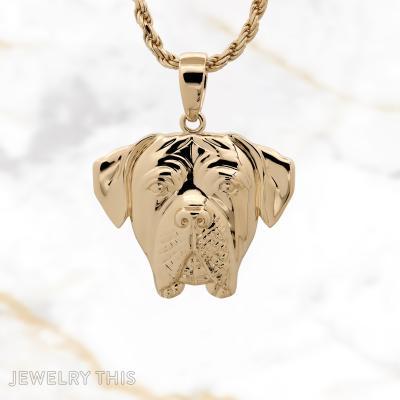
This pendant was carved to reproduce the face and upper chest of a Cane Corso ...

Crafted as a heartfelt tribute to a cherished family heirloom. The cross is intricately designed ...


An anniversary gift for an owl lover, beautifully crafted in silver. Measuring 1 inch (25mm) ...

This striking custom pendant is an emblem of strength and resilience. Crafted from black rhodium-plated ...

This pendant was built around a business name, rendered in two contrasting lettering styles — ...

This 10k yellow gold pendant was built around a client-provided image, translated into a raised, ...

This sterling silver pendant transforms a small business logo into an exquisite sword design, standing ...

This custom pendant is a proud emblem of a beloved podcast, meticulously crafted to capture ...

This beautiful custom pendant celebrates the love of beloved family pet, Lucy the beagle. Crafted ...



