

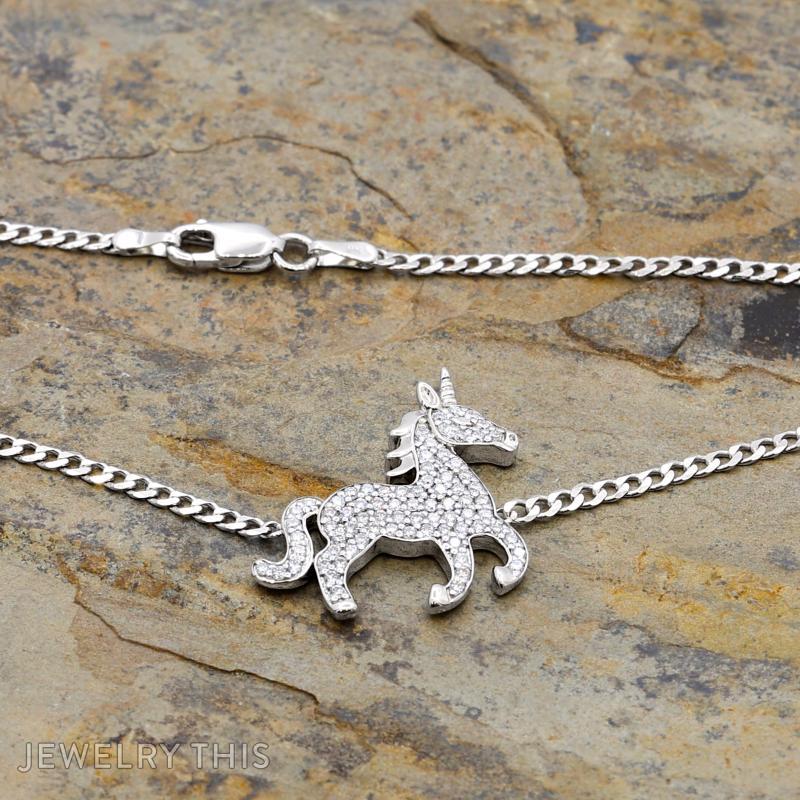
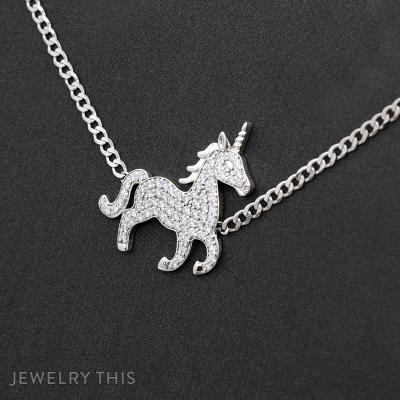
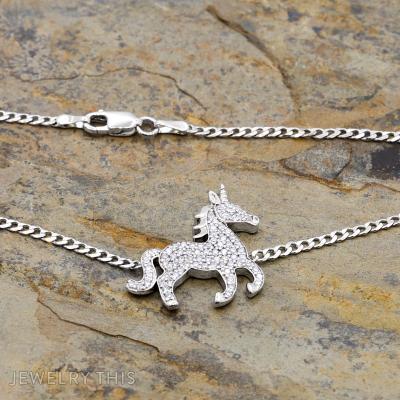
Diamond Unicorn Anklet in 14k White Gold
$$$
14k white gold, lab-created diamonds
A client wanted a small, unobtrusive unicorn anklet for a partner he described as strong and unique — playful in subject but classy enough to wear at work. He sketched a rough idea himself, and the design team's first render nailed it on the first try: 'Oh God yes. Looks playful and regal. Like her.' The finished piece carries a short engraving on the back, and he was still waiting for the right moment to give it to her when he wrote in: 'I love it.'
'Oh God yes. Very much so. I like it. Looks playful and regal. Like her.' — on seeing the first render
'Haha. This is awesome thank you. Never saw anything like this. Cool how you model it out in resin. I'm good to go with this.' — on seeing the resin model
Quick specs
Design type
Primary Metal
Shape / Cut
Primary Stone
Accent Stones
Style
Design Complexity
Intent: Certainty
Size
Charm 0.75in; chain connected on both sides. Anklet length 8in. Curb chain 1.95mm.
How they made it distinctive
-
01
Unicorn charm connects to the chain on both sides rather than dangling, keeping the silhouette flat and secure for ankle wear
-
02
Full pave diamond coverage across the horse's body and mane, chosen for a refined rather than costume-like look
-
03
Compact 0.75 inch scale specifically requested to keep the piece unobtrusive and workplace-appropriate
-
04
Extended, trotting pose selected over a static or rider-mounted design to feel more playful and dynamic
-
05
Short personal engraving on the back adds a private layer of meaning invisible when worn
How you'd make it yours
Stone type: this piece uses lab-created diamonds — a new commission could use natural diamonds for the same look at higher cost
Metal: this piece is 14k white gold — the same design works in yellow gold, rose gold, or platinum
Charm size: this piece is 0.75 inches — a new piece could be sized larger or smaller depending on how bold or subtle it should read
Chain style: this piece uses a 1.95mm curb chain — a paperclip or other chain style could be substituted
Engraving: the back of a new charm can carry its own short word, name, or initials
One of a kind: this exact anklet was designed for one client and is not reproduced — a new commission is an original piece inspired by this one, not a copy
Design changes made
Design matched the initial brief without major changes — the first render was approved as sent, once the client's rough sketch and reference image were translated into a workable design.
Who this is for
This piece is for someone who wants a meaningful symbol without it announcing itself — a small, refined charm rather than a bold statement piece. It's especially right for someone who wants jewelry that reads as classy and low-key at work, but carries real personal significance underneath.
How it's made
Once the design was approved, the piece moved into a 3D-printed resin model, a physical preview of the final charm and chain connection shared with the client before any metal was cast. The resin was then used to build an investment mold, which was fired in a kiln to burn out the wax/resin, leaving a hollow cavity. Molten 14k white gold was poured into that mold, producing the raw charm and chain sections.
After casting, the charm was cleaned up and polished to a bright white gold finish, then the pave setting was completed — each small lab-created diamond set individually across the horse's body and mane to achieve full coverage without visible metal gaps. The chain was connected to both sides of the charm rather than fitted with a jump ring for a dangle, keeping the piece flat and secure against the ankle, and the back was engraved as a final finishing step before polishing.
Key note
The charm is connected to the chain on both sides rather than hung from a single point, which is why it sits flat and close to the ankle instead of swinging like a typical dangle charm.
Pricing guidance
A small pave-set charm anklet like this sits in the mid range for custom fine jewelry, largely because of the labor involved in hand-setting dozens of small stones across a compact, detailed shape. Chain length and style add a modest amount on top of the charm cost. Metal choice and stone count are the two levers that move the price most from there.
Moves price up ↑
- ↑ Upgrading from lab-created to natural diamonds for the pave setting
- ↑ Choosing platinum instead of 14k white gold
- ↑ Increasing the charm size beyond 0.75 inches, which adds more stones and setting time
- ↑ Adding a matching charm or second engraved element to the chain
- ↑ Selecting a heavier or more elaborate chain style
Moves price down ↓
- ↓ Reducing the stone coverage to a partial pave or single accent stone
- ↓ Using sterling silver with rhodium plating instead of 14k white gold
- ↓ Choosing a thinner, simpler chain style
- ↓ Omitting the back engraving
- ↓ Making the charm smaller than 0.75 inches
Questions people ask
A well-set pave charm can hold up to daily wear, but anklets face more contact and abrasion than a necklace or ring, since they brush against shoes, socks, and furniture. Each stone in a pave setting is held by small shared prongs, so the setting should be checked periodically to make sure none have loosened. Lab-created diamonds used in pave work are just as hard as natural diamonds, rating a 10 on the Mohs scale, so the stones themselves are not the weak point — the metal prongs are. Most jewelers recommend an annual prong check for any pave-set piece worn frequently.
Lab-created and natural diamonds are chemically and optically identical — same hardness, same brilliance, same fire. The only difference is origin: one is grown in a controlled lab environment, the other is mined. For a pave setting using many small stones, lab-created diamonds are the more common choice because the visual result is the same regardless of which type is used. The main practical distinction is cost, which is significantly lower for lab-created stones at equivalent size and quality.
Yes, this is a design choice rather than a limitation. Connecting a charm on both sides, rather than hanging it from a single bail, keeps the piece flatter and more secure against the skin, which works well for an anklet where a dangling charm could swing, flip over, or catch on clothing. This construction does mean the charm's orientation is fixed once made, since it cannot rotate freely like a hanging charm would. It's a common approach for pieces meant to sit close and stay put during daily movement.
A compact charm anklet with full pave-set lab diamonds in 14k white gold generally falls in the mid range for custom fine jewelry. Most of the cost comes from the hand-setting labor required to place dozens of small stones cleanly across a detailed shape, rather than from the metal itself. Chain length and style add a smaller amount on top. Choosing natural diamonds, a larger charm, or platinum instead of white gold would all push the price higher.
A piece like this typically takes several weeks from design approval to shipping, following a standard custom process: a photorealistic render for approval, a 3D-printed resin preview, then investment casting, stone setting, and finishing. Design approval usually takes about a week including any revisions, and production after that runs another several weeks. Rush timelines are sometimes available for holiday deadlines but should be discussed with the studio early in the process.
Yes, small charms can carry a short engraving on the back, though the length of text is limited by the size of the piece — a single word or short name works well on a charm around 0.75 inches. Engraving is typically done as one of the final finishing steps, after casting and before final polishing, so it doesn't get worn down by the polishing process. If you want a specific font style, it's worth confirming that with the jeweler before production begins.
An anklet can absolutely be worn daily, but it depends on lifestyle and the specific design. A low, flat charm connected on both sides to a moderate-weight curb chain, like this one, is more resilient for daily wear than a dangling or delicate design, since there's less to catch or flip. That said, anklets generally see more abrasion than other jewelry types simply from footwear and daily movement, so periodic inspection is a good habit regardless of the design.
The same unicorn charm design would translate well into yellow gold or rose gold, since the pave setting and overall silhouette don't depend on a specific metal color. Platinum is also an option, though it's a heavier and typically higher-cost metal choice than 14k white gold for a piece with significant surface area like a pave charm. Sterling silver with rhodium plating is a lower-cost way to achieve a similar bright white look, though the plating will need periodic renewal over time.



