Rainbow Gemstone Gold Hoop Earrings — Recreated Pair
$$$
14k yellow gold, lab-created ruby, pink tourmaline, lab-created sapphire, citrine, peridot
G. came to us to recreate a pair of earrings his wife had been wearing years earlier when she was hit by a car while cycling — one earring was lost in the accident. Working from a single photo and his description of the five colored stones, the design went through two rounds of sizing adjustments until the proportions matched what he remembered. When they arrived, he wrote: 'The earrings are stunning... This was sort of the last piece of her 5 year recovery... She is thrilled and could not be happier.'
'The earrings are stunning... This was sort of the last piece of her 5 year recovery from being hit by a car on her bike and losing a similar earring in the accident. She is thrilled and could not be happier. Great work!' — on delivery
Quick specs
Primary Metal
Shape / Cut
Primary Stone
Accent Stones
Design Complexity
Intent: Certainty
Size
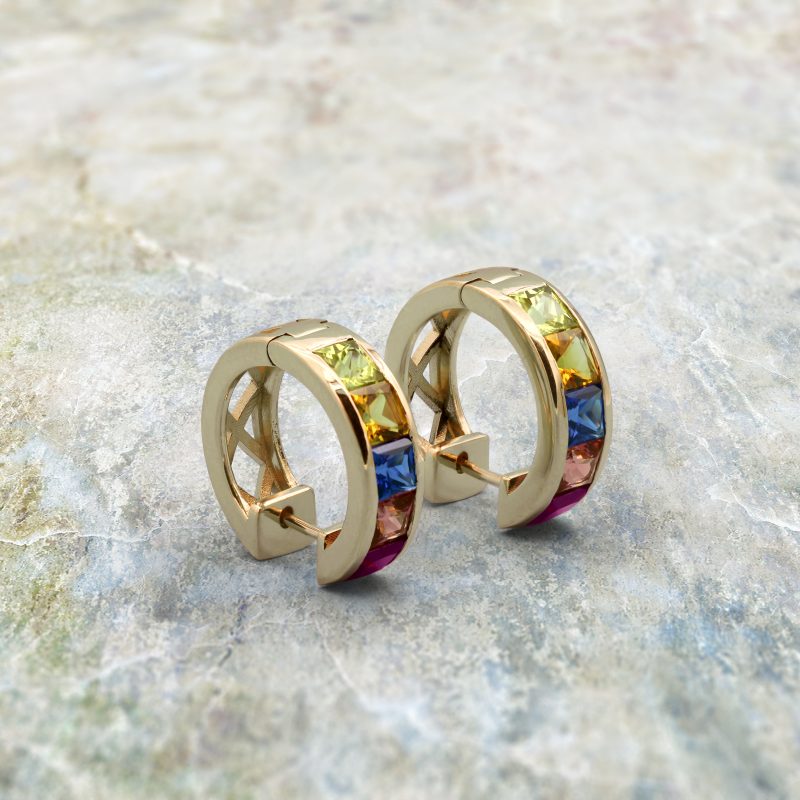
Hoop inside diameter 13mm (0.5in); outside diameter approximately 18.25mm. Five princess-cut stones set front-facing; criss-cross lattice pattern on rear interior.
How they made it distinctive
-
01
Five princess-cut gemstones in a rainbow gradient recreate the original pair's color sequence from a single reference photo
-
02
Open criss-cross lattice on the rear of the hoop keeps the piece lightweight despite the stone-set front
-
03
Hoop diameter was fine-tuned twice using caliper measurements to match the scale of the lost original
-
04
Click-hinge closure chosen specifically for security after the client raised concern about the earrings coming loose
-
05
Ruby swapped in for a deeper, truer red than the original render to better match the remembered color
How you'd make it yours
Stone selection: this piece uses ruby, pink tourmaline, blue sapphire, citrine, and peridot; a new commission could use a different five-color sequence or fewer stones
Stone origin: this piece uses lab-created ruby and sapphire; a new commission could use natural stones for the same colors
Metal: this piece is 14k yellow gold; the same hoop design works in 18k yellow gold, white gold, or rose gold
Hoop size: made to this wearer's measured diameter; a new piece is sized to its own wearer
Closure: this piece uses a click-hinge closure; a new commission could specify a different latch style
One of a kind: this exact pair was designed and cast for one client's wife and is not reproduced — a new commission is an original piece inspired by this one, not a copy
Design changes made
The hoop size was increased twice after the resin sample felt smaller than the original — first to confirm a 13mm inside diameter, then scaled up roughly 10% to 13mm ID by 18.25mm OD after precise caliper measurements. The red stone was also shifted from a rendered ruby tone to an actual lab-created ruby for a deeper, truer color match.
Who this is for
This piece is for someone replacing a piece that carries real history — not just a lost accessory, but a marker of something the wearer lived through. It's especially right if you have only a photo and a memory to work from, and want the recreation to feel personal rather than generic.
How it's made
Once the design and gemstone options were finalized, the piece was 3D modeled and printed in resin to confirm proportions before any metal was committed — the resin was adjusted twice as sizing was refined. The approved model was then printed in wax, attached to a wax tree, and invested in plaster; the flask was fired in a kiln to burn out the wax, leaving a hollow mold. Molten 14k yellow gold was cast into the mold, cooled, and removed for finishing.
After casting, the hoops were cleaned and polished to a bright finish, with the open criss-cross lattice on the rear left unpolished-free to keep the hoop lightweight. The five princess-cut gemstones — lab-created ruby, pink tourmaline, lab-created blue sapphire, citrine, and peridot — were set in sequence across the front face of each hoop, finishing with the hinge and click-closure mechanism tested for secure engagement.
Key note
The gemstones were sourced and received before the final model was adjusted, because the exact dimensions of each cut stone had to be confirmed before the metal housing could be finalized.
Pricing guidance
Gold hoop earrings set with five fitted colored gemstones sit in the mid-to-upper range for custom earrings of this complexity. Most of the added cost comes from sourcing five different gemstone types in matching cuts and sizes, plus the hand-fitting required once the stones arrive. Metal karat and the choice between lab-created and natural stones are what move the price most from there.
Moves price up ↑
- ↑ Using natural stones instead of lab-created versions for the sapphire and ruby
- ↑ Increasing the hoop diameter or stone size beyond what's shown here
- ↑ Upgrading to 18k gold instead of 14k
- ↑ Adding a safety latch or additional locking mechanism beyond the standard click closure
- ↑ Using higher-clarity or custom-cut stones that require special sourcing
Moves price down ↓
- ↓ Reducing the number of colored stones from five to three
- ↓ Using cubic zirconia or synthetic stones for the colored gems instead of lab-created gemstones
- ↓ Choosing a smaller hoop diameter
- ↓ Using a single stone type instead of five different gemstone varieties
- ↓ Selecting 10k gold instead of 14k
Questions people ask
Yes, a single clear photo along with a detailed written description of the stones, metal, and proportions is often enough to build an accurate 3D model. The process starts with a render for approval, and a resin sample can be printed and shipped so the actual size can be checked in person before casting. Adjustments to scale and proportion are normal at this stage and don't require starting over. The more reference detail provided — even just approximate measurements against a known object — the closer the first render will land to what's remembered.
Lab-created gemstones share the same chemical structure, hardness, and visual appearance as their natural counterparts — a lab-created ruby and a natural ruby look identical to the eye and have the same durability. The difference is origin and cost: natural stones are mined and priced based on rarity, while lab-created stones are grown in controlled conditions and typically cost significantly less. For a multi-stone piece like this, lab-created stones make it possible to use five different gemstone types without the cost scaling as dramatically.
A click or hinge-closure hoop snaps into place with an audible click and is designed to stay secure through normal daily wear. If the earring doesn't click fully shut, it may need a small adjustment from a local jeweler to tighten the hinge mechanism. This closure style is generally more secure than a simple friction or wire-through design because it locks mechanically rather than relying on tension alone. It's a common choice for hoops that will be worn daily rather than removed often.
Princess-cut stones have pointed corners that are more prone to chipping than rounded cuts if struck directly, but in a setting like this — where the stones are channel-set into a hoop rather than raised and exposed — the corners are largely protected by the surrounding metal. Stones like sapphire and ruby rank 9 on the Mohs hardness scale, among the hardest gem materials available, while tourmaline, citrine, and peridot are softer but still suitable for regular wear. Earrings generally see less impact than rings since they aren't exposed to hands-on activity. Routine care — avoiding hard knocks and occasional professional cleaning — keeps the setting secure long-term.
Multi-colored gemstone hoop earrings with five individually set stones typically fall in the mid-to-upper range for custom earrings, largely because of the gemstone sourcing involved — finding five different stone types in matching cut and proportion takes more time than sourcing a single center stone. Choosing lab-created stones over natural ones is the single biggest lever for bringing the cost down while keeping the same look. Gold karat and hoop size are secondary factors that shift the price from there.
A piece like this typically takes four to five weeks once the design and gemstones are finalized, plus the initial design and sizing phase before that. Multi-stone pieces can take a bit longer than single-stone designs because the stones must be sourced and received before the final metal model can be adjusted to fit them precisely. Expedited shipping is sometimes available once the piece is complete if there's a time-sensitive delivery need. Build in extra time for any sizing adjustments during the design phase, since those happen before production starts.
Yes, hoop diameter can be adjusted during the design and resin-sample phase before casting begins — this is the ideal time to catch sizing issues, since a solid cast hoop is far harder to resize afterward. Sending a printed resin sample lets you measure the actual inside and outside diameter with calipers before committing to metal. Small percentage adjustments, like scaling a hoop up by ten percent, are straightforward to make at this stage. Once the piece is cast in gold, especially with stones already set, size changes become much more limited.
Reasonably close, yes — a photo gives a strong reference point for hue, and the design team will typically propose a couple of gemstone options at different price points that approximate the colors shown. Exact matching has limits, since photo color can shift with lighting and camera settings, and natural variation exists within any gemstone type. For the closest match to a deeper or richer tone, a lab-created stone in a different variety (for example, choosing ruby over garnet for a deeper red) can get closer than sticking to a single stone category. It's worth flagging specific tone preferences early so the gemstone sourcing can account for them.
Check what our clients say about us

Jan & Glenn
5 years ago
About 5 years ago my wife was hit by a car on here bike. Aside from the broken bones and concussion, one of her favorite earrings didn't make it to the emergency room with her. Years later, she's recovered from the physical injuries but we've looked high and low for replacement earrings to no avail. I came upon this this site and sent them a picture and basic size information from the one remaining piece. What we received were earrings that are far nicer than the one that disappeared. These had five different color gemstones involved and the selection of stones by Jewelry This added an incredible amount of fire and sparkle to the finished pieces. We could not have been happier with the service, advice, and craftsmanship provided. Bravo JewelryThis!