
Five Nails Cufflinks — Silver Family Name Design
$$
Sterling silver
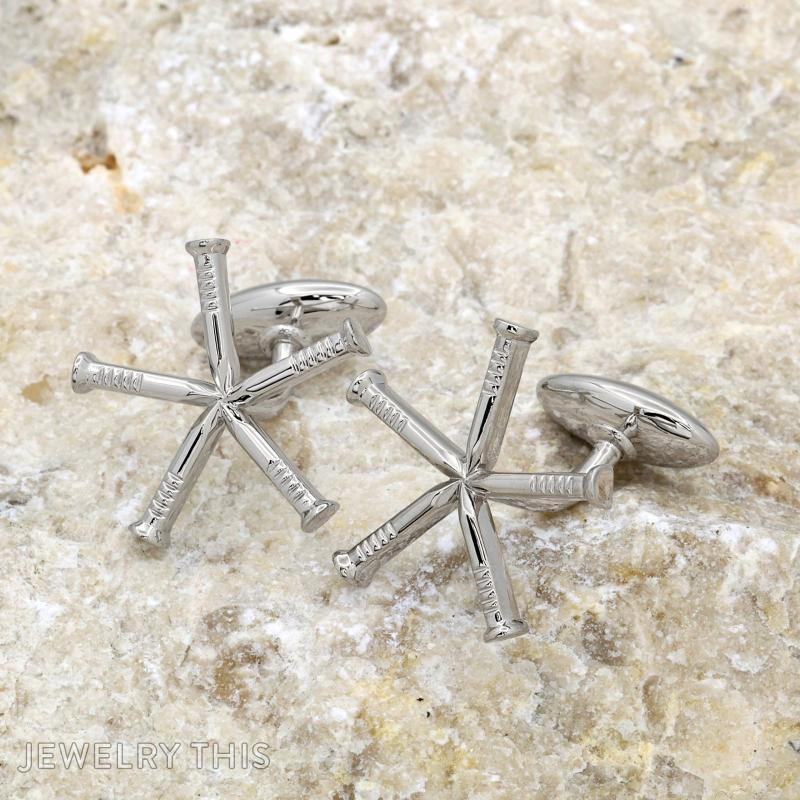
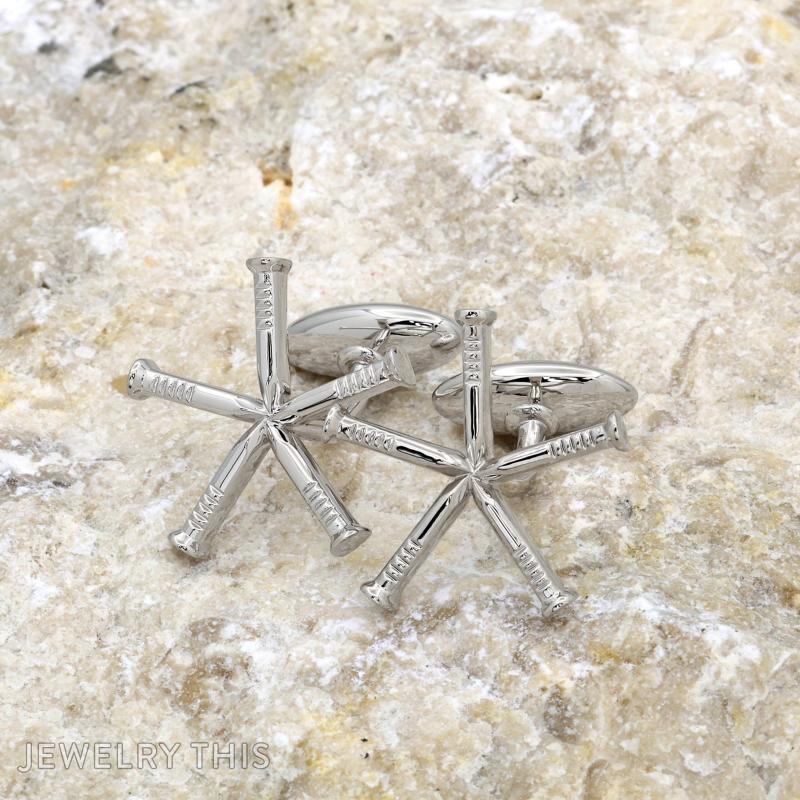
A client wanted cufflinks that reflected her family's name — five nails coming together for the five members of her family. She worked through two rounds of sketches to get the etching count and the way the nail points met in the center exactly right, then had the finished pair made as a gift for her son's wedding.
'We love it and would love to get this ordered.' — on design approval
'Thank you. We are excited.' — on delivery
Quick specs
Design type
Primary Metal
Primary Stone
Accent Stones
Design Complexity
Intent: Certainty
Size
Approximately 0.6in cut-out design per cufflink; five nail-form elements radiating from a center point, each nail head detailed with 5 etched lines.
How they made it distinctive
-
01
Five individual nail forms cast to stand alone rather than engraved into a background, for a lighter and more dimensional look
-
02
Each nail head etched with exactly 5 lines, refined down from an initial 6-line version at the client's request
-
03
Nail points reworked across two rounds of sketches to converge together at a single center point, rather than sitting as a looser cluster
-
04
Design connects directly to the family surname, with five nails representing the five members of the family
-
05
Backing reinforced at the center point during finishing to compensate for the structural fragility of the open design
How you'd make it yours
Element count: this piece uses five nail forms — a new commission could use a different number to represent a different family or group size
Metal: this piece is sterling silver — the same design language works in 14k white gold or other precious metals
Etching detail: this piece uses 5 lines per nail head — a new piece could vary the line count or add other surface texture
Overall size: this piece is sized close to 0.6 inches — a new commission could be scaled larger for more visual presence
One of a kind: this exact cufflink design was created for one client's family and is not reproduced — a new commission is an original piece inspired by this one, not a copy
Design changes made
The nail etching was changed from 6 lines to 5 per the client's request, and the nail points were reworked to meet together at the center rather than sit as a looser cluster, matching the family's five members.
Who this is for
This piece is for someone who wants a formal accessory that carries a private, personal meaning rather than a purely decorative motif. It's especially right for a family milestone gift, like a wedding, where the design itself becomes part of the occasion's story.
How it's made
Once the design was approved, a 3D-printed resin model was produced first — the physical preview of the piece before any metal was committed, and a photo of this resin was shared with the client so she could see the form ahead of casting. The resin was then used to build an investment mold, which was fired in a kiln to burn out the pattern, leaving a cavity into which molten sterling silver was poured to form the raw cufflinks.
After casting, each cufflink was cleaned and hand-finished to bring out the fine etched lines on each nail head, then polished to a bright reflective finish across all five nail forms. Because the open, cut-out design leaves the nails joined only at a single center point, the backing post was reinforced where it attaches to that center to keep the piece structurally sound for regular wear.
Key note
The center point where all five nails converge is the structural weak point of the design, so the cufflink backing was deliberately reinforced there during finishing to compensate for the open, stand-alone construction.
Pricing guidance
A sculptural cut-out cufflink design like this sits in the mid range for custom cufflinks of this complexity. The cost is driven mainly by the labor of modeling five separate stand-alone elements that must align and etch cleanly rather than a single engraved surface. Metal choice is the next biggest lever on price.
Moves price up ↑
- ↑ Upgrading from sterling silver to 14k or 18k white gold
- ↑ Adding more individual stand-alone elements beyond five
- ↑ Increasing the etching detail or adding stone accents to each element
- ↑ Enlarging the overall diameter beyond a compact design, which increases metal and finishing labor
Moves price down ↓
- ↓ Reducing the design to an engraved or raised motif on a solid background instead of a cut-out
- ↓ Simplifying to fewer stand-alone elements
- ↓ Choosing a smaller overall size to reduce metal and hand-finishing time
- ↓ Ordering multiple identical sets at once, which lowers the per-unit cost after the first pair
Questions people ask
Yes. A cut-out design means the shapes stand alone rather than being engraved into or raised from a solid background. This style requires more modeling and finishing work because each element has to be individually formed and aligned, but it produces a lighter, more dimensional look. It does mean the piece can be more delicate at very small sizes, so the connecting points are often reinforced during finishing.
Sterling silver is a solid choice for cufflinks that are not worn daily, such as for weddings or formal events. It's softer than platinum but holds detailed shapes and etching well, and with occasional wear it resists everyday wear and tarnish reasonably well as long as it's stored properly between uses. Silver can be polished again later if it dulls over time. For daily wear, a harder metal like white gold or platinum would hold up better long-term.
Sterling silver and white gold look similar in color when both are polished, but white gold is a precious metal with a higher material cost, so it runs significantly more than silver for the same design. White gold is also generally more durable for long-term or frequent wear. Many clients start with a silver pair to confirm they like a design before ordering the same design in a higher metal.
The design phase for a custom set typically takes about a week, during which sketches and a 3D render are refined based on feedback. Once the design is approved, production usually takes four to five weeks, covering wax/resin modeling, casting, finishing, and polishing. Fine, detailed designs like an open cut-out shape can occasionally need an extra pass through quality control before they're ready to ship.
Yes, this is a common request — a shape, initial, or symbol tied to a family name or personal meaning translates well into a small wearable piece like a cufflink. The key is working through a sketch phase to get the proportions and details right, since cufflinks are small and the design needs to read clearly at that scale. Symmetry and the exact positioning of elements are usually the details worth refining most carefully.
Yes, once a design is finalized and approved, additional pairs made from that same design typically cost less than the first pair. The first pair carries the design and modeling cost, while repeat pairs only carry the casting and finishing cost. This makes cufflinks a practical option for ordering multiple sets for groomsmen or family members.
Yes, dimensional cufflink designs are entirely possible and are usually modeled in 3D CAD before casting so the rounded forms read correctly at cufflink scale. A rounded, tapered form (like a nail shape coming to a point) reads more realistically than a flat silhouette. This does add some modeling time compared to a flat engraved design, since every angle has to be considered.
Occasionally a cast piece will not meet the finishing standard expected, particularly with delicate or open cut-out designs where thin connection points are more likely to show casting flaws. When this happens, the piece is remade rather than shipped as-is, which can add a week or two to the original timeline. This is done to make sure the finished piece is structurally sound for actual wear, not just visually acceptable.
Explore Similar Creations
Every masterpiece starts with a spark. Explore how our clients raw ideas - sketches, heirlooms, inspirations - were transformed into bespoke works of arts.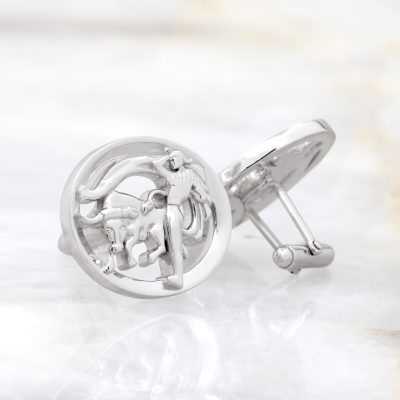
These sterling silver cufflinks were meticulously crafted to recreate a pair previously owned by the ...
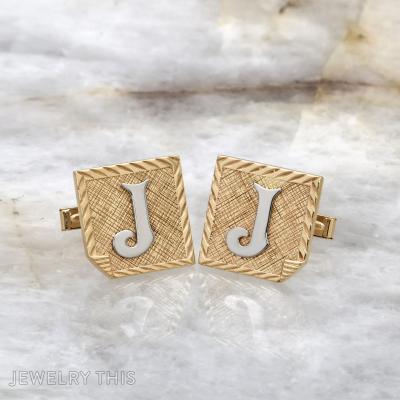
This exquisite pair of custom two -toned initial letter cufflinks blends timeless elegance with personalized ...

Our 1-inch silver moon cufflinks, each adorned with a constellation—Gemini and Aquarius. Meticulously crafted, the ...

These cufflinks blend sophistication with individuality. The timeless bar shape, expertly crafted in silver and ...




