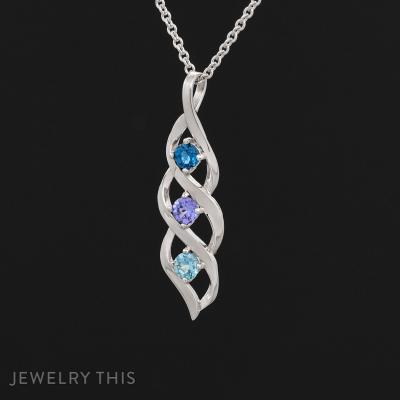
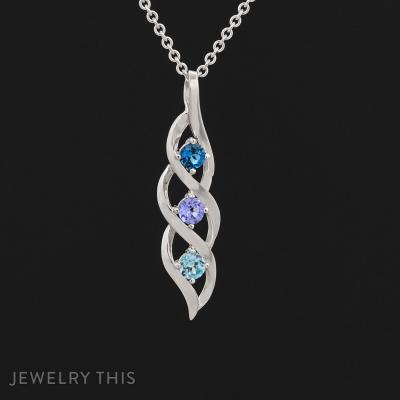
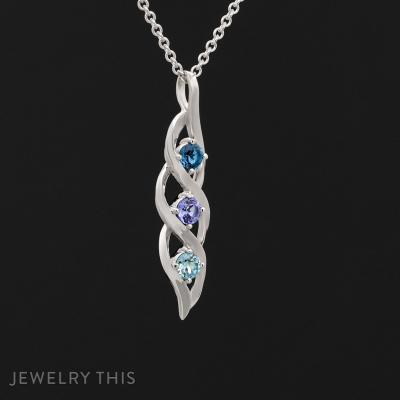
Triplet Birthstone Pendant — Three Stones, One Bond
$$
14k white gold, tanzanite, blue zircon, blue topaz
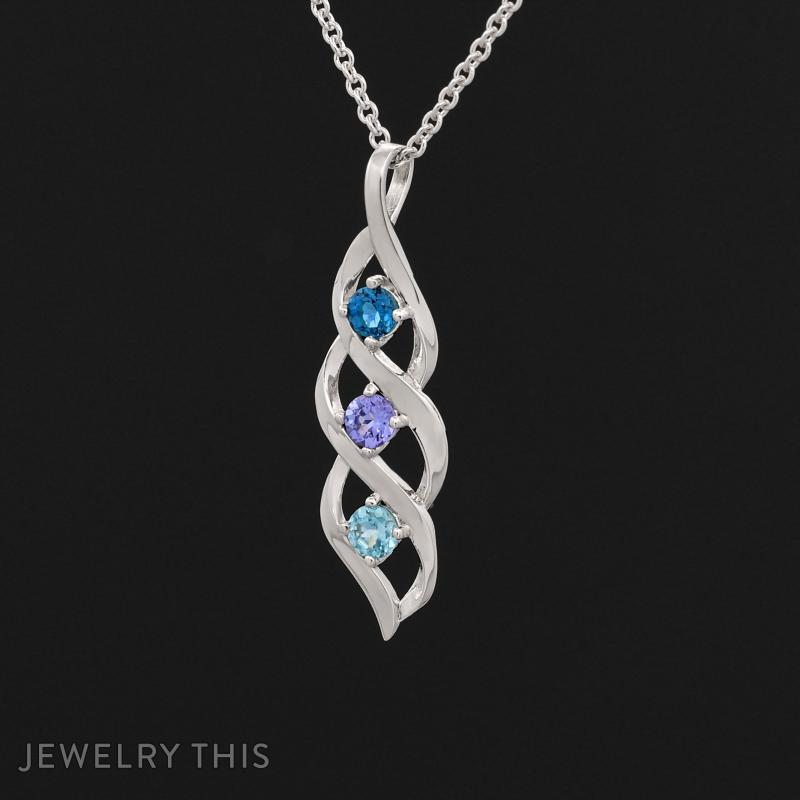
A husband wanted to mark the bond his wife shares with her two triplet sisters, all three born in the same December. Rather than one shared birthstone, he chose three different December birthstones — tanzanite, blue zircon, and blue topaz — so each sister's color stood apart within the same design. When he saw the finished render, he wrote: 'That looks absolutely fantastic. It's exactly what I had in mind.'
'That looks absolutely fantastic. It's exactly what I had in mind.' — on seeing the first render
Quick specs
Design type
Primary Metal
Shape / Cut
Primary Stone
Accent Stones
Design Complexity
Intent: Certainty
Size
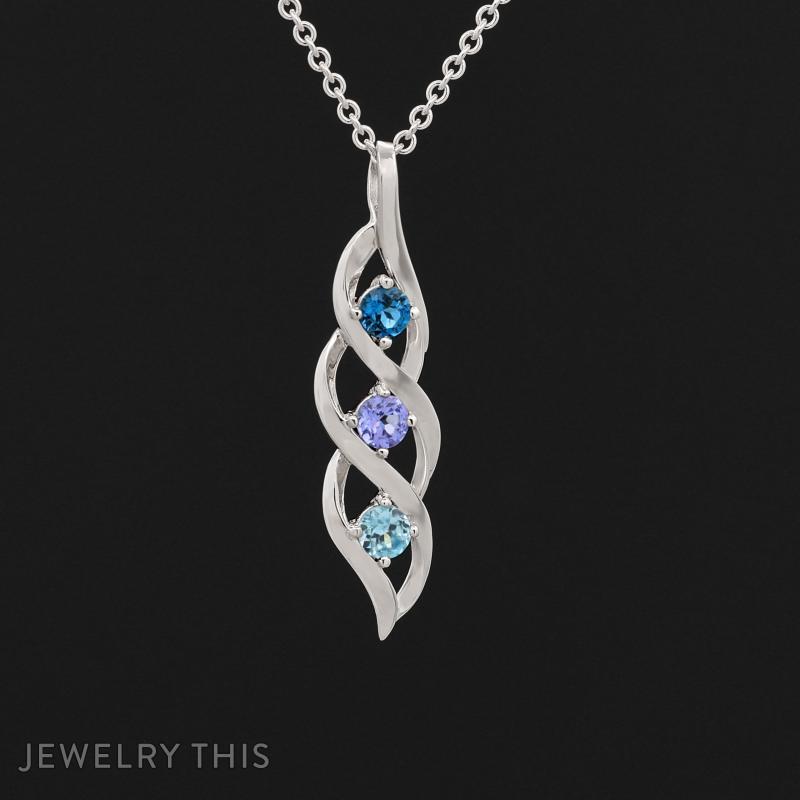
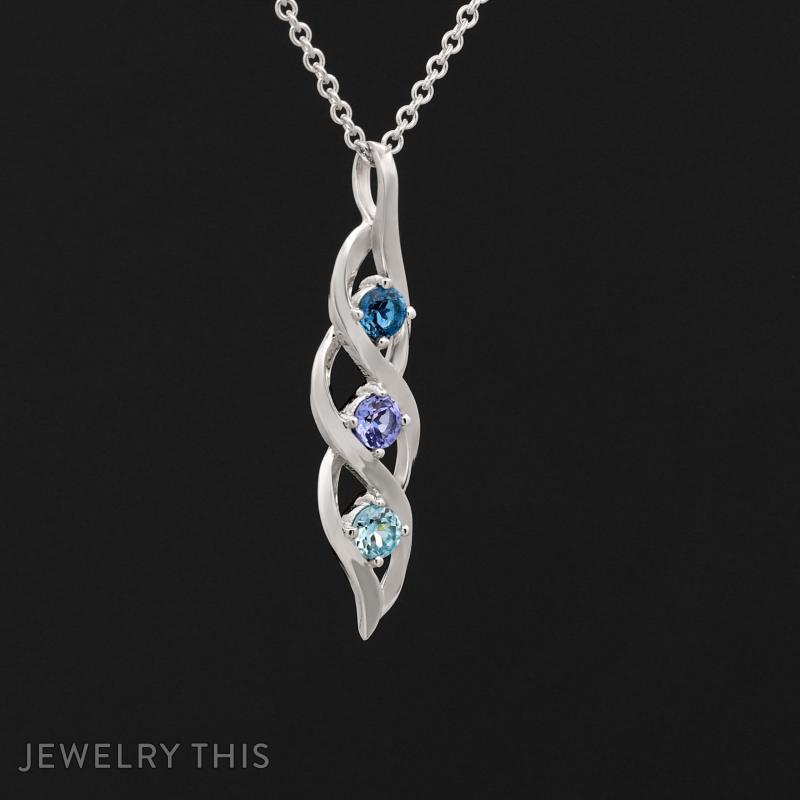
Pendant approximately 35mm drop length. Three round stones approximately 4mm each, arranged vertically along a twisting ribbon design.
How they made it distinctive
-
01
Three different December birthstones used instead of one repeated stone, so each of three sisters is represented by a distinct color
-
02
Open twisting ribbon silhouette chosen over a solid backing, letting each stone catch light independently
-
03
A fourth stone position deliberately reserved at the base for a future addition without disrupting the current design
-
04
White gold selected over sterling silver for added durability and more reliable holiday-season casting
-
05
Vertical three-stone arrangement kept intact rather than shifting the center stone, preserving the pendant's symmetry
How you'd make it yours
Stone selection: this piece uses tanzanite, blue zircon, and blue topaz; a new commission could use any combination of birthstones for a different month or family group
Metal: this piece is 14k white gold; the same twisting silhouette works in yellow gold, rose gold, or sterling silver
Stone count: this piece holds three stones with a reserved fourth position; a new commission could be designed for two, three, or more stones from the outset
Chain: this piece pairs with a matching white gold chain; a new commission could use an existing chain or a different metal chain
One of a kind: this exact pendant was designed for one client's family and is not reproduced — a new commission is an original piece inspired by this one, not a copy
Design changes made
The design was built with a fourth stone position at the base in reserve, so a birthstone for his mother-in-law could be added later without disturbing the arrangement of the original three. The metal was also changed from sterling silver to white gold after discussing durability and holiday production timing.
Who this is for
This piece is for someone who wants to represent more than one person in a single design without making everyone identical. It's especially right if you're marking a shared bond — siblings, triplets, a close family group — and want each person's presence in the piece to feel distinct rather than symbolic in a generic way.
How it's made
Once the twisting ribbon design was approved from the 3D render, a wax model was produced and used to create an investment mold. Molten 14k white gold was cast into the hollow mold, producing the raw pendant with its open, twisting silhouette intact from a single pour rather than assembled from separate pieces.
After casting, the pendant was cleaned up and polished to bring out the reflective quality of the white gold ribbon form, with attention paid to the open curves where light passes through the twists. The three round stones were then set by hand into their prong settings along the vertical run of the ribbon, positioned so each stone sits in its own segment of the twist. The piece was given a final quality check before the matching white gold chain was attached.
Key note
The design was engineered with an open fourth position at the base of the ribbon, so a later stone addition would not require re-casting or altering the original three-stone arrangement.
Pricing guidance
A multi-stone white gold pendant of this kind sits toward the mid range for custom pendant work. Most of the cost comes from the labor of hand-finishing an open, twisting metal form and setting several small stones individually rather than in a single cluster. Stone choice and metal type are what move the price meaningfully from there.
Moves price up ↑
- ↑ Adding a fourth or fifth stone position to the design
- ↑ Upgrading from sterling silver to platinum instead of white gold
- ↑ Using larger stones than the standard round accent size
- ↑ Adding milgrain or filigree detail along the twisting band
- ↑ Choosing a natural sapphire or diamond in place of one of the birthstones
Moves price down ↓
- ↓ Returning to sterling silver rather than white gold
- ↓ Reducing to two stones instead of three
- ↓ Choosing a simpler, non-twisting pendant silhouette
- ↓ Using a single birthstone shared by all three stones instead of three different types
- ↓ Skipping the matching chain and using an existing chain instead
Questions people ask
Yes, this is a common request when a piece needs to represent multiple people who share the same birth month but not the same personality or color preference. Each stone is set individually into its own prong setting, so the stones do not need to be the same shape or exact shade. December alone has several recognized birthstones, including tanzanite, blue zircon, blue topaz, and turquoise, which gives some room to choose colors that look good together. The main limitation is that stones cut in noticeably different styles, like turquoise's typically cabochon cut versus the faceted cut of the others, can be harder to set on one even surface.
White gold is more durable and harder than sterling silver, which matters more for a piece with an open, thin twisting design like this one because there is less bulk metal to resist bending. Sterling silver will tarnish over time with air exposure and needs occasional cleaning, while white gold holds its finish longer with normal wear. Cost difference between the two is often smaller than people expect on a pendant like this, since most of the price is in the hand-finishing and stone-setting labor rather than the raw metal itself. Either option will hold small round stones like tanzanite or topaz securely in prong settings.
Tanzanite rates around 6 to 7 on the Mohs hardness scale, which is softer than sapphire or diamond, so it's better suited to a pendant that isn't subject to frequent knocks than to a ring or bracelet. In a pendant setting like this one, where the stone sits protected within prongs and isn't exposed to the same daily impact as a ring, tanzanite performs well. It should still be kept away from harsh chemicals and ultrasonic cleaners, which can affect its clarity over time. A jeweler can typically re-polish or re-set a tanzanite if it gets scratched from years of wear.
A pendant with this level of design complexity — an open twisting metal form with three individually set stones — sits in the mid range for custom pendant work. The dominant cost driver is labor: hand-finishing the open silhouette and setting three separate stones takes more time than a single-stone pendant. Metal choice between sterling silver and white gold affects the price less than people expect, since labor makes up the majority of the total. Adding stones, upgrading metal to platinum, or adding decorative detail like milgrain would all push the cost higher.
The standard process runs about five to six weeks from first conversation to delivery, starting with roughly a week of design work including a sketch, 3D model, and render for approval. Once a design is approved and paid to the required deposit level, sourcing materials and casting typically takes several more weeks. Rush timelines are possible around holidays but depend on the studio's current workload and the complexity of the piece. A multi-stone piece like this one adds a small amount of time for stone sourcing and individual setting compared to a single-stone design.
It depends on whether the original design was built with a future stone position in mind. In this case, the design intentionally left an open segment at the base of the twisting ribbon so a fourth stone could be added later without disturbing the original three-stone arrangement or its symmetry. Retrofitting a stone position into a pendant that wasn't designed for it is possible but often requires more significant rework and can affect the piece's visual balance. If you know you may want to add a stone in the future, it's worth mentioning during the initial design conversation.
All three are recognized as December birthstones, but they look and behave differently. Blue topaz is the most widely available and affordable, typically a clear, bright blue. Blue zircon has a similar cool blue tone but with slightly more brilliance due to its higher refractive index. Tanzanite stands apart with a distinct purple-blue color and is generally the most valuable of the three, though it's also the softest and needs a bit more care over time.
Yes, though where a stone is added affects the design's symmetry. In this pendant, adding a fourth stone in the center would have required shifting the existing center stone to the side, which changes the visual balance of the piece. Adding the new stone at the bottom instead preserves the original vertical arrangement and was the option chosen here. Either approach is technically possible, but it's worth discussing the visual outcome with a designer before finalizing.
Explore Similar Creations
Every masterpiece starts with a spark. Explore how our clients raw ideas - sketches, heirlooms, inspirations - were transformed into bespoke works of arts.
The key to life always hangs around your neck, serving as a timeless symbol of ...

This custom pendant is a beautifully crafted sterling silver key design, making it a symbol ...

Crafted in sterling silver, this striking pendant captivates with its mesmerizing design. Fashioned into a ...

Crafted from 14K gold plated sterling silver, this pendant showcases a striking lightning bolt design, ...

This 3D dog pendant is a heartfelt tribute to a beloved canine companion. This pendant ...

Crafted in 14k white gold, this pendant showcases a captivating design that combines the shapes ...

Celebrate family bonds with this 1-inch pendant, designed in 14kt yellow gold. Its coin-like texture ...


Club logo pendant with dimensional text. This pendant is 2 inches in size and was ...

This sterling silver pectoral cross pendant is a striking symbol of faith and devotion. With ...