


Leaf Pendant in 14k Gold with Oval Emerald Center
$$
14k yellow gold, lab-grown emerald
N. came to us wanting a leaf pendant for his wife, built around an oval green emerald nestled in the leaves. He refined two small details after seeing the first render — asking for the bail to flow more naturally out of the leaf shape and for the veins to taper more distinctly toward the tips — and approved the revised design as final.
'I love it! ... Otherwise it's perfect!' — on seeing the first 3D render
'It looks great! I'm very happy with this as the final product' — on design approval
Quick specs
Design type
Primary Metal
Shape / Cut
Primary Stone
Accent Stones
Style
Design Complexity
Intent: Certainty
Size
Pendant approximately 0.75-1in long. Center stone approximately 0.75ct oval.
How they made it distinctive
-
01
Two overlapping leaves form an integrated setting that cradles the emerald without separate prongs
-
02
Vein engraving tapers from thick at the center rib to fine near the leaf tips, refined after the client's render feedback
-
03
Bail reworked to flow directly out of the top leaf rather than sitting as a separate loop
-
04
Oval lab-grown emerald chosen specifically to fit the organic leaf opening
-
05
Chain left unselected so the recipient can choose her own
How you'd make it yours
Stone: this piece uses a lab-grown emerald; a new commission could use a natural emerald or a different green stone for a similar look
Metal: this piece is 14k yellow gold; the same leaf design works in 18k gold or rose gold
Stone shape: this piece frames an oval stone; a new leaf design could be adapted around a round or pear shape
Scale: this piece sits just under an inch; a new commission could be sized larger or smaller
One of a kind: this exact pendant was designed for one client's wife and is not reproduced — a new commission is an original piece inspired by this one, not a copy
Design changes made
The bail was reworked to flow more smoothly out of the top leaf rather than sitting as a separate loop, and the leaf veins were adjusted to taper more visibly from center to tip, both requested after the client reviewed the first render.
Who this is for
This piece is for someone choosing a gift with a specific image already in mind rather than browsing a catalog for something close enough. It suits a partner who wants nature-inspired jewelry that reads as refined rather than rustic, with a center stone treated as part of the design rather than just mounted on top.
How it's made
Once the 3D design was approved, the pendant was first produced as a 3D-printed wax model, which was attached to a wax tree and invested in plaster. The flask was fired in a kiln to burn out the wax, leaving a hollow mold, and molten 14k yellow gold was cast into that mold under pressure. After cooling, the raw casting was broken out of the mold and prepared for finishing.
The cast pendant was cleaned up and polished to a uniform bright finish across the leaf surfaces, with the incised vein lines left crisp against the polished metal to keep the texture readable. The oval lab-grown emerald was then set into the recess formed between the overlapping leaves, where the surrounding gold itself holds the stone in place rather than a separate prong structure.
Key note
The leaves themselves form the stone's setting — the overlapping gold shapes were designed to cradle the emerald directly, without a separate prong or bezel structure layered on top.
Pricing guidance
A moderately detailed gold leaf pendant with a lab-grown center stone sits toward the lower end of the mid-range for custom pendant work. Most of the cost comes from the hand-finishing needed to keep carved vein detail crisp after casting, plus the stone itself. Metal purity and stone origin are the two levers that move the price most from there.
Moves price up ↑
- ↑ Upgrading from lab-grown to natural emerald of comparable size and clarity
- ↑ Increasing the stone size beyond roughly 0.75 carats
- ↑ Moving from 14k to 18k gold
- ↑ Adding stone-set accents along the leaf edges or bail
- ↑ Extending the leaf wrap to a fuller, more dimensional 3D form
Moves price down ↓
- ↓ Reducing the center stone size
- ↓ Choosing a more common stone cut that requires less custom calibration
- ↓ Simplifying the vein engraving to fewer lines
- ↓ Using sterling silver with gold plating instead of solid 14k gold
- ↓ Omitting the hand-finishing pass on the incised detail
Questions people ask
Yes. A lab-grown emerald has the same chemical composition and hardness as a natural emerald, rated around 7.5 to 8 on the Mohs scale, so it wears the same way day to day. Emeralds of either origin tend to have natural inclusions that can make them slightly more prone to chipping than diamonds or sapphires, so a pendant setting like this one — where the stone sits nestled in metal rather than exposed on raised prongs — offers a bit more protection. The main practical difference between lab-grown and natural is cost, not durability or appearance. Most people cannot tell the two apart without lab equipment.
From approved design to finished piece, a pendant like this typically takes about three to four weeks in production, plus one to two weeks of design time before that. The design phase includes a technical sketch, a 3D render for approval, and usually one or two rounds of small adjustments. Production covers wax printing, casting, finishing, and stone setting. Rush timelines are sometimes available but add to the standard process.
A pendant like this, with a moderately detailed leaf design and a lab-grown center stone around three-quarters of a carat, sits toward the lower end of the mid-range for custom pendant work. The main cost driver is the hand-finishing required to keep engraved vein detail sharp after casting, along with the stone itself. Switching to a natural stone or a higher karat gold would push the price up from there, while simplifying the engraving or using silver would bring it down.
Yes, this is a normal part of the design process. On this piece, the client asked for the leaf veins to taper more noticeably from the center rib to the leaf tip, and for the bail to blend more smoothly into the top leaf shape. Both changes were made to the 3D model before casting, since adjustments are far easier to make digitally than after the metal is cast. There are practical limits — veins can only be made so thin before they become fragile, so extremely dramatic tapering isn't always possible.
14k gold does not tarnish the way silver does, since it is a durable alloy that resists everyday wear well. It can pick up a light film of oils or lotion over time, which is easily removed with a soft cloth or a mild soapy water soak. The polished finish on a pendant like this will keep its shine with normal care, though any engraved detail should be cleaned gently rather than scrubbed to avoid wearing down the fine lines. 14k is a common choice for pieces meant to be worn regularly because it balances durability with a rich gold color.
Yes, the leaf wrap design was specifically built to cradle an oval stone, but the same overall concept can accommodate other shapes with some adjustment to the leaf opening. A round or pear-shaped stone, for example, would change the proportions of the gap between the leaves slightly. The design team typically builds a technical sketch first specifically to work out how a given stone shape will sit within the leaf form before moving to a 3D render.
Neither — on this pendant, the stone sits in a recess formed where the overlapping leaves meet, and the surrounding gold itself holds the stone in place. This is sometimes called an integrated or sculptural setting, since the setting function is built into the design rather than added as separate prongs or a bezel. It gives a cleaner look with less visible metal, though it does require the stone to be cut to fit that specific recess precisely. This approach works well for organic, nature-inspired designs where visible prongs would interrupt the flow of the shape.
Yes, many clients prefer to select their own chain separately, especially when they want to leave that choice to the person receiving the gift. The pendant's bail is sized to accommodate a standard chain width, so it will work with most chains sourced elsewhere. If you'd rather have chain options included as part of the order, that can be arranged as well, with the cost added to the total.
Explore Similar Creations
Every masterpiece starts with a spark. Explore how our clients raw ideas - sketches, heirlooms, inspirations - were transformed into bespoke works of arts.
Elegance takes flight with this custom origami bird pendant. Meticulously crafted in white gold, the ...
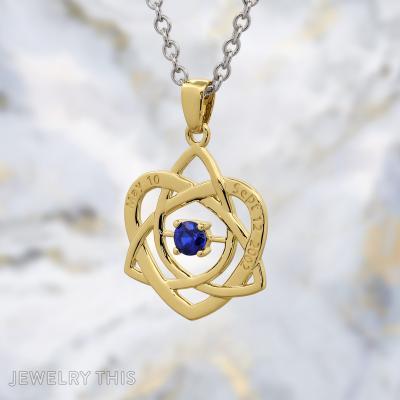
This pendant takes an interlocking Celtic-knot heart design and reworks it in 14k yellow gold, ...

This pendant centers a round lab-grown emerald inside a cushion-shaped double halo of small round ...

Expertly crafted in lustrous 14k yellow gold, this custom pendant features a charming cutout design ...

This lovely gold plated silver pendant is a symbol of love, commitment and family. The ...

This sterling silver pendant showcases a beautifully customized U-shaped top accompanied by a dangling number ...

This rectangular pendant draws its structure from a vintage Art Deco brooch design, reworked into ...

Circular 14k yellow gold pendant featuring client’s logo. Size of pendant: 1 inch

This pendant renders the Roman numeral XXII entirely in pave-set round diamonds, sized to sit ...

This custom dinosaur pendant is crafted in 14K yellow gold. The dinosaur pendant stands at ...

With deep personal significance, this 1.5-inch 14kt yellow and white gold pendant beautifully represents the ...

Embark on an enchanting journey with this custom dragonfly pendant, meticulously crafted in 14k white ...



