


Gold Star Lapel Pin with Diamond Milestone Accents
$$$$
Sterling silver, 14k yellow gold, lab diamonds, sapphires, emeralds
An organization came to us wanting a set of lapel pins to mark different milestone levels, using one consistent star shape with the stone count and placement changing to signal each tier. They reviewed renders of every version before approving the full set for production, including a late addition for a milestone that had no recipients yet. When the pieces arrived, the client wrote that the design itself was well received, though a hardware issue with the pin backings came up afterward.
'looks great' — on seeing the first renders
'Looks great!' — on design approval
'everything was great' — on delivery
Quick specs
Design type
Primary Metal
Secondary Metal
Shape / Cut
Primary Stone
Design Complexity
Intent: Certainty
Size
Not specified
How they made it distinctive
-
01
One shared star-outline model used across every milestone tier, with only stone count and placement changed to differentiate versions
-
02
Open, hollow-center star shape rather than a solid silhouette, giving the design a lighter, more linear look
-
03
Produced across two metals — sterling silver and 14k yellow gold — to visually separate milestone levels within the same organization
-
04
Stone combinations (sapphires, emeralds, lab diamonds) varied deliberately by tier rather than using one uniform gem across the set
-
05
An additional milestone version was rendered and approved in advance of having any recipients for it, future-proofing the recognition program
How you'd make it yours
Metal: this set uses sterling silver and 14k yellow gold — a new commission could use a single metal throughout, or add white or rose gold tiers
Stone combination: this set mixes sapphires, emeralds, and lab diamonds — a new design could use a single stone type or a different palette
Stone type: lab diamonds were used here — natural diamonds or other gems could be substituted for a different look
Backing hardware: standard clutch backings were used — screw-style or locking clutches are available for more secure attachment
Number of tiers: this set has a fixed number of milestone levels — a new commission could scale up or down the number of versions
One of a kind: this exact pin set was designed for one organization's recognition program and is not reproduced — a new commission is an original set inspired by this one
Design changes made
The client requested an additional version be rendered for a milestone tier with four diamonds and one emerald before anything had been produced for it, so the full milestone range would be ready even without a current recipient. Otherwise the approved design carried through production unchanged.
Who this is for
This is for an organization that wants a recognition or milestone program with real visual continuity — where someone can look at a pin and immediately know what tier or achievement it represents. It suits a group planning ahead for future milestones, not just the ones with current recipients, and one that wants the design refined through renders before committing to production across every tier.
How it's made
Each pin began as a 3D-printed wax model, attached to a wax tree and set into a flask. The flask was placed in a kiln to burn out the wax, leaving a hollow mold shaped exactly like the star. Molten metal — sterling silver for most of the set and 14k yellow gold for the remainder — was then poured into the mold under heat and allowed to cool before the raw piece was removed for finishing.
After casting, each star was cleaned and polished to bring out the high shine on the tapered points and open framework. The round stones — sapphires, emeralds, and lab diamonds depending on the tier — were set by hand at the inner angles of the star in the exact placement approved in the renders. A pin stem and clutch backing were then attached to the reverse so each piece could be worn on a lapel.
Key note
Because the set used one shared star model with only the stone count and placement changed between versions, the design team could alter a single master file to generate every milestone tier rather than building each pin from scratch.
Pricing guidance
A multi-piece lapel pin set like this, produced across two metals with varying diamond, sapphire, and emerald accents per tier, sits toward the higher end for custom organizational jewelry given the volume and the per-piece hand-setting required. Most of the cost comes from the number of individual pieces produced and the gem-setting labor across every version, rather than from any single pin's complexity. Metal choice per tier and total stone count across the set are the biggest levers on the total.
Moves price up ↑
- ↑ Increasing the number of pieces produced across the full milestone set
- ↑ Using 14k gold rather than sterling silver for more tiers in the set
- ↑ Adding more stones per tier, or upgrading to larger stones
- ↑ Introducing additional milestone tiers requiring new renders and models
- ↑ Using natural diamonds or sapphires instead of lab-grown stones
Moves price down ↓
- ↓ Producing the set in sterling silver only, without a gold tier
- ↓ Reducing the total number of pieces ordered
- ↓ Limiting the design to fewer milestone tiers
- ↓ Using a single accent stone type across all tiers instead of mixing sapphires, emeralds, and diamonds
- ↓ Simplifying the clasp/backing hardware specification
Questions people ask
This set was produced in two metals: sterling silver for most of the tiers and 14k yellow gold for others, used to visually distinguish milestone levels. Sterling silver is a .925 alloy that holds a bright polish well and is durable for everyday lapel wear. 14k yellow gold costs more but carries a warmer tone and will not tarnish the way silver can over time. Both metals were cast from the same star-shaped model, so the design reads consistently across tiers regardless of metal.
Yes, and this set used lab-grown diamonds for its diamond-accented tiers. Lab diamonds are chemically and optically identical to natural diamonds, with the same hardness and sparkle, but are typically lower in cost. For a design with multiple accent stones across several pieces, lab diamonds make it more practical to maintain consistent quality across every version. The visual difference between lab and natural diamonds is not detectable to the naked eye.
A pin backing, also called a clutch, is a small spring-loaded piece that slides onto the pin's post and grips it through friction or a locking mechanism. Standard clutch backings can vary in quality, and a loose or worn clutch may allow a pin to slide off the post over time rather than staying locked. If a clutch isn't gripping properly, replacement backings are a simple and inexpensive fix, though persistent slipping can point to a mismatch between the post design and the backing style used. Screw-style or locking clutches generally offer more security than basic friction clutches for pieces worn regularly.
A set like this, with multiple milestone versions produced across two metals and varying gemstone combinations, falls in the higher range for custom organizational jewelry because of the volume of pieces and the hand-setting required on each one. The primary cost driver is the number of pieces produced and the total stone count across the full set, not the complexity of any single pin. Choosing a single metal for the whole set, or limiting the number of milestone tiers, are the two factors that most reduce the total cost.
After a design is approved, production typically takes about four to five weeks, following an initial design and rendering phase. For a multi-piece set with several milestone versions, the rendering phase may take a bit longer since each version needs its own visual review before the whole set is approved together. Casting, finishing, and stone-setting then happen across all pieces before they ship as a completed set. Adding a new tier after the initial approval, as happened with this set, can extend the overall timeline slightly.
Yes, this is a common request for ongoing milestone or recognition programs. Because the base design exists as a model, the design team can alter the stone count and placement to create a new tier without rebuilding the piece from scratch. This makes it practical to expand a recognition program over time as new milestones are reached, even if there are no recipients for a tier yet. The new version typically goes through its own render and approval step before being added to production.
Sterling silver is a reasonably durable choice for lapel pins, standing up well to the kind of occasional wear a lapel pin typically receives. It can tarnish over time with air exposure, though regular polishing restores its shine. The open, tapered-point star design in this set doesn't have thin or fragile elements that would be prone to bending or breaking under normal handling. For organizational pins passed between recipients or worn at events rather than daily, sterling silver generally holds up well.
If a pin backing isn't holding securely, replacement clutch backings are typically available as a simple fix and can usually be swapped onto the existing post without any rework to the pin itself. If the issue persists across multiple backings, it may point to a mismatch between the post and backing style rather than a flaw in the pin itself, which is worth having a jeweler look at directly. Sending a sample piece back to the original maker allows them to inspect the post and backing fit and recommend the right hardware. This kind of hardware issue is separate from the pin's casting or stone-setting quality.
Explore Similar Creations
Every masterpiece starts with a spark. Explore how our clients raw ideas - sketches, heirlooms, inspirations - were transformed into bespoke works of arts.
This tie bar was built around a client-sourced pre-made bar rather than cast from scratch, ...
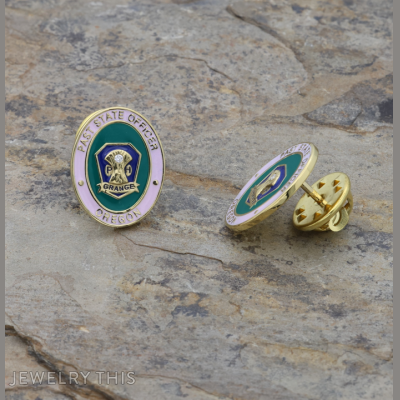
This oval lapel pin reproduces a state agricultural organization’s past-officer insignia — a wheat sheaf ...

This lapel pin takes the classic “I ❤ [Name]” motif and renders it as an ...

This piece pairs a pave-set diamond infinity symbol with a single bezel-set diamond stud, the ...



