


Cardinal Charm Bracelet — Platinum & Rose Gold, Ruby Eye
$$$
Platinum, 14k rose gold, natural diamonds, natural ruby
A woman wanted to honor her best friend, who had passed away from cancer, by giving her friend's daughter something to wear on her wedding day. The cardinal was chosen as a quiet stand-in for her friend's memory, and the design moved through several rounds of adjustment — enamel to a ruby eye, a diamond center to a sculpted rose gold bird — until it felt right. The piece was delivered in time for the bride's bridal shower.
'I love the robin so much.' — on seeing the final render
Quick specs
Design type
Primary Metal
Secondary Metal
Shape / Cut
Primary Stone
Design Complexity
Intent: Certainty
Size
Bracelet length 7.5 inches. Double chain style, platinum, with 6 bezel-set round diamonds spaced along the chain.
How they made it distinctive
-
01
Cardinal centerpiece sculpted with real dimension rather than as a flat silhouette, chosen as a quiet personal symbol rather than an obvious memorial piece
-
02
Ruby set into the eye instead of a diamond or enamel outline, adding a single deliberate point of color
-
03
Cardinal cast in 14k rose gold while the chain is platinum — two metals chosen specifically for contrast and integrated directly into the chain rather than mounted on top
-
04
Six bezel-set diamonds spaced along a platinum double-strand chain for subtle sparkle without overwhelming the centerpiece
-
05
Design went through multiple rounds of adjustment specifically to avoid looking like a pendant glued onto a bracelet
How you'd make it yours
Centerpiece animal: this piece uses a cardinal; a new commission could use any bird or animal meaningful to the client
Eye stone: this piece uses a ruby; a new commission could use a diamond, sapphire, or other colored stone
Metal combination: this piece pairs platinum chain with rose gold centerpiece; a new commission could use all platinum, all gold, or a different two-metal pairing
Diamond count: this piece has six bezel-set diamonds; a new commission could use more, fewer, or none
Chain style: this piece uses a double-strand chain; a new commission could use a single strand or a different link style
One of a kind: this exact bracelet was designed for one client's specific tribute and is not reproduced — a new commission is an original piece inspired by this one, not a copy
Design changes made
The cardinal's eye moved from a planned diamond or enamel outline to a single ruby for a touch of color, and the centerpiece itself shifted from a flat diamond pendant to a dimensional rose gold bird integrated directly into the platinum chain rather than sitting on top of it. Both changes were driven by the client's wish for something subtle rather than showy.
Who this is for
This piece is for someone who wants to carry a person's memory in a way that feels personal rather than obviously sentimental — a detail only they and a few others will fully understand. It suits someone attending a milestone occasion who wants the gift itself to quietly mark an absence, worn alongside everything else rather than announcing it.
How it's made
Once the design was finalized, the piece was 3D printed in wax and attached to a tree within a flask. The flask was invested in plaster and fired in a kiln to burn out the wax, leaving a hollow mold. Molten platinum was then cast into the mold for the chain, while the cardinal centerpiece was cast separately in 14k rose gold, since the two metals require different casting temperatures and cannot be poured together.
After casting, the platinum chain was cleaned, assembled into its double-strand structure, and brought to a high polish finish. The rose gold cardinal was finished separately and polished before a small ruby was hand-set into the eye. Six round diamonds were then bezel-set directly into the platinum chain, spaced evenly along both sides of the centerpiece, before the cardinal was joined to the chain as the bracelet's focal point.
Key note
The cardinal and the chain were cast separately in different metals — rose gold and platinum — because the two metals require different pouring temperatures and cannot be cast together in a single mold.
Pricing guidance
A platinum bracelet with a sculpted bi-metal centerpiece and several bezel-set diamonds sits in the mid range for custom bracelets of this complexity. Platinum itself carries a higher baseline cost than gold or silver due to the density and value of the metal, and casting two different metals separately adds labor. Diamond quality and count are the other major variables that move the price from there.
Moves price up ↑
- ↑ Choosing mined diamonds over lab-created diamonds for the bezel-set accents
- ↑ Increasing the diamond count along the chain beyond six
- ↑ Adding stone detailing or pave work to the cardinal centerpiece itself
- ↑ Using platinum for the cardinal as well as the chain, rather than a mixed-metal approach
- ↑ Upgrading the ruby eye to a larger stone or adding ruby accents elsewhere
Moves price down ↓
- ↓ Using white gold instead of platinum for the chain to lower the base metal cost
- ↓ Reducing the diamond count along the chain
- ↓ Switching to lab-created diamonds instead of mined for the bezel accents
- ↓ Using a single-strand chain instead of the double-strand design
- ↓ Simplifying the cardinal to a flatter, less dimensional form
Questions people ask
Yes, platinum is one of the most durable precious metals available and holds up very well to daily wear. It is also naturally hypoallergenic, which makes it a good choice for people with sensitive skin. Unlike white gold, platinum does not require rhodium replating to stay white, since its natural color does not fade or yellow over time. The tradeoff is that platinum is denser and heavier than gold, so a platinum chain will feel more substantial than the same design in gold.
Yes, mixed-metal designs like a rose gold centerpiece on a platinum chain are a common approach when a client wants visual contrast or a specific color for a decorative element. The two metals are cast separately, since they require different pouring temperatures, and then joined together during assembly. This lets the designer use the ideal metal for each part of the piece rather than compromising on one metal throughout.
A platinum bracelet with a sculpted centerpiece and several bezel-set diamonds generally falls in the mid range for custom bracelet work. Platinum has a higher baseline material cost than gold or sterling silver, and a bi-metal design with separately cast components adds labor cost on top of that. Diamond count and whether the stones are lab-created or mined are the two factors that most affect the final price.
Lab-created and mined diamonds are chemically and visually identical — the same hardness, brilliance, and clarity grading apply to both. The difference is origin: mined diamonds are extracted from the earth, while lab-created diamonds are grown in a controlled setting. For small bezel-set accent stones like these, lab-created diamonds typically cost meaningfully less than mined diamonds of the same clarity grade, with no visible difference to the naked eye.
A piece with this level of detail — a sculpted bi-metal centerpiece, a hand-set ruby, and six bezel-set diamonds along a double-strand chain — typically takes three to four weeks once the design is finalized and production begins. The process includes wax printing, casting each metal separately, finishing and polishing, hand-setting the stones, and final assembly. Because each step depends on the one before it finishing properly, the timeline can extend if adjustments are needed along the way.
Yes, a small charm or centerpiece can be sculpted with real dimension — wings, feathers, and other details rendered in three dimensions rather than as a flat silhouette. This requires more detailed 3D modeling and hand-finishing than a flat engraved or cut-out design, but it produces a more lifelike and tactile result. The tradeoff is that very small dimensional pieces have practical limits on how much fine detail can be preserved once cast.
Yes, a small ruby or other colored stone can be hand-set into a detail as small as an eye on a charm or figural centerpiece, provided the design accounts for a secure setting at that scale. This is typically done with a small bezel or flush setting that holds the stone without prongs, which would be too fragile at that size. It is a common way to add a single point of color to an otherwise monochrome metal design.
Not really — platinum and 14k rose gold are both durable, daily-wear-appropriate metals that do not require special maintenance beyond normal jewelry care. Platinum will develop a soft patina with wear, which many people like, though it can be re-polished to a high shine at any time. Rose gold holds its color well since the copper alloy is mixed throughout the metal rather than plated on the surface. Both metals can be cleaned with mild soap and water or a standard jewelry cleaning cloth.
Explore Similar Creations
Every masterpiece starts with a spark. Explore how our clients raw ideas - sketches, heirlooms, inspirations - were transformed into bespoke works of arts.
This bracelet centers a round engraved charm set into an oval-link chain, designed to display ...

A symbol of sisterly love and lifelong bond, these matching bracelets were crafted to commemorate ...

Adorn your wrist with the timeless beauty of this custom bangle bracelet—a harmonious fusion of ...

Ignite your sparkle with this stunning Cut-Out Star Bracelet, beautifully crafted in luxurious platinum and ...

Presenting a distinctive Art Deco-inspired white gold onyx and diamond bracelet, carefully crafted in a ...
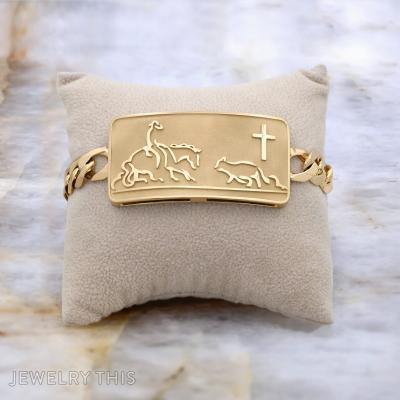
This bracelet centers on a large rectangular ID plate cast in solid 14k yellow gold, ...

This bracelet pairs a fine curb-link chain in 14k yellow gold with a small script-style ...

This cuff-style bracelet emanates comfort and meaning. Designed to fit snugly while embracing the wearers ...

This sterling silver bangle bracelet centers on a sculpted pair of clasped hands, inspired by ...

Embrace the harmonious blend of color and elegance with this captivating custom bracelet. Crafted in ...

This bracelet centers on a small 14k yellow gold disc, engraved with a vertical dividing ...
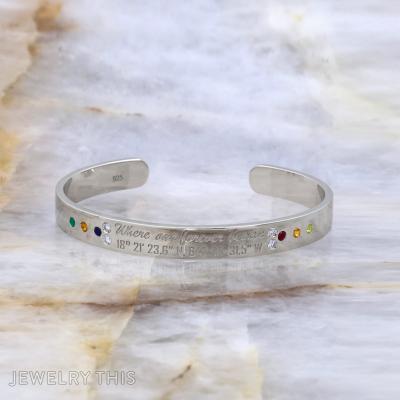
This sterling silver cuff bracelet was designed around a couple’s wedding coordinates and a phrase ...



