Platinum Harp Pendant — Graduation Gift for a Performer
$$$$$
Platinum, lab diamonds, amethyst-tone accent stones
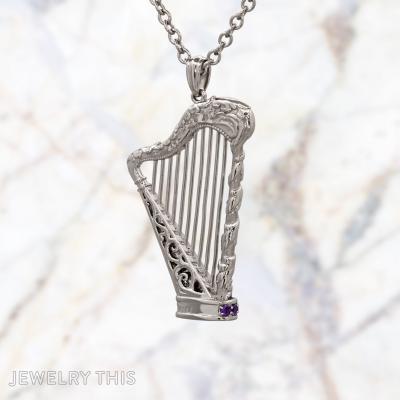
A mother wanted a graduation gift for her daughter, a harpist, and set out to turn a simple reference photo into a true-to-life miniature of an 18th-century royal harp. Over several weeks of research into harp anatomy, stone cuts, and metal tones, mother and designer worked through soundboard proportions, stone placement, and a two-tone option before settling on platinum with diamonds and purple accent stones. When it arrived, she wrote: 'It's so so pretty! I couldn't stop staring at it. Beautiful craftsmanship and details.'
'What a beautiful pendant design! I am just speechless! If every detail you drew in the draft will be doable, it's basically my dream come true!' — on seeing the first design draft
'It's so so pretty! I couldn't stop staring at it. Beautiful craftsmanship and details.' — on delivery
Quick specs
Design type
Primary Metal
Shape / Cut
Primary Stone
Design Complexity
Intent: Certainty
Size
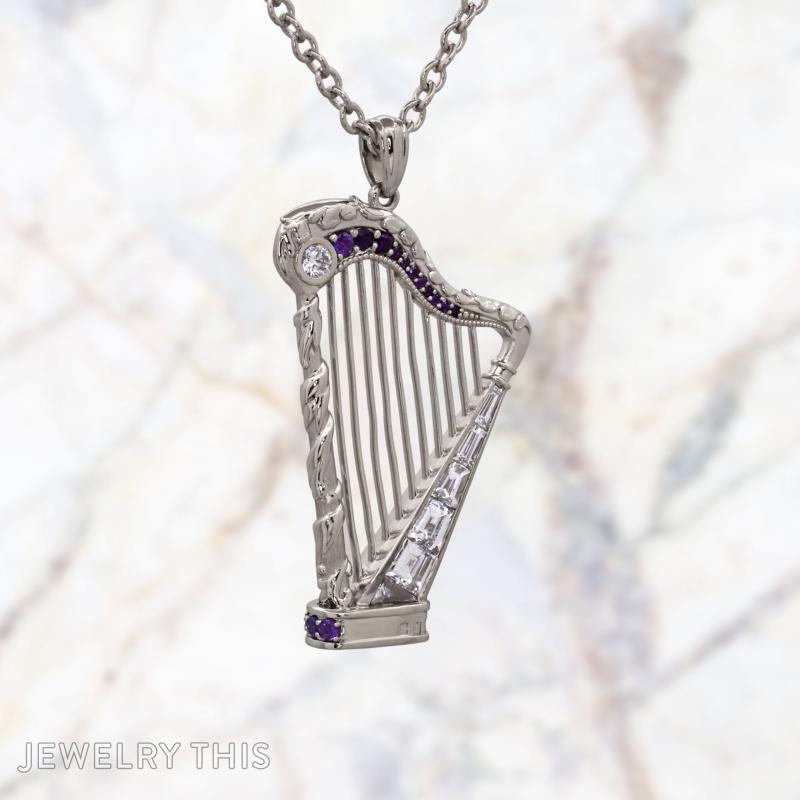
Pendant approximately 1.5in (38mm) tall. Six tapered baguette/baguette-cut stones on the soundboard (three custom cut), one round stone at the crown, three round stones at the feet, and an alternating row of round stones along the harmonic curve.
How they made it distinctive
-
01
Modeled after a specific 18th-century royal harp rather than a simplified generic harp silhouette, down to the scrolled crown and tapering soundboard
-
02
Several soundboard stones custom cut specifically to preserve the harp's true tapering shape rather than adjusting the design to fit standard stone sizes
-
03
Stones placed across four separate structural zones — crown, neck, soundboard, and feet — rather than concentrated in one area
-
04
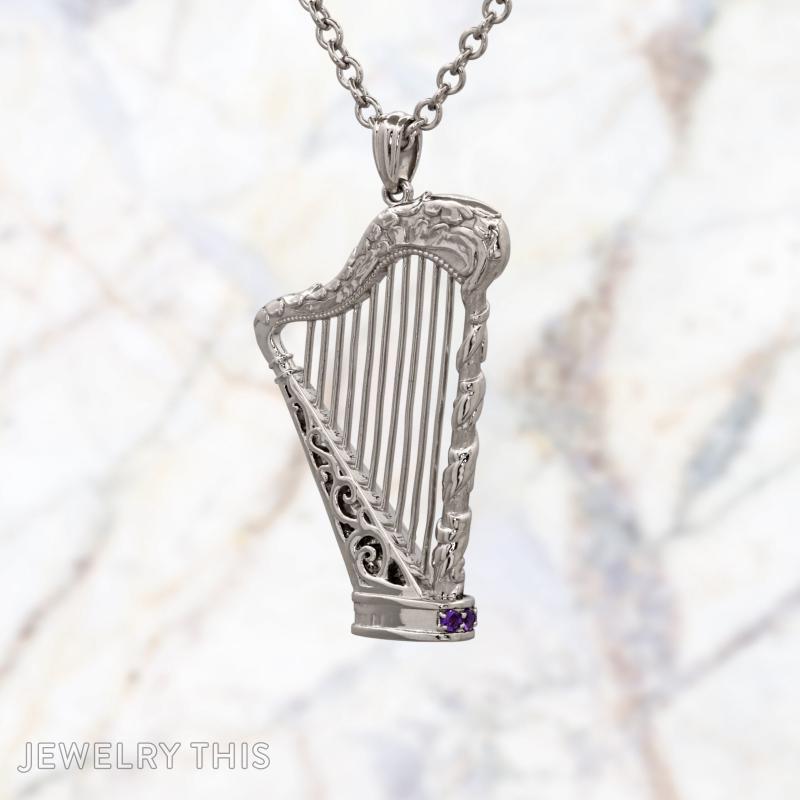
Reverse side finished with open filigree scrollwork, matching the level of detail on the front
-
05
Platinum chosen over a two-tone gold option after a side-by-side render comparison showed the added color competed with the amethyst-tone stones
How you'd make it yours
Stone type: this piece uses lab diamonds and imitation amethyst-tone stones — a new commission could use natural diamonds and natural amethyst throughout
Metal: this piece is platinum — the same sculptural design language works in 18k or 14k white gold
Stone placement: this piece places stones across the crown, neck, soundboard, and feet — a new commission could concentrate stones in fewer zones for a simpler look
Two-tone accent: this piece stayed single-metal after a render comparison — a new commission could revisit a two-tone vine or leaf accent on the column
One of a kind: this exact harp pendant was designed for one client's daughter and is not reproduced — a new commission is an original piece inspired by this one, not a copy
Design changes made
The design grew from a simple two-dimensional harp outline into a fully three-dimensional instrument modeled after a specific antique royal harp, with stones added to the neck, soundboard, crown, and feet rather than just the soundboard. A two-tone gold accent on the column vines was explored via render but ultimately dropped in favor of platinum throughout, since the added color competed with the amethyst-tone stones.
Who this is for
This piece is for a performer who wants jewelry that reflects their actual instrument, not just a decorative nod to music. It's especially right if you want a piece built to real structural proportions rather than a simplified charm, and if you want something with enough stone detail to catch stage lighting.
How it's made
Once the design was approved, the piece was modeled digitally to the exact proportions of a real pedal harp rather than a simplified outline, then printed as a wax model on a 3D printer. Several soundboard stones were custom cut to match the harp's true taper, scanned once complete, and used to update the CAD model for an exact fit. The wax model was attached to a tree, invested in plaster, and fired in a kiln to burn out the wax before molten platinum was cast into the resulting mold.
After casting, the piece was cleaned, polished, and finished to bring out the dimensional scrollwork on the crown and the open filigree on the reverse side. The tapered and standard baguette stones were set diagonally along the soundboard to preserve the harp's true taper, round stones were set in an alternating pattern along the harmonic curve, and small round stones were set at the crown and feet last, after all polishing was complete.
Key note
Several of the soundboard stones were custom cut specifically to preserve the harp's true tapering silhouette, then scanned and used to update the CAD model before casting — rather than the design being adjusted to fit off-the-shelf stone sizes.
Pricing guidance
A fully sculptural, three-dimensional pendant in platinum with custom-cut stones sits at the top end of custom jewelry pricing. The dominant cost driver here is the combination of platinum's material cost and the extensive hand-labor required for a dimensional, anatomically accurate design with multiple stone-setting zones. Custom-cut stones add further cost on top of the base design and metal.
Moves price up ↑
- ↑ Custom-cutting stones to match a specific taper or proportion rather than using standard sizes
- ↑ Choosing platinum or high-karat gold over sterling silver
- ↑ Adding stone settings across multiple structural zones (crown, neck, soundboard, feet) instead of one
- ↑ Selecting natural diamonds and natural amethyst over lab-grown or imitation equivalents
- ↑ Increasing overall pendant size, which increases both metal weight and stone count
Moves price down ↓
- ↓ Using sterling silver with lab-grown diamonds and imitation amethyst instead of platinum with natural stones
- ↓ Choosing standard, readily available stone sizes instead of custom-cut stones
- ↓ Reducing the pendant to a smaller scale with fewer stones
- ↓ Limiting stone placement to a single area of the design rather than multiple zones
- ↓ Simplifying the reverse side finish rather than adding open filigree detail
Questions people ask
Yes, fully three-dimensional instrument-shaped pendants are possible, including detailed elements like strings, a scrolled crown, and a tapering body that reflect the real instrument's proportions. This typically requires more design time than a flat or simplified silhouette because every structural element has to be modeled and then made strong enough to cast and wear safely. Small functional-looking parts, like strings, are usually solidified rather than left as thin wires so they survive daily handling. The result is a piece that reads clearly as the instrument it represents rather than an abstract shape.
In very small stones, natural and lab-grown diamonds are graded similarly and often show little to no visible difference to the naked eye. Lab-grown diamonds are chemically identical to natural diamonds and are generally less expensive, which matters more as stone count increases. Color and clarity grading for small stones is typically given as a range rather than an exact grade, since minor variation isn't visually distinguishable at that scale. Cut quality has a bigger impact on how a diamond sparkles than color or clarity does at small sizes.
Custom cutting is used when a design calls for a stone shape or taper that doesn't exist in standard inventory, such as a soundboard that needs to narrow at a very specific rate to stay proportionally accurate. Standard baguette and tapered baguette cuts come in a limited range of set sizes, so a design built around exact real-world proportions may need one or more stones cut to order. Custom cutting adds time, typically a few weeks depending on the cutter's schedule, and a modest cost increase over standard sizes. Once custom-cut stones are finalized, they generally aren't available for later exchange or resizing, since they're cut to fit one specific setting.
Platinum is one of the most durable and hypoallergenic metals used in fine jewelry, and it holds fine dimensional detail, like scrollwork and open filigree, very well over time. Unlike white gold, platinum does not require rhodium replating to stay white, since its natural color doesn't fade or yellow. It is a denser and heavier metal than gold, which adds substance to a larger sculptural piece like this. The tradeoff is that platinum is typically priced higher than gold at the same design complexity.
A three-dimensional, anatomically detailed pendant in platinum with multiple custom-cut stones sits at the highest end of custom jewelry pricing, largely due to labor and material cost combined. Sterling silver with lab-grown or imitation stones brings the cost down substantially while keeping the same design. Reducing the piece's scale or limiting stone placement to fewer structural areas are the two most effective ways to bring a design like this into a lower budget. The metal choice and whether stones are custom cut or standard size are the two biggest cost levers.
Yes, mixing metals such as white and yellow gold on different structural elements of a design is possible and can be reviewed via a rendered preview before committing. Platinum cannot be plated or color-treated, so a two-tone look requires using gold throughout instead of platinum. Whether two-tone works well depends on the specific design; on a piece with colored stone accents, added gold tones can sometimes compete visually with the stones rather than complement them. Comparing a same-piece render in both single-tone and two-tone is the most reliable way to decide before production.
A design phase for a highly detailed sculptural piece typically takes one to two weeks to reach an approved render, though pieces requiring custom-cut stones need an additional few weeks for the cutter to source and finish those stones. Once the design and stones are finalized, production typically runs six to eight weeks, and holiday seasons can add extra time. Custom-cut stone sourcing and production can run in parallel to save time rather than happening strictly one after the other. Total timeline for a complex, custom-cut piece like this commonly runs two to three months from first deposit to delivery.
Minor adjustments are more difficult on a fully dimensional, multi-stone sculptural piece than on a simple band or plain pendant, because changes to one area can affect the proportions or stone settings elsewhere. Once custom-cut stones are set, they generally can't be swapped for a different size without re-cutting new stones. Standard jewelry care, like re-polishing or re-tipping prongs over years of wear, is still possible on a piece like this. Structural design changes, however, are best made before the piece is cast rather than after.
Explore Similar Creations
Every masterpiece starts with a spark. Explore how our clients raw ideas - sketches, heirlooms, inspirations - were transformed into bespoke works of arts.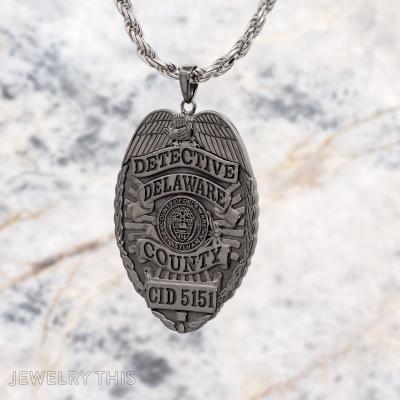
This custom pendant is a deeply meaningful tribute, meticulously crafted to honor a dedicated detective’s ...

This silver pendant is a captivating blend of eerie and contemporary aesthetics. At its core, ...

Celebrate the art of self-expression with this 0.75-inch round pendant, expertly crafted in silver. This ...

This art nouveau style pendant is a stunning recreation of a lost family piece. The ...

This beautiful white gold 3D pendant is a perfect representation of the client’s beloved pug. ...

Embrace the natural beauty of the wilderness with this captivating custom pendant. Entirely three-dimensional, it ...

This exquisite multicolored pendant is a masterpiece of elegance. Crafted in yellow gold, the circular ...

This stunning custom pendant is a true masterpiece. Made of high-quality sterling silver, it features ...

This pendant was created with love and thoughtfulness, as it was intended as a heartfelt ...


This custom pendant is a heartfelt tribute to cherished college memories, designed to celebrate a ...

This custom cross pendant is a testament to faith and devotion. Its intricate design features ...