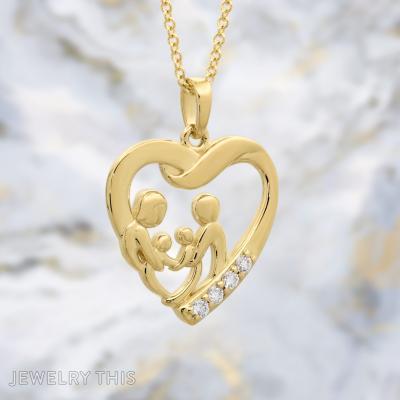
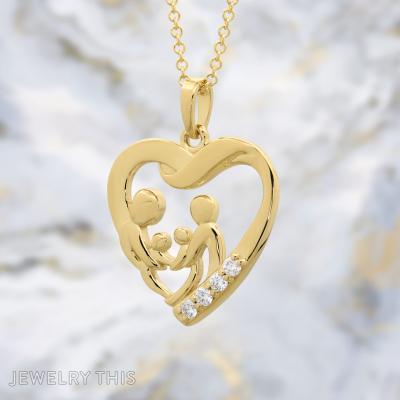
Family Heart Pendant — Push Gift for Twins, Yellow Gold
$$
14k yellow gold, lab-grown diamonds
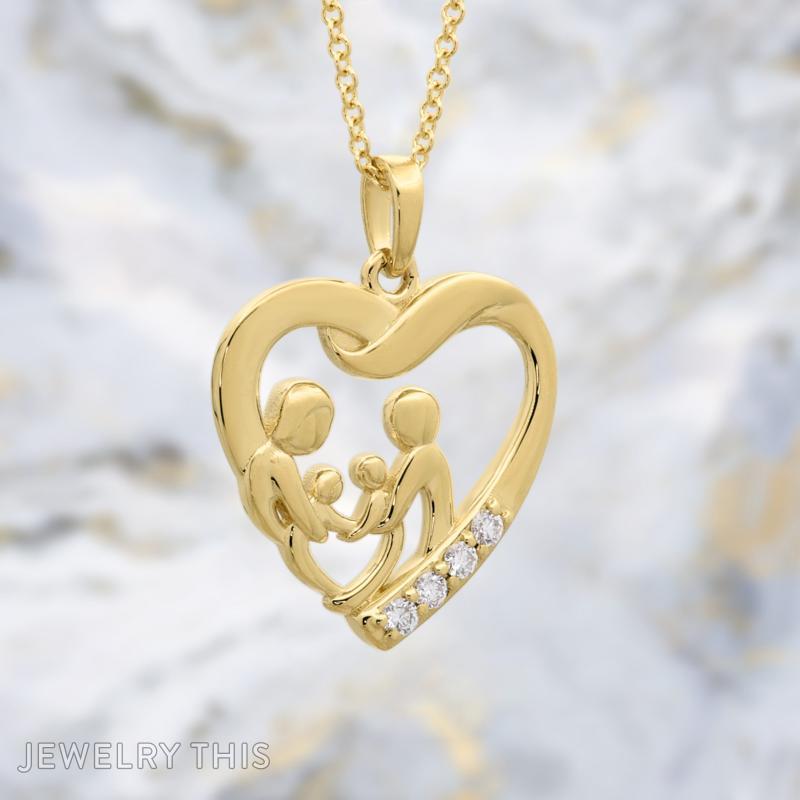
A client returning to commission a piece for his wife came in with a reference image and a growing family — twins on the way — and wanted a pendant showing two parents holding two children. Birthstones were the original plan, but after learning his wife wasn't a birthstone person, he pivoted to diamonds and yellow gold, then pushed for the top curve of the heart to feel as dimensional as the reference even without stones wrapping around it. When it arrived, he wrote: 'It looks great! Thank you sooo much for all your help and your services.'
'This came out great! I love it.' — on seeing the first render
'It looks great! Thank you sooo much for all your help and your services.' — on delivery
Quick specs
Design type
Primary Metal
Shape / Cut
Primary Stone
Accent Stones
Style
Design Complexity
Intent
Intent: Certainty
Size
Pendant approximately 1 inch. Chain: cable style, 16 inches.
How they made it distinctive
-
01
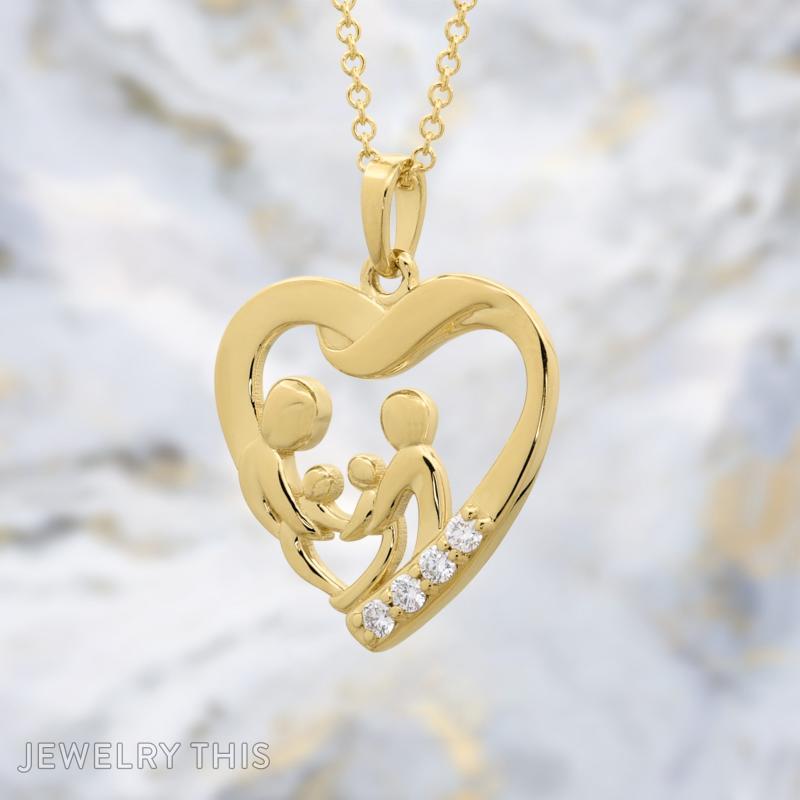
Open heart silhouette holds two parent figures and two child figures, made to represent the client's family after learning he was expecting twins
-
02
Original birthstone concept swapped for four diamonds after the client discovered his wife doesn't wear birthstone jewelry
-
03
Metal changed from rose gold to yellow gold specifically to complement the diamond swap
-
04
Top heart bridge intentionally re-sculpted to preserve a dimensional, elevated curve that the reference image achieved through wrapped stones
-
05
16-inch cable chain chosen for a higher, more compact fit
How you'd make it yours
Stone type: this piece uses four round lab-grown diamonds — a new commission could use natural diamonds or colored birthstones for the same layout
Metal: this piece is 14k yellow gold — the same design language works in rose gold or white gold
Figure count: this piece shows two parents and two children — a new commission could add or remove figures to match a different family size
Chain: this piece uses a 16-inch cable chain — a new piece could use a different length or chain style
Engraving: the back of the pendant can carry a name, date, or short phrase on a new commission
One of a kind: this exact pendant was designed for one client's family and is not reproduced — a new commission is an original piece inspired by this one, not a copy
Design changes made
The design shifted twice: first from a birthstone concept (December, August, February, March) to four diamonds after the client learned his wife doesn't wear birthstone jewelry, and the metal changed from rose gold to yellow gold to match. The client also asked for the top heart bridge to be reshaped with more pronounced curvature to better match the original reference despite no longer needing to accommodate wrapped stones.
Who this is for
This piece is for someone marking the start of parenthood or a growing family who wants something more personal than a generic heart pendant. It's especially right for a partner picking a push gift or family milestone gift who wants the design to visually represent specific family members without being literal or matching a birthstone-driven look.
How it's made
Once the design was approved, the team built a resin wax model — the first physical version of the pendant, shared with the client as a preview. The model was assembled onto a wax tree and invested in a mold, which was fired in a kiln to burn away the wax before molten 14k yellow gold was cast into the resulting cavity. After casting, the raw pendant was separated from the tree and prepared for finishing.
The cast piece was polished to bring up the yellow gold's shine across the open heart silhouette and the two parent-and-child figures. The four round lab-grown diamonds were then set by hand along the diagonal lower-right curve of the heart, the final step before a last quality check and cleaning.
Key note
The top heart bridge was reshaped after casting specifics were finalized because its dimensional curve in the original reference was partly a byproduct of stones wrapping the edge — recreating that curve without stones required deliberately re-sculpting the bridge's profile.
Pricing guidance
A moderate-complexity heart pendant featuring figural silhouettes and a small diamond accent line sits toward the lower end of the mid range for custom pendant work. Most of the cost comes from the figural modeling and hand-finishing needed to keep the parent-and-child silhouettes clean and readable at this scale, plus the diamond setting. Metal karat and stone choice are what move the price most from there.
Moves price up ↑
- ↑ Increasing the diamond count beyond four or upgrading to larger stones
- ↑ Choosing natural diamonds instead of lab-grown
- ↑ Adding more figures to represent a larger family
- ↑ Upgrading from 14k to 18k gold
- ↑ Adding two-sided engraving to the back of the pendant
Moves price down ↓
- ↓ Removing the stone accent line altogether and leaving the heart open
- ↓ Selecting a smaller pendant size to reduce metal weight
- ↓ Choosing sterling silver or gold-plated silver instead of solid gold
- ↓ Simplifying the figures to a more abstract, less detailed silhouette
- ↓ Choosing a lighter-gauge cable chain
Questions people ask
Yes, family pendants like this one can be designed to represent any number of family members, with figures added or removed to match the client's actual family. In this case, the design shows two parents and two children inside an open heart. The figures are kept simple and silhouette-based so the design stays clean regardless of how many people are included. Adjusting the figure count is one of the more straightforward customizations on this style of pendant.
Lab-grown and natural diamonds are chemically and visually identical — same hardness, same brilliance, same durability for everyday wear. The distinction is only in how they're formed: one is grown in a controlled environment, the other mined from the earth. For small accent stones like the four used in this pendant, lab-grown diamonds typically cost meaningfully less while looking exactly the same to the eye. Either option holds up well in a pendant that isn't subject to the daily impact a ring would see.
Yes, this kind of swap can happen even after an initial design has been rendered, as long as it happens before the piece moves into production. In this case, the birthstone concept was fully rendered before the client requested diamonds instead, and the design team was able to update the render before any metal was cast. Changing stone type at this stage typically also means revisiting the metal color, since certain metals pair better visually with certain stones. It's a normal part of the design refinement process, not a major disruption.
A moderate-complexity heart pendant with figural details and a small diamond accent line generally falls toward the lower end of the mid-range for custom pendant work. The main cost driver is the hand-finishing required to keep detailed figures crisp at pendant scale, along with the diamond setting itself. Choices like metal karat, stone count, and whether diamonds are lab-grown or natural all shift the price from there. A simpler version without stones would cost meaningfully less.
From deposit to delivery, a custom pendant like this typically takes around five to six weeks on a standard timeline. The first week or so covers the 3D design and render process, including any revisions the client requests. Once the design is approved and moved into production, casting, polishing, and stone setting take roughly four to five weeks. Design changes requested mid-process, like a stone or metal swap, can add a few extra days for re-rendering.
Yes, shape adjustments are a normal part of the design process and can be made after the first render is reviewed. In this case, the client asked for the top curved element of the heart to be reshaped with a more pronounced, three-dimensional profile after seeing the first version. Because the original reference design's curve was partly shaped by stones wrapping around it, the design team had to intentionally re-sculpt the curve to preserve that dimensional look without the stones. Multiple rounds of adjustment like this are typical before a final design is locked in.
Lower-karat gold like 10k or 12k is generally not recommended for pieces that need to hold stones securely. These karats are harder but more brittle, which makes the metal less forgiving during the stone-setting process and can compromise how securely a stone stays in place over time. For any pendant or ring with set stones, 14k gold is typically the minimum recommended karat because it offers enough workability to set stones securely. Lower-karat gold is a better fit for stone-free designs where flexibility during setting isn't a factor.
Yes, chain length is one of the easiest elements to customize on a pendant like this. Eighteen inches is the most common length, but shorter options like 16 inches sit higher on the chest and work well for smaller frames or a more compact look. The chain style also matters visually — a simple cable chain, like the one used here, keeps the focus on the pendant rather than competing with it. Both length and chain style can be selected independently of the pendant design itself.
Explore Similar Creations
Every masterpiece starts with a spark. Explore how our clients raw ideas - sketches, heirlooms, inspirations - were transformed into bespoke works of arts.
Seeking to elevate a beloved piece, the client opted to replicate their cherished rose pendant ...

This exquisite multicolored pendant is a masterpiece of elegance. Crafted in yellow gold, the circular ...

Embrace the natural beauty of the wilderness with this captivating custom pendant. Entirely three-dimensional, it ...

This custom pendant features a unique diamond-shaped design with an intricate cut-out cloud motif at ...

This exquisite custom-made 14k yellow gold round pendant is a timeless piece of jewelry, designed ...

This yellow gold pendant is crafted in the shape of a rectangular badge, intricately designed ...

This sterling silver pectoral cross pendant is a striking symbol of faith and devotion. With ...

This sterling silver dog tag-shaped pendant features a beautifully detailed scene commemorating a beloved woman. ...

This .75 inch, highly polished 10K yellow gold anchor pendant is a perfect accessory for ...

This stunning custom pendant beautifully combines personal meaning with elegant craftsmanship. The design spells out ...
This unique pendant is a meaningful fusion of heritage and faith, masterfully blending two iconic ...

Embrace the heartfelt joy of this custom pendant, a whimsical creation born from the imagination ...