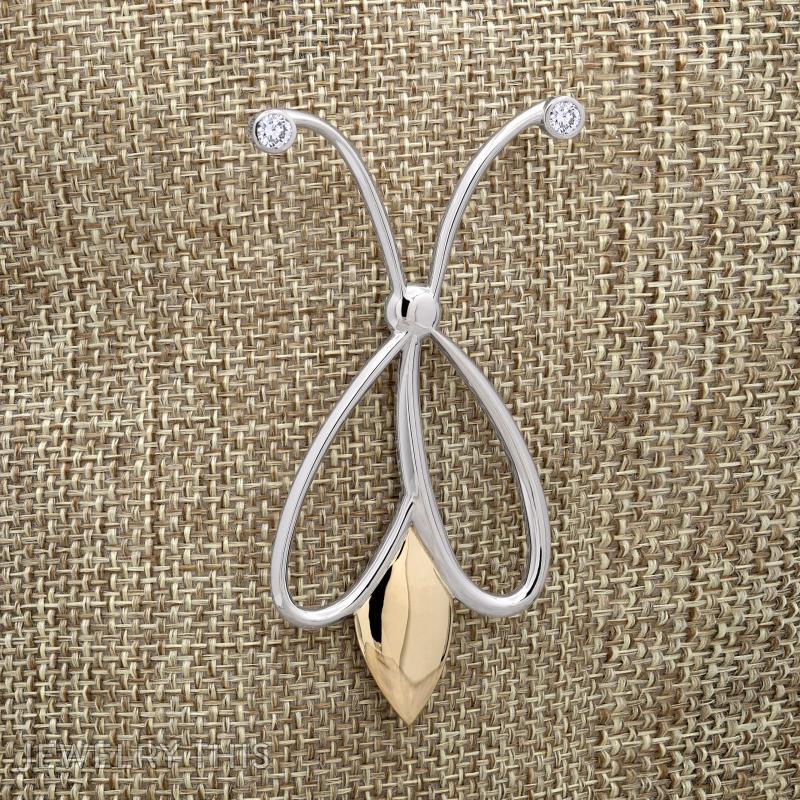
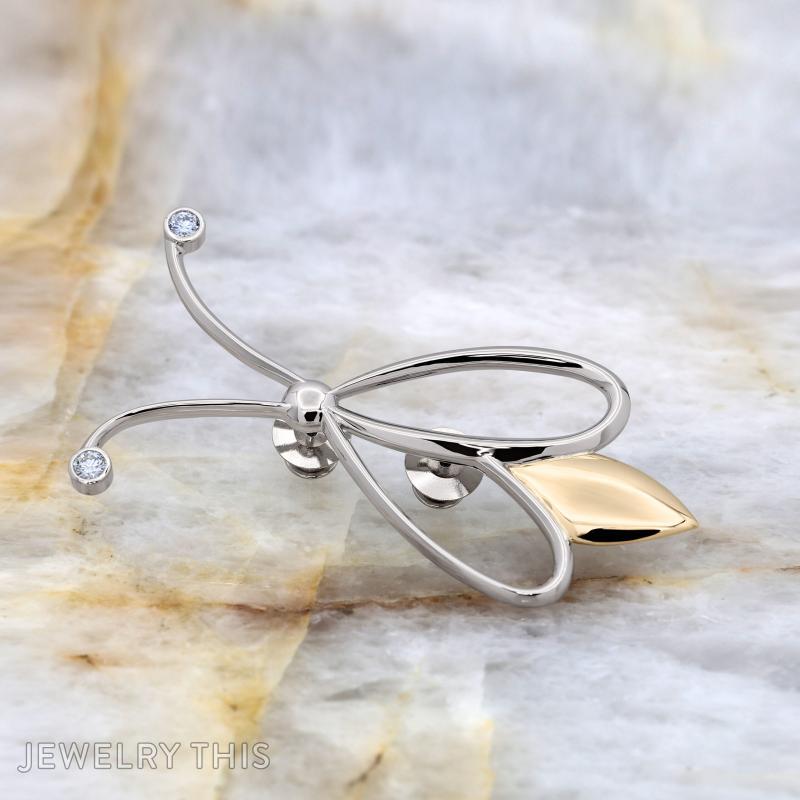
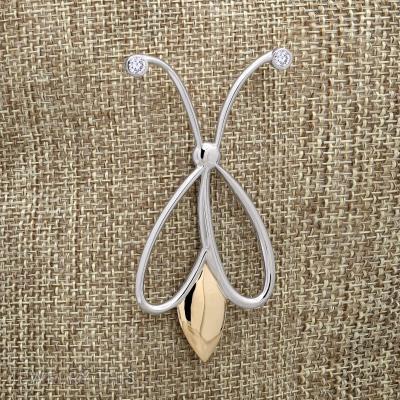
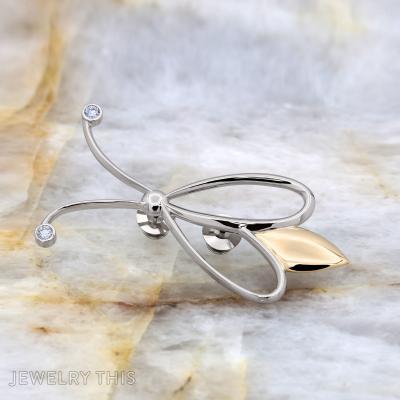
Firefly Logo Brooch in Silver and Gold with Diamonds
$$$
Sterling silver, 10k yellow gold, lab-created diamonds
A client wanted his property's firefly logo turned into a wearable brooch, right down to the yellow gold tail and diamond-tipped antennae from the original drawing. He asked the team to keep the wings' natural asymmetry from the sketch but smooth the curves so it read as finished jewelry rather than a school project. When it arrived, he wrote: 'She absolutely loves it! And I am extremely pleased with your service and methods.'
'This is PERFECT!!!!' — on seeing the first render
'She absolutely loves it! And I am extremely pleased with your service and methods.' — on delivery
Quick specs
Design type
Primary Metal
Secondary Metal
Shape / Cut
Primary Stone
Accent Stones
Style
Design Complexity
Intent: Certainty
Size
Brooch approximately 3 inches tall. Lapel-pin posts 10mm (3/8 in) long, positioned at head, mid-wing, and mid-body.
How they made it distinctive
-
01
Open-wire wing outline chosen over a solid wing to keep the piece recognizable as the client's own logo while managing size and weight at three inches
-
02
Wing curves intentionally kept asymmetrical to preserve the character of the original hand-drawn logo
-
03
Three lapel-pin posts used instead of a single pin stem so a piece this wide stays fully supported on fabric
-
04
Gold tail piece left without a silver outline once it became a solid inset, simplifying the design at the client's request
-
05
Two-tone silver and gold construction used to translate the logo's original color scheme directly into metal
How you'd make it yours
Stone type: this piece uses lab-created diamonds at the antennae tips; a new commission could use moissanite or natural diamonds
Metal combination: this piece pairs sterling silver with 10k gold; a new piece could use white gold with yellow or rose gold for a similar two-tone effect
Size: this piece is sized at 3 inches with three support posts; a smaller design could use a single standard pin back
Wing structure: this piece uses an open-wire outline; a new commission could use a solid or partially filled wing surface
One of a kind: this exact brooch was designed from one client's own logo and is not reproduced — a new commission is an original piece inspired by this one, not a copy
Design changes made
The gold tail piece was simplified to remove its silver outline once it became a solid inset rather than a hollow shape, and the wing curves were smoothed for a more finished look while intentionally keeping the asymmetry from the original logo sketch.
Who this is for
This piece is for someone who has a logo, symbol, or drawing that means something specific to them and wants it turned into a real, wearable object rather than just printed or embroidered. It's especially right for anyone who wants a statement piece with presence, not a small, easily overlooked pin.
How it's made
Once the design was approved, a 3D-printed resin model was produced and shared with the client as a preview of the piece's form before any metal was committed. The resin was then set on a wax tree, invested in plaster, and fired in a kiln to burn out the pattern, leaving a hollow mold. Sterling silver was cast for the wing framework, with the tail piece cast separately in 10k gold, then the pieces were cooled, extracted, and cleaned.
After casting, the silver wing wires were polished to a bright finish while the gold tail was polished separately to a mirror shine, keeping the two metal tones distinct where they meet. Two round lab-created diamonds were bezel-set into the silver at the antennae tips. Three lapel-pin posts were then attached at the head, mid-wing, and body, rather than a single pin stem, so the finished 3-inch piece stays supported across the width of the design.
Key note
The brooch uses three separate lapel-pin posts instead of a single pin stem because no standard brooch pin was long enough to fully support a piece three inches wide.
Pricing guidance
A sculptural silver-and-gold brooch of this size and complexity sits in the mid range for custom pin work. Most of the cost comes from the open-wire fabrication and hand-finishing needed to keep two metal tones crisp where they meet, plus the diamond setting at the antennae tips. Size and the number of support posts required are secondary cost drivers.
Moves price up ↑
- ↑ Increasing the size beyond 3 inches, which requires thicker wire gauge and more support posts
- ↑ Using natural diamonds instead of lab-created diamonds at the antennae tips
- ↑ Adding a solid or filled wing surface instead of an open-wire outline
- ↑ Using 14k or 18k gold for the tail piece instead of 10k
- ↑ Adding more stones or a pave-set accent along the wing edges
Moves price down ↓
- ↓ Reducing the piece to a smaller scale, such as 1.5 to 2 inches
- ↓ Using moissanite in place of lab-created diamonds at the antennae tips
- ↓ Using a single standard pin back instead of three lapel-pin posts, on a smaller design
- ↓ Simplifying to a single-metal design rather than a silver-and-gold combination
- ↓ Omitting the stones and leaving the antennae tips plain metal
Questions people ask
Yes, this is a common request and the process usually starts with a sketch based on the original artwork, followed by a 3D model and a photorealistic render for approval. Fine details like asymmetry or specific proportions from the original drawing can be preserved or smoothed out based on preference. Two-tone metal combinations, like silver paired with gold, are a common way to translate a logo's color scheme into metal. The whole process typically takes about one week for design and four to five weeks for production.
Lab-created diamonds have the same hardness and chemical composition as natural diamonds, rating a 10 on the Mohs scale, which is the hardest natural material there is. This means they resist scratching and wear just as well as a natural diamond in daily use. The main difference is origin and cost, not durability or appearance. For small accent stones like antennae tips on a brooch, a lab-created diamond will hold up identically to a natural one.
A sculptural silver-and-gold brooch of moderate complexity, in the three-inch size range, sits in the mid range for custom pin work. The main cost drivers are the open-wire fabrication, the hand-finishing required to keep two metal tones distinct, and the diamond setting. Size, metal choice, and stone type all move the price up or down from that baseline.
For a brooch several inches wide, a single pin stem often isn't enough to keep the piece flat and stable. One solution is to use multiple smaller lapel-pin posts spaced across the design, so the weight is distributed and the piece is supported all the way across rather than pivoting on one point. Post length also matters: a post around 3/8 of an inch works well for medium-weight fabrics like a sweater, while thinner fabrics need a shorter post to stay comfortable.
Yes, mixing sterling silver and gold in the same piece is a well-established technique and a good way to create visual contrast or represent multiple colors from an original design. The two metals are cast and finished separately, then joined during assembly, which lets each retain its own polish and tone. This two-tone approach is especially useful for translating logos or drawings that use more than one color.
Yes, an open-wire or cut-out design is a common technique, especially for larger pieces where a fully solid version would be too heavy or costly. It keeps the outline and shape of the original design recognizable while reducing weight and material cost. This approach works particularly well for wing shapes, letters, or other forms where the silhouette carries the design.
Small structural details like antennae length, curve, and stone placement are typically finalized during the sketch and 3D render stages, before casting begins. Once the metal is cast, changes become more difficult and costly since they may require remaking a piece rather than adjusting a digital model. This is why the render approval step exists: to confirm every detail, including size, feel, and finish, before production starts.
Explore Similar Creations
Every masterpiece starts with a spark. Explore how our clients raw ideas - sketches, heirlooms, inspirations - were transformed into bespoke works of arts.
Celebrate bold individuality and fearless expression with this custom-designed pin, crafted to honor a remarkable ...

This yellow gold pin embodies a sleek design with a simple, classic logo. The logo ...

Celebrate whimsy with our 1-inch silver pin, a playful homage to the Eveready Battery Logo. ...

This lapel pin takes the shape of a single capital letter D, rendered as an ...
![A small openwork 14k white gold lapel pin reading 'I [heart] AI' with the letters and heart outline set in small round diamonds and the heart's interior filled with round red rubies, photographed on a marble surface.](https://cdn.jewelrythis.com/uploads/comment_attachments/2024/07/467157_22-400x400.jpg)
This lapel pin takes the classic “I ❤ [Name]” motif and renders it as an ...

This stunning custom pin features a dreamcatcher design made from 14K gold, set with a ...

These star-shaped lapel pins are a lovely way to add a touch of elegance to ...
This custom silver pin is crafted in the shape of a German Shorthaired Pointer, capturing ...

This elegant pin features a unique double-heart design that embodies timeless romance and sophistication. Crafted ...

This exquisite piece is expertly plated in luxurious 14K rose gold, radiating an enchanting allure. ...

Sterling silver rectangular pin featuring infinity symbol + 1. Pin was 1 inch long and ...

Inspired by alumni and tradition this Silver Black Rhodium Plated Brooch Pin showcases a charming ...